Romans 6:1–7 contains some of the New Testament's richest imagery about baptism. Paul writes: “Or don't you know that all of us who were baptized into Christ Jesus were baptized into his death?”
He continues: “We were therefore buried with him through baptism into death in order that, just as Christ was raised from the dead…we too may live a new life.” A baptism study might ask: “What do you see here about baptism?”
The expected answers are:
- When someone is baptized, they are baptized “into Christ.”
- When baptized, they share in the death, burial and resurrection of Jesus.
- Baptism is the point at which a person enters a new life.
A common diagram may reinforce the idea: Jesus: Death → Burial → Resurrection
You: Old Life → Baptism/Burial → Raised to New Life
It's a powerful image. And some of it comes directly from Paul. But one phrase deserves closer examination: “Baptism is the point at which a person enters a new life.” Does Paul actually say that?
First, Notice What Paul Clearly Does Say
We shouldn't minimize the connection Paul makes between baptism and Jesus. It's profound. Paul connects baptism with:
- Christ's death
- Christ's burial
- Christ's resurrection
- our death to sin
- our new life
Baptism isn't presented as an insignificant religious ceremony. Paul uses it to describe participation in the Jesus story.
We have been:
- baptized into Christ
- baptized into his death
- buried with him
and called to: walk in newness of life. That's powerful baptismal language. But there's a difference between recognizing that connection and constructing a precise chronology of salvation from it.
Start With Verse 1, Not Verse 3
Romans 6 begins: “What shall we say, then?” That's a giant contextual clue. Paul is responding to something he has already been discussing. He asks: “Shall we go on sinning so that grace may increase?” Why would anyone ask that? Because of what Paul has just said in Romans 5. Paul has been talking about:
- sin
- death
- Adam
- Christ
- grace
- new humanity
Then comes the provocative statement: “Where sin increased, grace increased all the more.” That raises an obvious objection: If grace increases wherever sin increases, why not keep sinning?
Paul's answer: Absolutely not. Why? Because: “We are those who have died to sin; how can we live in it any longer?” That's the question Romans 6 is answering. (and don't forget who Paul is talking to)
Paul Isn't Explaining How to Become a Christian
This is enormously important. Paul isn't addressing people considering baptism and explaining what they must do to become Christians. He's writing to an existing Christian community in Rome. And he speaks about their baptism in the past tense: “All of us who were baptized…” Paul is reminding them of something they already experienced. Why? To explain how they should live now. His argument isn't primarily: “Here's how you enter salvation.” It's: “If you've been united with Christ, how can you continue living as though nothing changed?” That's a very different question.
Pattern #1: Paul's Reminder Becomes a Conversion Instruction
Watch the movement. Paul says:
You were baptized into Christ. Therefore: You were baptized into his death. Therefore: Live differently now. That can become: A person must be baptized into Christ. Then: Baptism is when the person enters Christ. Then: Baptism is the point when the person receives new life. Then potentially: Before baptism you are outside Christ; after baptism you are inside Christ.
We've moved from Paul using their baptism to explain Christian living to using Romans 6 to establish the precise mechanics of conversion. That's an interpretive move.
The Graphic Makes the Interpretation Feel Obvious
This is where the diagram becomes especially important. Graphics are powerful teaching tools because they organize complicated ideas instantly. You see: Jesus dies. Then: Jesus is buried. Then: Jesus rises. Below that: You die. Then: You enter the water. Then: You emerge into new life.
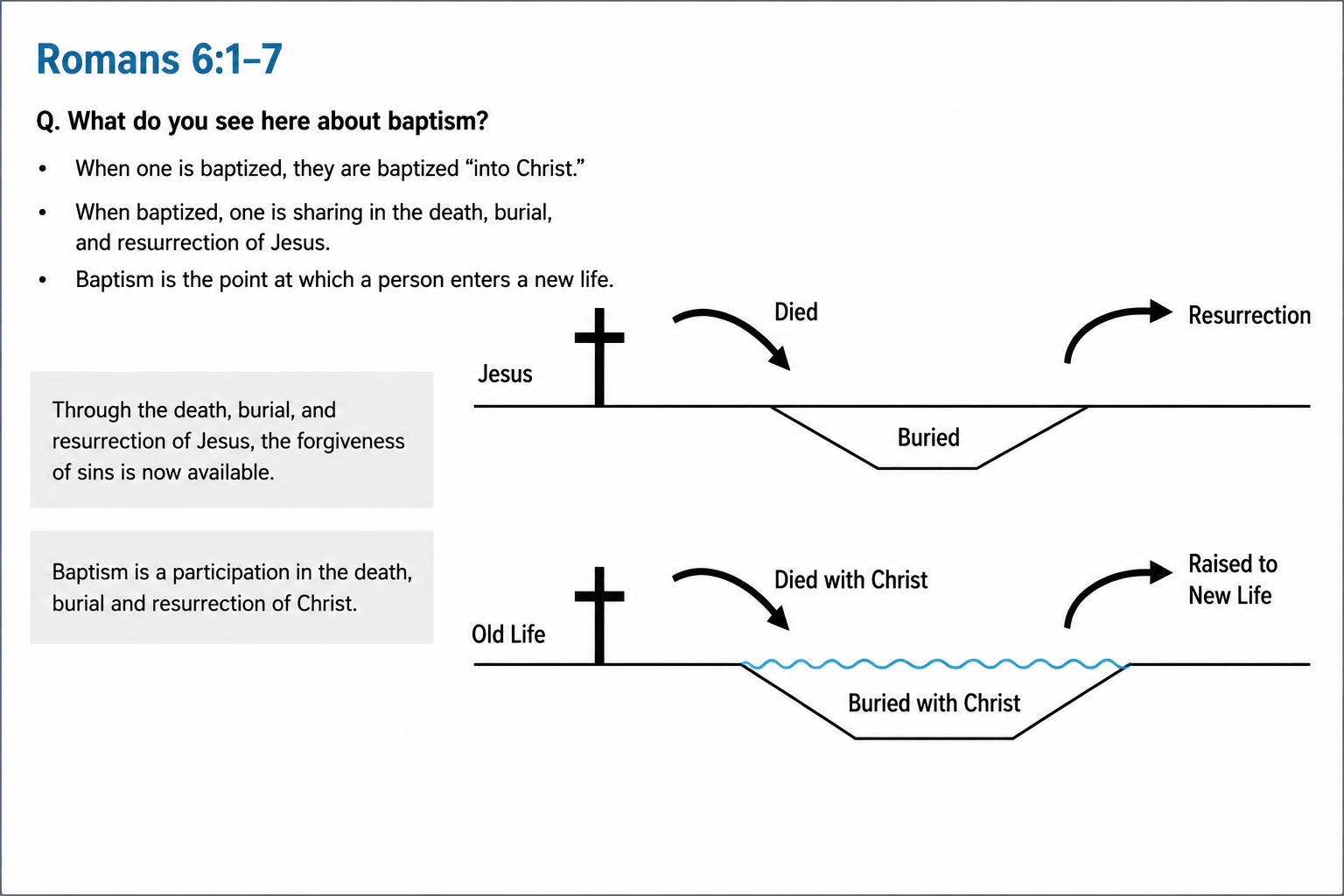
The parallel is memorable. And Paul absolutely uses death, burial and resurrection imagery. But the following new diagram adds something: a timeline.
The water becomes the dividing line between: old life and new life. Before the water: old life. After the water: new life. That makes the conclusion feel visually unavoidable: Baptism is the exact point at which new life begins. But we should ask: Did Paul draw that line or did the diagram?
Pattern #2: An Image Becomes an Argument
This is a useful Bible-study lesson far beyond baptism. Illustrations don't merely explain interpretations. Sometimes they create them. Once an interpretation has been converted into a picture, we can stop recognizing which parts came from the biblical text and which parts came from the person who designed the picture. Romans 6 gives us:
- death
- burial
- baptism
- resurrection
- new life.
The diagram gives us: the precise moment at which someone's spiritual status changes. Those aren't necessarily the same claim.
What About Forgiveness?
The graphic also says: “Through the death, burial, and resurrection of Jesus, the forgiveness of sins is now available.” That's certainly consistent with the larger Christian story. But notice something interesting. In Romans 6:1–7, Paul doesn't actually mention: forgiveness of sins. His subject is: death to sin and new life. That distinction matters because Acts 2 and Romans 6 can easily be combined into one theological system. Acts 2 supplies: baptism → forgiveness Romans 6 supplies: baptism → death/burial/resurrection Then the diagram combines them into: baptism is the precise point at which forgiveness and new life occur.
Someone can certainly construct a theological argument for that conclusion. But we should recognize that it is a constructed argument from multiple passages, not simply something Romans 6:1–7 states.
What Does “Into Christ” Mean?
Paul says: “All of us who were baptized into Christ Jesus…” That's significant language. But again, we should resist immediately turning the word “into” into a chronological mechanism: outside Christ → baptism → inside Christ. Paul uses participation language throughout his letters. Believers are:
- in Christ
- with Christ
- crucified with Christ
- buried with Christ
- raised with Christ
This is identity language. Paul is describing a new reality shaped by participation in Jesus. Baptism embodies that reality beautifully. But Paul's concern in Romans 6 is what that identity means for the way people live.
Keep Reading
Verse 11 gives us Paul's application: “In the same way, count yourselves dead to sin but alive to God in Christ Jesus.” Then: “Therefore do not let sin reign in your mortal body…” There's the direction of the argument. Paul doesn't appear to be trying to establish: the exact second at which salvation occurs. He's trying to establish: You cannot claim participation in Jesus' death and resurrection while continuing to let sin rule your life. Your baptism tells a story. Live like that story is true. That's a much more challenging application.
Pattern #3: Participation Becomes Transaction
This may be the central interpretive shift. Paul describes baptism using the language of participation:
- with Christ
- into his death
- buried with him
- united with him
The study can turn that into a transaction: This is the point at which something happens to you. Participation asks: What story do I now belong to? Transaction asks: At what moment did my status change? Those aren't necessarily mutually exclusive questions. But Paul's argument here seems much more concerned with participation and the life that follows than with establishing the precise moment someone's spiritual status changes. He wants the Romans to understand who they are because they belong to Christ.
Baptism as a Journey Marker
This connects beautifully with another way of understanding baptism. Baptism is an outward, embodied declaration: I'm stepping into the Jesus story. The old direction of my life is dying. I'm identifying myself with Jesus. I'm participating in his death and resurrection. I'm beginning to learn what resurrection-shaped life looks like. That makes baptism incredibly important. Perhaps more important than treating it merely as the moment when the correct spiritual transaction occurred. Because Romans 6 doesn't let baptism remain in the past. Paul essentially says: Remember what your baptism means—and live accordingly.
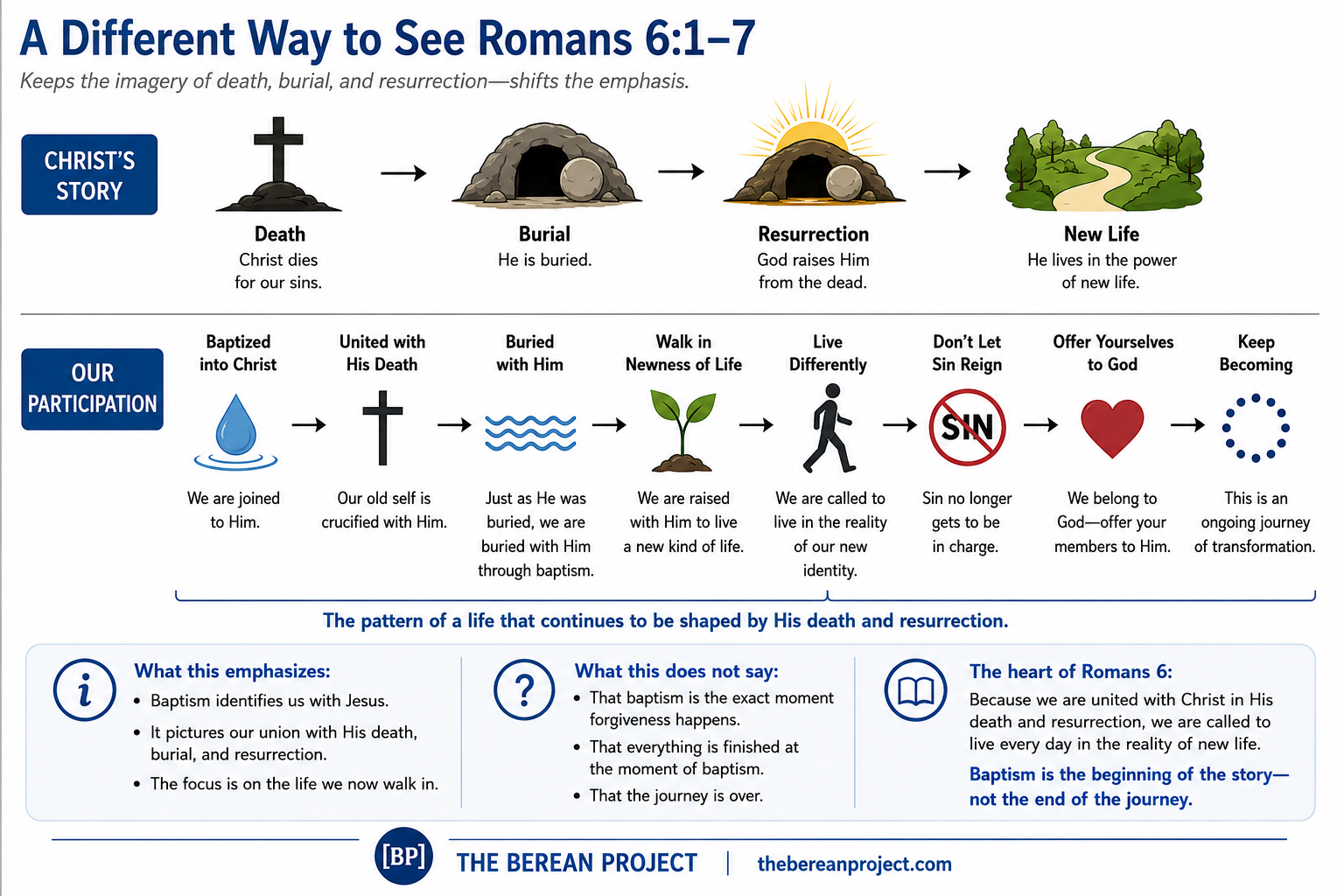
“Raised to New Life” Doesn't Mean the Journey Is Finished
There's another danger in the original diagram. Visually, it can look complete: Old Life → Baptism → New Life Done. But Romans 6 immediately demonstrates that new life must actually be lived. Paul has to tell baptized Christians:
- Don't let sin reign.
- Don't offer yourself to sin.
- Offer yourself to God.
Why? Because baptism didn't instantly make them completely Christlike. It marked participation in a new reality that they now had to learn to inhabit. That's discipleship. That's the journey.
Watch What the Question Is Doing
The study begins: “What do you see here about baptism?” Then supplies:
baptized into Christ
↓
share in death, burial and resurrection
↓
baptism is the point at which new life begins
The first two statements closely reflect Paul's language. The third is an interpretation built from them. Then the diagram makes that interpretation visible:
before water = old life, after water = new life
At that point, the conclusion doesn't merely sound biblical. It looks biblical. That's why illustrations deserve the same careful examination as words.
A Better Question
Instead of asking only: “At what point does a person enter new life?” perhaps Romans 6 invites a much bigger question: “If my baptism identifies me with the death and resurrection of Jesus, what kind of life should that produce?” That's Paul's concern. Not merely: When did something happen to me? But: What should be happening in me now?
Maybe that's the real power of the death, burial and resurrection picture. Baptism doesn't merely give us a date on which we crossed from one side of a diagram to another. It gives us a story to spend the rest of our lives learning how to live. You were buried with Christ. You were raised to new life. Now comes the much harder part:
Live like it.
It is recommended to explore this important questions next Where did our baptismal wording come from?
Listen to an AI-generated audio discussion of this question
This audio was generated from the material on this page using Google NotebookLM.