Biblical Tension: Living Faithfully Between Seemingly Opposite Truths
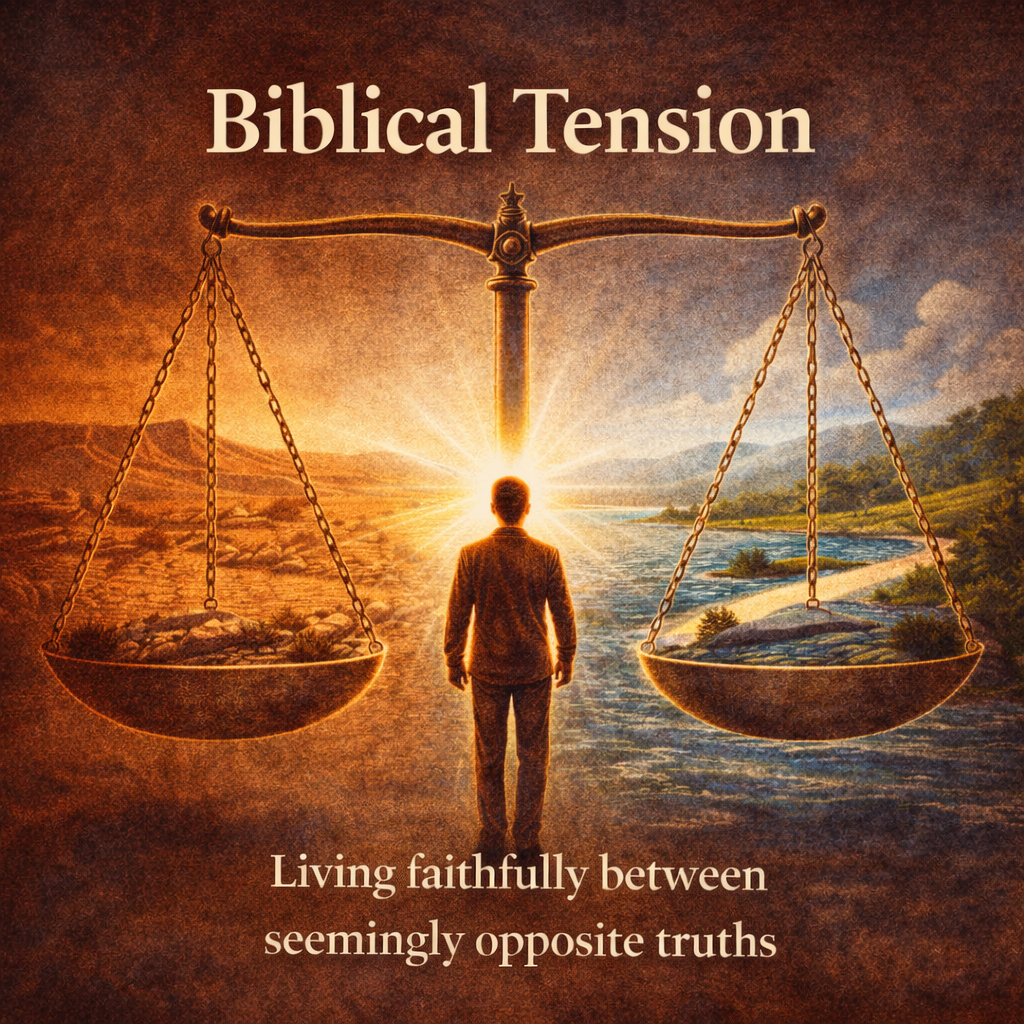
Biblical Tension: Living Faithfully Between Seemingly Opposite Truths
Key Takeaways
-
Biblical tension refers to holding two equally true scriptural teachings that appear to pull in opposite directions without forcing artificial resolution.
-
Classic examples include God’s sovereignty paired with human responsibility, grace with obedience, and rest with running the race.
-
Embracing tension is not intellectual compromise but faithful engagement with the multi-dimensional nature of God’s Word.
-
Growth happens when we stay centered in Scripture and Christ rather than swinging to simplistic extremes.
-
This approach shapes how Christians pray, make decisions, counsel others, and respond to suffering in real life.
What Is Biblical Tension?
Biblical tension occurs when Scripture presents two truths that are both fully affirmed by God’s Word yet feel like they pull in opposite directions. Consider John 10:28–29, where Jesus declares no one can snatch believers from His hand, alongside Hebrews 3:12–14, which warns against unbelieving hearts that fall away. Both are true. Both matter.
This tension is not contradiction or error. It reflects the dynamic, multi-dimensional nature of revealed biblical truth that our finite minds struggle to hold together completely.
| Tension Pair | Example Passages |
|---|---|
| Rest vs. Race | Psalm 23; Hebrews 12:1-2 |
| Law vs. Grace | Romans 3:20-28; Matthew 5:17-20 |
| Already vs. Not Yet | Matthew 12:28; Revelation 21:1-4 |
How we handle these paired truths shapes everything: how we pray, make decisions, counsel others, and respond to suffering.
I remember the first time I read Romans and James side by side. Paul seemed to say faith alone saves. James seemed to say faith without works is dead. I felt unsettled for weeks. That discomfort became one of the most fruitful seasons of my own spiritual growth.

God’s Sovereignty and Human Responsibility
Scripture simultaneously teaches that God is absolutely sovereign over history and salvation while humans remain genuinely responsible for their responses and choices. Romans 8:28-30 describes God foreknowing, predestining, calling, justifying, and glorifying believers in an unbroken chain. Ephesians 1:3-11 affirms He chose us before the foundation of the world.
Yet Joshua 24:15 commands, “Choose this day whom you will serve.” Acts 17:30 declares God commands all people everywhere to repent. Philippians 2:12-13 holds both together beautifully: “Work out your own salvation with fear and trembling, for it is God who works in you.”
Common questions arise: If God is in control, why pray, evangelize, or fight sin? The New Testament uses God’s sovereignty as motivation, not excuse. In Acts 18:9-10, Paul was encouraged to speak because the Lord had many people in that city.
In counseling, this tension comforts those who suffer while still calling them to wise, obedient choices. When I faced a difficult ministry decision years ago, I had to wrestle with trusting God’s control and still acting decisively. Both were required.
Grace, Faith, and Obedience
Ephesians 2:8-9 and Titus 3:5 insist salvation comes by grace through faith, not works. James 2:14-26 declares faith without works is dead. John 15:8-10 ties abiding in Christ to fruit-bearing obedience.
The New Testament refuses two extremes:
-
Legalism: trying to earn God’s favor through performance
-
Lawlessness: using grace as license to continue in sin
Paul and James are not opponents. Grace produces the very obedience it demands. Romans 6:1-2 asks, “Shall we sin that grace may abound?” and answers emphatically: “By no means!”
In counseling, a person crushed by performance-based religion needs Ephesians 2:8-9’s freedom. Someone using grace to justify ongoing sin needs James 2’s call to genuine fruit. Different people need different sides of the same biblical truth emphasized.
I went through a season of ministry burnout, driven by performance. Rediscovering grace as rest transformed my relationship with God. Later, I drifted toward cheap grace and needed James to pull me back.
Forgiveness, Consequences, and Restoration
In Christ, repentant sinners are truly forgiven and declared righteous. First John 1:9 promises cleansing. Second Corinthians 5:21 speaks of imputed righteousness. Yet earthly consequences often remain: broken trust, damaged relationships, health fallout.
Consider adultery. A repentant sinner may receive full forgiveness from God while the marriage requires years to rebuild trust. Financial fraud may be forgiven while restitution remains necessary.
Genuine repentance owns consequences without self-pity. Genuine forgiveness releases vengeance but does not automatically restore roles overnight. Walking couples through this requires patience, wisdom, and safety.
Confronting Sin and Covering Offense
Matthew 18:15-17 and Galatians 6:1 call for loving, direct confrontation of sin. Proverbs 19:11 and 1 Peter 4:8 commend overlooking offenses in love.
Guiding questions for discernment:
-
Does this sin damage the person or others?
-
Is it a pattern or isolated incident?
-
Is the relationship safe for confrontation?
-
Is my motive love or personal irritation?
A forgotten birthday might be wisely overlooked. Persistent gossip destroying community requires gentle but direct address.
Personality and church culture push people toward extremes. Some confront everything; others confront nothing. Scripture calls us to Spirit-led nuance in the middle.
I once confronted too quickly over a misunderstanding. The defensiveness that followed taught me the value of prayerful timing. Another time, I stayed silent too long on betrayal, and trust eroded. Both experiences reshaped my approach.
God: Transcendent and Intimately Near
Isaiah 40:12-26 reveals a God who measures waters in His hand and stretches out the heavens. Psalm 115:3 declares He does whatever He pleases. This is transcendence: God high above all creation.
Yet John 15:13-15 calls believers friends, not servants. Romans 8:15 invites us to cry “Abba, Father.” This is intimacy: God near and personal.
Both visions are necessary. Transcendence guards us from trivializing God. Intimacy protects us from seeing Him as cold or distant.
Some fear God but feel He is far away. They need the intimacy of Psalm 139. Others see God as a casual buddy with little reverence. They need the awe of Job 38-41.
Picture standing under a night sky, overwhelmed by stars, sensing God’s bigness. Then imagine a hospital room at 3 a.m., sensing His nearness in whispered prayer. Both experiences reveal truth about who God is.

Resting in Christ and Running the Race
Scripture presents both rest and race. Psalm 23 speaks of green pastures and still waters. Matthew 11:28-30 invites the weary to find rest. Hebrews 4 describes entering God’s rest.
First Corinthians 9:24-27 urges running to win the prize. Hebrews 12:1-2 calls us to run with endurance, fixing our eyes on Jesus.
Rest in Christ is not laziness. Running the race is not anxious self-salvation. Both are called for.
Different seasons emphasize different sides:
-
Burnout requires renewed embrace of rest
-
Complacency calls for fresh urgency and holy ambition
Practical applications include Sabbath rhythms, vocational diligence, learning to say “no,” and spiritual disciplines that combine receiving and pursuing.
I once refused to slow down until exhaustion forced the issue. Rediscovering rest reoriented my schedule. Later, comfort tempted me toward passivity. Running the race pulled me back into mission.
Living at the Center of Biblical Tension
The Christian faith is not about choosing one side of a biblical truth pair. It is about staying centered where Scripture holds them together.
Robertson McQuilkin observed that extremes feel simpler and more consistent. True faithfulness often lies in the harder, more balanced middle.
What does this look like? Praying as if everything depends on God. Working as if choices matter deeply. Letting the whole counsel of Scripture decide where the weight falls in any situation.
My ongoing engagement with God’s Word continues to expose my own imbalances. I keep discovering where I have drifted toward a consistent extreme. Scripture pulls me back toward Christ.
Practical Ways to Grow in Embracing Biblical Tension
Growing in this area requires intentional practices:
-
Read whole biblical books rather than isolated verses
-
Compare contrasting passages side by side
-
Study with others who see things differently
-
Pray for humility and discernment (James 1:5)
-
Journal tensions you encounter (justice vs. mercy, lament vs. praise)
Participation in a local church community helps. Preaching, sacraments, and shared life pull believers back from extremes.
Resources from Scripture-rich, Christ-centered authors like Robertson McQuilkin and others who wrestle with mystery can help guide the way.
This growth is gradual. I am still learning, still being corrected. I invite you into that same ongoing process.
Conclusion
Biblical tension is not a problem to solve but a reality to inhabit under the authority of Scripture and the lordship of Jesus Christ.
The tensions discussed—sovereignty and human responsibility, grace and obedience, forgiveness and consequences, confrontation and covering, transcendence and intimacy, rest and race—represent examples, not an exhaustive list. Many other tensions exist throughout Scripture.
Do not fear tension. See it as an invitation into deeper worship, wiser counseling, and more resilient Christian faith. The ultimate conflict is not between biblical truths but within our limited understanding.
My own prayer is to keep returning to the center of God’s Word when tempted to choose the easy extreme. May the Holy Spirit guide us all into the mystery and beauty of holding truth together in Christ.

FAQ
Is biblical tension just a way of excusing contradictions in the Bible?
No. A contradiction would affirm and deny the same thing in the same way at the same time. Biblical tensions hold different aspects of truth together. Apparent conflicts often disappear when context, genre, and other scriptures are considered. What remains is mystery, not error. Calling them contradictions is rarely valid when the full counsel of Scripture is examined.
How do I know which side of a tension to emphasize in a specific situation?
Start by listening carefully to the person’s story and current distortions. A simple rule: lean toward the side that corrects the error you observe while acknowledging the other truth. Pray for wisdom. Seek counsel from mature believers who know Scripture and the situation. The answer emerges through discernment, not formula.
Can holding biblical tension make my faith feel unstable?
Initially, yes. Embracing tension can unsettle those accustomed to rigid answers. Over time, however, it often produces deeper, more resilient faith. Ground your hope not in abstract balance but in the person of Christ, who embodies these tensions perfectly—lion and lamb, servant and king, fully God and fully humanity.
What if my church seems to live on only one side of many biblical tensions?
Approach this with humility and prayer rather than criticism. Every community has blind spots. Gently introduce neglected passages in conversations or small groups. Let Scripture widen the church’s vision. If a church persistently denies clear biblical teaching, seeking a more balanced community may be wise, but make this decision prayerfully.
How can I introduce biblical tension to new believers without confusing them?
Start with simple, concrete examples tied to everyday life. Emphasize God’s goodness: even when things work in ways that are hard to understand, the God who speaks is trustworthy. Model humility by admitting where you are still learning. Mature faith is comfortable saying, “I don’t fully understand, but I trust the One who does.”
The Problem With Certainty