Exodus Language: Meaning, Origins, and Modern Use
Exodus Language: Meaning, Origins, and Modern Use
When Martin Luther King Jr. declared he had “been to the mountaintop,” he wasn’t talking about a hiking trip. He was drawing on a pattern rooted in one of the oldest liberation stories ever written. This pattern—leaving oppression, passing through testing, arriving at promise—shapes how millions of people across history have described their own journeys toward freedom and renewal.
Key Takeaways
-
Exodus language refers to the words, images, and patterns drawn from the biblical Book of Exodus to describe journeys from bondage, through wilderness, into renewed life.
-
This language is rooted in concrete biblical events—Israel leaving Egypt, wandering in the Sinai, entering Canaan—but now appears in theology, politics, activism, and art.
-
The repeatable pattern: people leave an oppressive place, travel through a wilderness of testing, and come into a better, promised place (see Exodus 1–15; Numbers 13–14; Joshua 3–4).
-
Games like Metro Exodus and secular journalism also use “exodus” terminology, though often without the moral and covenantal dimensions of the biblical source.
-
Understanding these roots helps you recognize how ancient story patterns quietly influence modern language.
What Is “Exodus Language”?
Exodus language is the vocabulary, metaphors, and narrative frames borrowed from the Book of Exodus to talk about liberation and transition. It is not a spoken tongue like Hebrew, Spanish, or French—it’s a way of speaking and writing shaped by a specific biblical story.
You’ll hear it in sermons, political speeches, civil rights rhetoric, and songs. Phrases like “Let my people go” (Exodus 5:1), “out of Egypt,” or “crossing the Red Sea” appear whenever someone describes real social change. When activists in the 1960s compared segregation to Pharaoh’s oppression, they were talking in exodus language. The same patterns exist in recovery narratives, refugee accounts, and community movements worldwide.
Biblical Foundations of Exodus Language
The Book of Exodus is the second book of the Torah and Christian Old Testament, traditionally linked with Moses and Israel’s escape from Egypt. Scholars often associate the events with Late Bronze or early Iron Age memories (roughly 13th–11th century BCE), though the final written text likely took shape during the Babylonian exile (6th century BCE) and Persian period.
The core story follows a clear arc:
| Event | Reference |
|---|---|
| Oppression in Egypt | Exodus 1 |
| God’s call at the burning bush | Exodus 3 |
| Ten plagues | Exodus 7–12 |
| Passover night | Exodus 12:1–28 |
| Red Sea crossing | Exodus 14–15 |
| Wilderness journey | Exodus 16–Numbers 21 |
| Ten Commandments at Sinai | Exodus 19–20 |
| Tabernacle instructions | Exodus 25–31, 35–40 |
These episodes generate recurring images: slavery versus freedom, Egypt versus promised land, sea crossing as turning point, desert as testing ground, and covenant as new identity.
Core Exodus Pattern: Out, Through, and Into
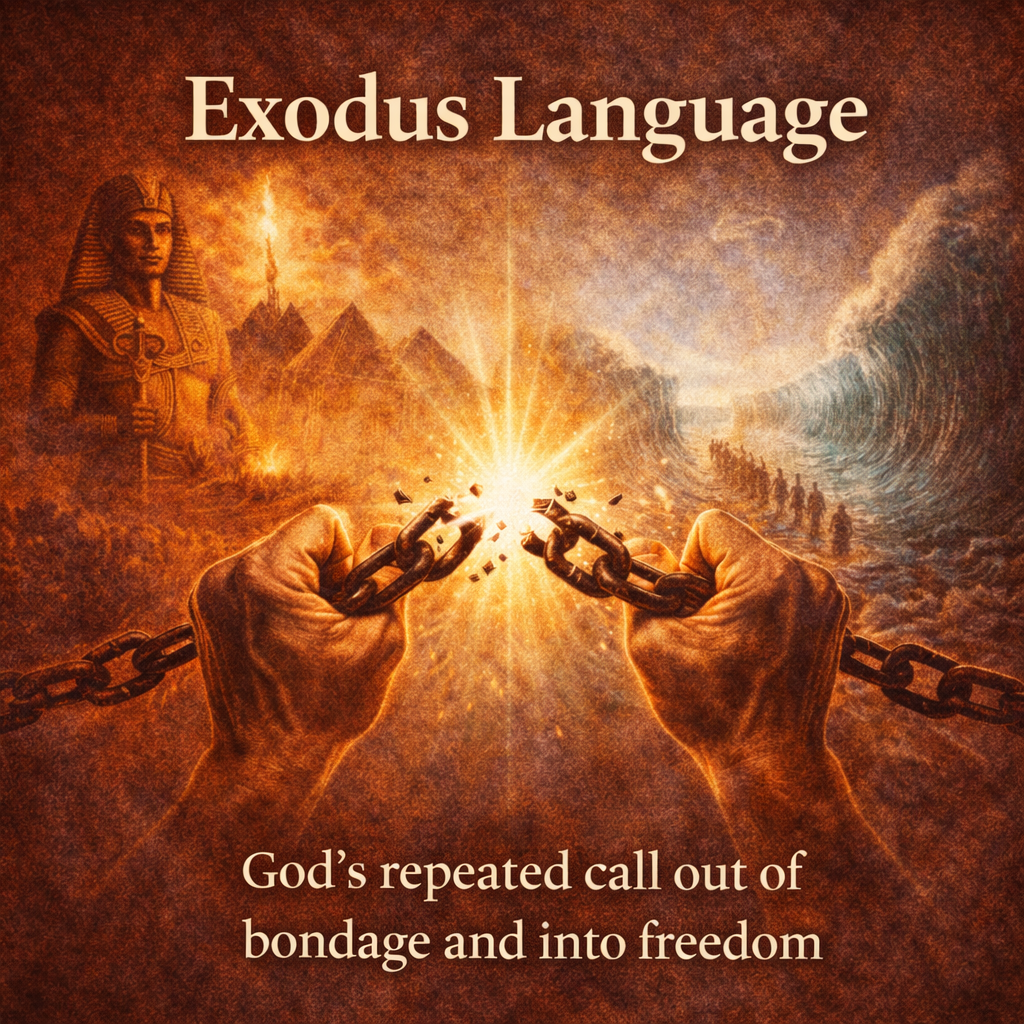
Exodus language usually follows a three-step movement: out of bondage, through wilderness, into a better place. This pattern appears throughout the Bible and echoes in countless modern settings.
Out means leaving an oppressive or constricting situation. For Israel, this was Pharaoh’s forced labor—brickmaking without straw, infanticide decrees (Exodus 1:8–14). The person or people can no longer stay where they are.
Through describes the in-between wilderness: dangerous, confusing, but transformative. Israel faced hunger (manna in Exodus 16), thirst (water from rock in Exodus 17), and moments of doubt. This phase tests character and builds new identity.
Into marks arrival in a renewed situation of promise and stability. God first described this hope in Exodus 3:8—“a land flowing with milk and honey.” The pattern reaches fulfillment when Joshua leads Israel across the Jordan River into Canaan (Joshua 3–4).
Biblical Examples of Exodus Language in Action
The following examples walk through specific biblical stories that embody the exodus pattern: going out, crossing wilderness, entering a better place.
Example 1: Israel Leaving Egypt (Exodus 1–15)
Pharaoh’s oppression included forced brickmaking and a decree to kill Hebrew infant boys (Exodus 1:15–22). Moses, called by God at the burning bush, confronted Pharaoh with escalating plagues—turning the Nile to blood, sending locusts, and culminating in the death of Egypt’s firstborn. The Passover night (Exodus 12:29–42) marked the decisive break: families ate lamb with unleavened bread, blood on doorposts, ready to leave at a moment’s notice. This is the concrete “going out.”
Example 2: Through the Wilderness of Sinai (Exodus 15–Numbers 21)
The Red Sea victory song (Exodus 15:1–18) celebrated escape but didn’t signal final arrival. Israel immediately faced hunger—God provided manna daily for 40 years. At Rephidim, Moses struck rock to bring water (Exodus 17). At Mount Sinai, God gave the Ten Commandments (Exodus 19–20), forming a covenant people during the journey. The wilderness wasn’t punishment alone—it was transformation.

Example 3: From Wilderness into Promised Land (Numbers 13–14; Joshua 3–4)
From the wilderness of Paran, Moses sent 12 spies into Canaan. Ten returned with fear of giants (Numbers 13:32–33), and the people’s rebellion extended their wandering to 40 years (Numbers 14:34). Eventually, Joshua led the next generation across the Jordan River—waters parting like the Red Sea—into Canaan (Joshua 3–4). Twelve stones marked the crossing. This “coming in” fulfilled promises first voiced in Exodus 3:8, completing the exodus pattern.
How Exodus Language Shapes Theology and Spiritual Practice
Jewish and Christian traditions have built entire liturgical and theological frameworks around exodus language.
In Jewish practice, the annual Passover (Pesach) Seder retells Exodus 12–13 as if each generation personally came out of Egypt. The Haggadah text instructs participants to read and listen to the story with the phrase “We were slaves to Pharaoh in Egypt.” Torah portions throughout the year reinforce these themes.
Prophets like Second Isaiah (6th century BCE) reused exodus imagery to describe return from Babylonian exile as a “new exodus”—God “makes a way in the wilderness” (Isaiah 43:19). The hope of salvation through deliverance echoes across the universe of prophetic texts.
Christian theology applies the same language to Jesus and salvation. Paul calls Christ “our Passover lamb” (1 Corinthians 5:7). Baptism is likened to crossing the sea (1 Corinthians 10:1–2). The book of James and Hebrews 3–4 portray the church as pilgrims journeying toward promised rest. These traditions use concrete exodus scenes to describe inner change and communal identity.
Exodus Language in Politics, Culture, and Everyday Speech
Exodus language has moved far beyond religious texts into political speeches, protest movements, media, and art.
African American spirituals like “Go Down, Moses” adapted exodus plagues as coded messages during slavery. Civil rights leaders in the 1950s–1960s used Moses, Pharaoh, and the promised land as metaphors against segregation. MLK’s “I’ve Been to the Mountaintop” speech cast him as Moses viewing the promised land—a thing he might not enter, but his people would.
Today, journalists write about an “exodus of workers” or “resident exodus” from cities. Refugee accounts from Venezuela or Ukraine describe leaving oppression and crossing dangerous territory toward safety. Recovery narratives frame sobriety as arriving in a promised land after wilderness years of addiction.
Popular culture also draws on the idea. The video game Metro Exodus (2019) features characters fleeing post-apocalyptic Moscow through irradiated Russia—the title signals escape from ruin toward hoped-for safety, even if the story doesn’t retell the biblical account directly. You can watch or play these stories and hear exodus echoes throughout.

How “Exodus Language” Relates to Actual Languages (Hebrew, Greek, English)
While exodus language is metaphorical, it is grounded in real historical languages and translations.
The original Book of Exodus was written in Biblical Hebrew, where the title “Shemot” (Names) comes from its beginning words. The Greek Septuagint (3rd–2nd century BCE) used “Exodos”—ex meaning “out” plus hodos meaning “way”—giving us “departure.” Latin and English Bibles (Wycliffe in the 14th century; King James Version in 1611) adopted “Exodus” as the standard title.
When English speakers say “an exodus of workers” or “digital exodus,” they unconsciously draw on this Greek/Latin biblical title. A search through any dictionary confirms how deeply embedded this word has become in general speech—even for those who have never read the text.
Frequently Asked Questions
Is “exodus language” an actual spoken or programmed language?
No. Exodus language is not a user-created tongue like Hebrew, Python, or a sci-fi constructed language. It’s a way of speaking that borrows words, images, and story patterns from the biblical Exodus. While some games or science-fiction works use “Exodus” in titles (like Metro Exodus with its Russian and English dialogue), they rely on human languages—the “exodus” part refers to the theme of leaving one place for another, not to a separate linguistic system.
How is “exodus language” different from just talking about “change” or “travel”?
Exodus language always echoes a specific pattern: oppressed people, a decisive act of liberation, a risky wilderness passage, and arrival in a promised place—often with divine guidance in view. Generic talk about change or travel might not include themes of slavery, covenant, or moral transformation. When someone says “we need a Red Sea moment” or “Let my people go,” they’re tapping into exodus language, not neutral vocabulary. You can hear the continuity with the biblical story if you listen closely.
Can individuals use exodus language for their own lives?
Yeah, many do. People describe leaving an abusive relationship, walking through a “wilderness season” of confusion, and emerging into healthier life as a personal exodus. The books of Exodus, Numbers, and Joshua offer a template for thinking about personal growth: change requires leaving, enduring testing, and embracing new identity. Sometimes this language can accurately reflect people leaving abusive church communities in order to deconstruct their faith and find a better community.
Does exodus language only belong to religious communities?
Its roots are deeply biblical, but exodus language now appears in secular politics, literature, journalism, and activism across the earth. Journalists describe an “exodus of residents” from a city; activists call unjust systems “modern Pharaoh.” Awareness of these roots can reinforce how both religious and non-religious readers understand the influence and power of the metaphors they encounter in posts, videos, and everyday speech.
How can I recognize and use exodus language responsibly?
Watch for references to Egypt, Pharaoh, crossing the sea, wilderness, and promised land in speeches, songs, and books—these are common exodus markers. Use the language thoughtfully, especially when comparing present struggles to historical slavery, so you don’t minimize the suffering of those original contexts. If you want depth, read Exodus 1–15, wilderness passages (Exodus 16–17; Numbers 13–14), and Joshua 3–4 to ground your metaphors in the actual biblical account. Free PDF Bible versions exist online if you want to pass these texts along to others.

The Problem With Certainty