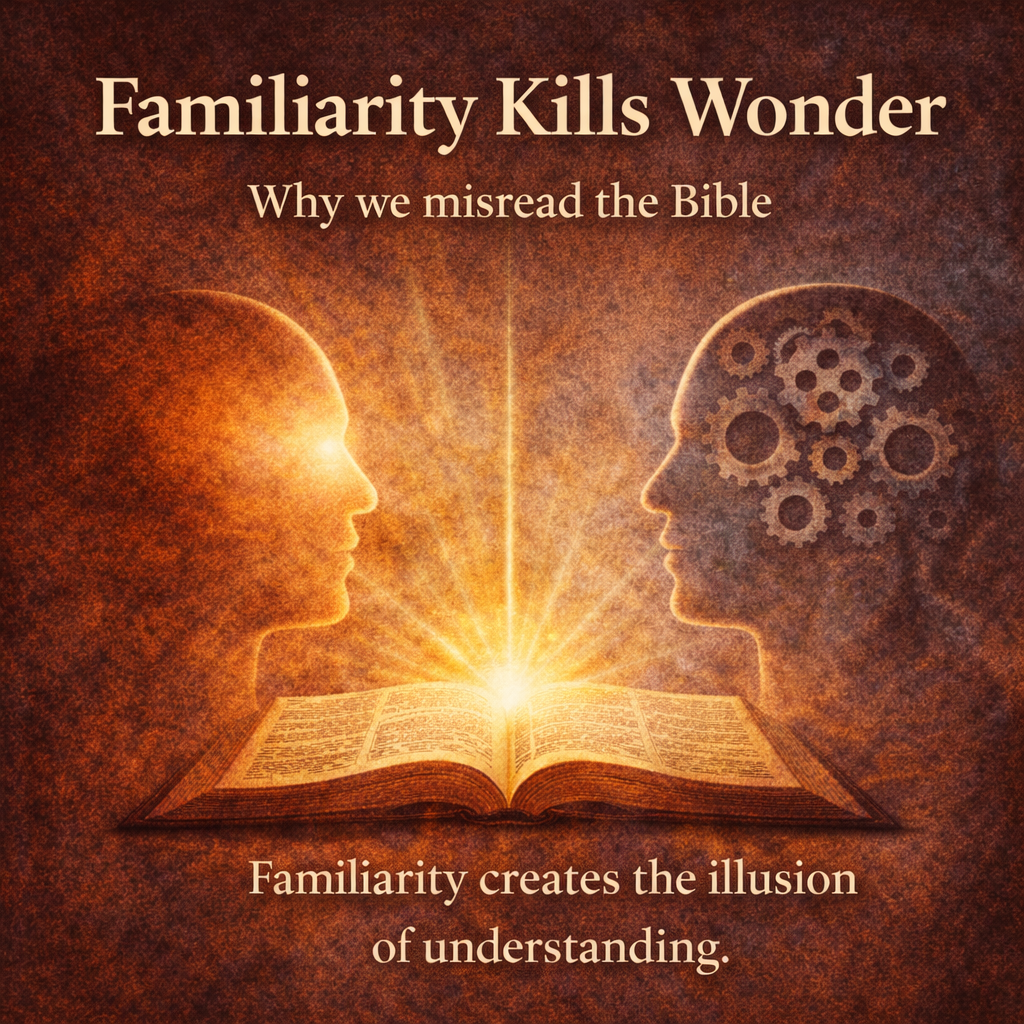
Familiarity doesn’t kill wonder by itself— it creates the illusion of understanding.
Familiarity Kills Wonder: Why We Stop Seeing What Scripture Is Doing
One of the most subtle dangers in reading Scripture isn’t misunderstanding, it’s familiarity. Not because it’s wrong to know the text. But because it’s easy to believe you already understand it. We hear a passage and think, “I’ve read this before.” And in that moment, something shifts. We stop looking. The words are still there. The meaning is still there. But our curiosity is gone. And without curiosity, we don’t actually see what the text is doing. We see what we expect it to do.
What Familiarity Does
Familiarity creates a kind of shortcut in the way we read. Instead of engaging the passage, we recognize it. Instead of observing, we recall. Instead of asking questions, we supply answers. Our minds move quickly to what we’ve already been taught. What we’ve already heard. What feels familiar and settled. nd because it feels right, we rarely question it. But recognition is not the same as understanding. And this is where meaning starts to flatten.
A Simple Example
Take a phrase like “judge not.” Most people don’t need to read the passage. They already know what it means. Or at least, they think they do. So the moment they see it, the process is already over. No questions. No tension. No curiosity. Just conclusion. But when you slow down and actually look at the passage, something different begins to emerge. The audience matters. The tone matters. The structure matters. And suddenly, what felt simple becomes layered. Not because the meaning changed, but because it was never that simple to begin with.
Where This Breaks Down
This is where a lot of misreading begins. Not from bad intent. But from assumed understanding. When familiarity takes over, we stop noticing things like: What is actually being said, What is not being said, How the passage is structured What tension is being held We move too quickly to application, without first understanding what’s happening. And this is how prooftexting quietly takes root. Because once a passage feels familiar, it becomes easy to use. Easy to quote. Easy to apply. Even if we’ve never really examined it.
The Deeper Issue
Familiarity doesn’t just remove curiosity. It creates the illusion of understanding. It tells us: “You already know this.” So we stop listening. We stop observing. We stop being surprised. And over time, Scripture becomes something we recognize, instead of something we discover.
The Deeper Invitation
What if familiarity isn’t something to rely on, but something to question? What if the passages you feel most confident about…
are the ones worth slowing down for? Because Scripture was never meant to be skimmed. It was meant to be engaged. To be wrestled with. To be seen from different angles over time. And that requires something familiarity often removes: Wonder.
Why This Matters More Than You Think
When wonder disappears, so does depth. We stop asking better questions. We stop noticing context signals. We stop seeing structure, tension, and meaning beneath the surface. And Scripture becomes predictable. Manageable. Flat. But the text itself hasn’t changed. Only the way we approach it has.
A Better Question
Instead of asking, “What does this passage mean?” Try asking: “What have I stopped seeing because this feels familiar?”
Because sometimes the greatest barrier to understanding Scripture… is the belief that you already do.
The Problem With Certainty