Literary Structure: Why the Bible Is Built the Way It Is
Literary Structure: Why the Bible Is Built the Way It Is
One of the most overlooked signals in Scripture is not the words themselves…
…but how those words are arranged.
We tend to read the Bible as a collection of verses.
But the biblical authors were building something much more intentional.
They were structuring their writing in ways that carry meaning.
And if we don’t see that structure, we will often miss the point entirely.
What We Expect
Most of us read Scripture linearly.
Verse after verse. Thought after thought.
We assume the meaning is found in individual statements, isolated from the rest.
So we focus on what each verse says, rather than how the passage is built.
But that’s not how ancient writing works.
What Scripture Is Actually Doing
The biblical authors used structure as a way to guide understanding.
They arranged ideas in patterns, parallels, contrasts, and repeated movements.
Sometimes the beginning mirrors the end.
Sometimes the middle is the emphasis.
Sometimes repetition is the signal that something matters.
The structure itself is part of the message.
A Simple Example
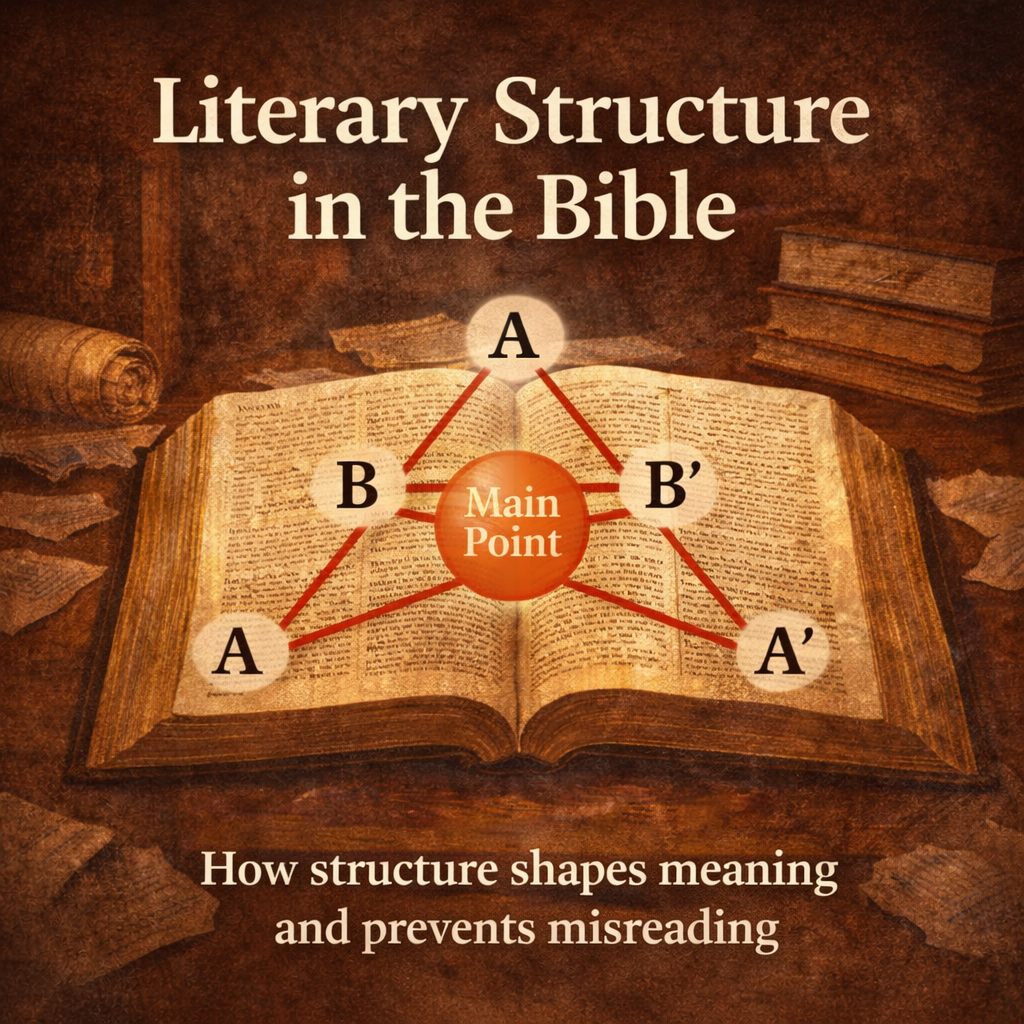
Many passages in Scripture are written in what’s called a “chiasm.”
This is a pattern that looks like this:
A
B
C
B’
A’
The outer ideas mirror each other, and the center becomes the focus.
That means the main point is often not at the beginning or the end…
…but right in the middle.
If you don’t see the structure, you might completely miss what the author is emphasizing.
Where This Breaks Down
This is where a lot of interpretation goes wrong.
When we ignore structure, we start pulling verses out of their designed flow.
We treat them like standalone statements instead of part of a larger movement.
That’s how meaning gets flattened.
And it’s one of the ways prooftexting quietly takes over.
Because once structure is ignored, any verse can be made to stand on its own.
The Deeper Invitation
Literary structure invites us to slow down and observe.
To ask questions like:
Why is this repeated?
Why does this section mirror another?
Why does this idea sit in the center?
It shifts us from reading for isolated meaning…
to reading for intentional design.
Why This Matters More Than You Think
The authors of Scripture were not careless.
They were precise.
They chose where things go, how ideas connect, and what gets emphasized.
When we ignore structure, we’re not just missing detail.
We’re missing direction.
We’re reading the words without seeing the path they’re creating.
A Better Question
Instead of asking, “What does this verse say?” try asking:
“How is this passage built?”
Because sometimes the meaning of Scripture isn’t just in the words…
…it’s in the way those words are arranged.

The Problem With Certainty