What Are Context Signals? (How to Read the Bible in Context)
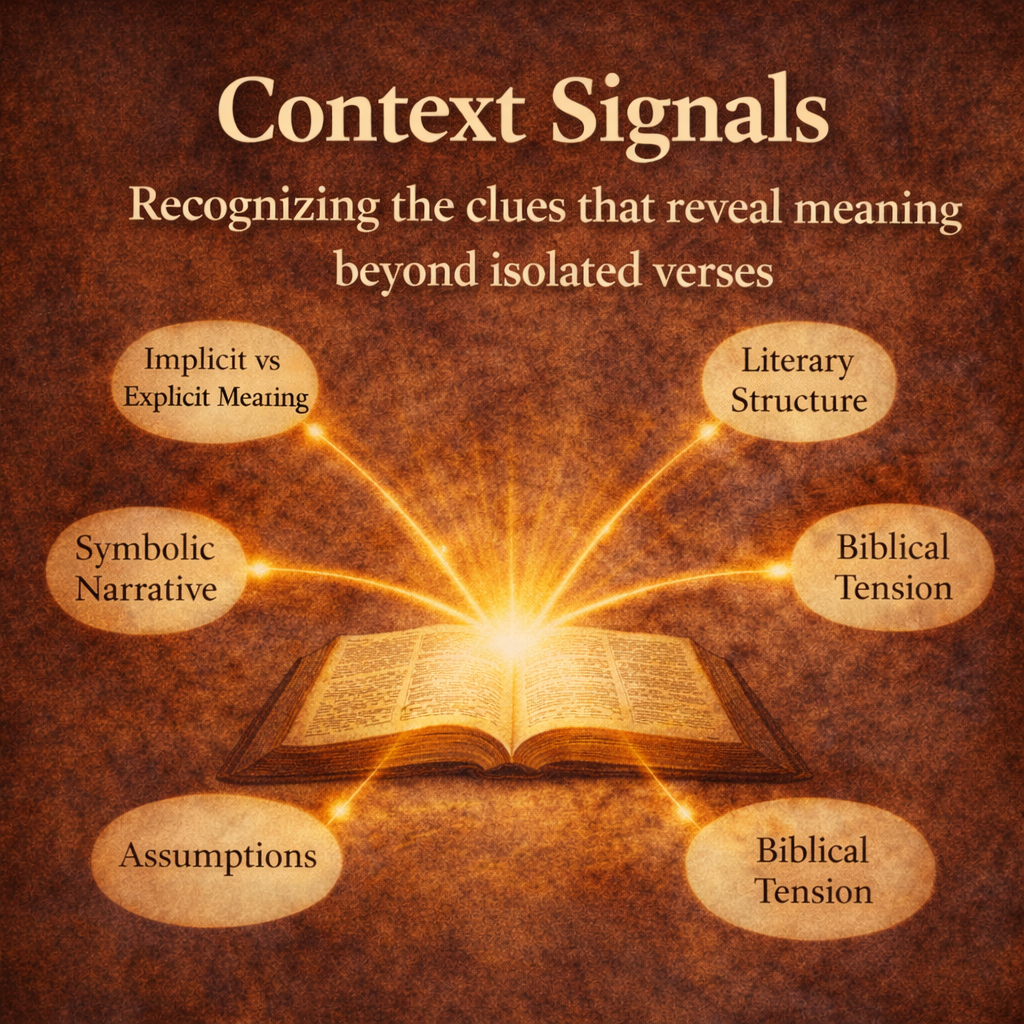
What Are Context Signals? Learning to See What Scripture Is Actually Doing
If you’ve ever read a verse and felt confident about what it meant…
only to later realize there might be more going on, you’ve already brushed up against something important. The Bible doesn’t communicate in isolated statements. It communicates through context. And context isn’t just about reading more verses around a passage. It’s about learning to recognize the signals that guide meaning. These are what we call context signals.
What We Usually Do
Most of us were taught to approach Scripture by focusing on the words themselves. Find the verse. Understand the statement. Apply the meaning. But this approach assumes that meaning lives in individual lines. And while the words matter, they were never meant to stand alone. They are part of something larger.
What Scripture Is Actually Doing
The biblical authors were not just writing ideas. They were communicating through story, structure, culture, and design. Which means meaning is often carried through patterns, relationships, and placement. Not just through direct statements. Context signals are the clues that help us see that. They are the indicators that show us how a passage is meant to be understood.
A Simple Way to Think About It
Imagine walking into the middle of a conversation. You hear a sentence, but you don’t know the tone, the relationship, or what was said before. You might understand the words, but miss the meaning entirely. Context signals are what give you the rest of the conversation. They help you understand not just what is being said, but what is actually happening.
Common Context Signals
There are several signals that consistently show up throughout Scripture. Once you begin to recognize them, the text starts to open up in a different way. These are also explained in our 5 W's article)
Implicit vs Explicit Meaning
Not everything is stated directly. Some meaning is embedded in the story or the moment itself.
Literary Structure
Passages are intentionally arranged. Patterns, repetition, and placement often reveal emphasis.
Symbolic Narrative
Objects, actions, and characters frequently carry deeper meaning beyond the surface.
Assumptions
We all bring expectations into the text. These can shape what we see and what we miss.
Biblical Tension
Scripture often holds ideas together that feel opposite. Resolving the tension too quickly can distort meaning. Each of these signals helps you see a different layer of what’s happening.
Why This Can Help you Understand Better
Most misinterpretation doesn’t come from bad intent. It comes from missing these signals. When we ignore them, we tend to:
Pull verses out of their natural flow
Flatten complex ideas into simple answers
Force the text to say what we expect it to say
This is where prooftexting begins. Not as a deliberate act, but as a natural result of reading without context.
The Deeper Invitation
Context signals don’t make Scripture more complicated. They make it more honest. They invite us to slow down. To observe instead of assume. To ask better questions instead of rushing to answers. And in doing so, they shift the way we engage the text. From extracting meaning, to discovering it.
A Better Question
Instead of asking, “What does this verse say?” Try asking: “What signals are present here that shape what this means?”
Because Scripture is not just giving you information. It’s inviting you into understanding.

When Outsiders Became Family: The Conflict That Shaped the Early Church