What Did the Number 7 Mean in the Bible?
Overview
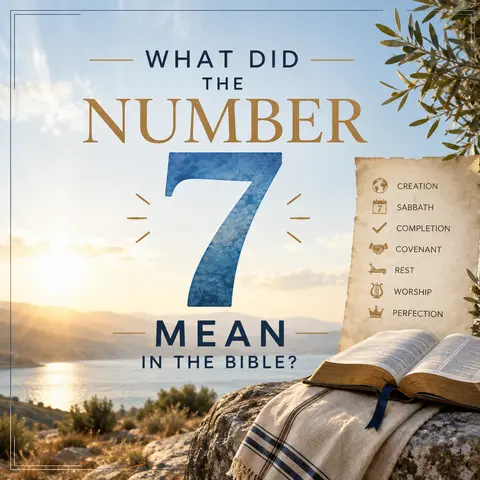
The number 7 in the Bible primarily symbolizes divine completeness, wholeness, and holiness, rooted in how God created the world in six days and rested on the seventh.
-
Sabbath patterns - the seventh day, the seventh year, and seven times seven years - form the backbone of Scripture's seven symbolism from Genesis through Revelation.
-
The Old Testament lays the foundation through creation, festivals, and rituals, while the New Testament - especially Jesus Christ's ministry and the book of Revelation - intensifies and fulfills the seven-fold patterns.
-
Biblical authors often organize words, themes, and visions in sevens to signal that something is complete in God's plan, making the number seven a structural tool, not a secret code.
-
While other numbers carry meaning in Scripture, seven is the most important symbolic number, representing God's perfect work in creation, redemption, and final restoration.
Introduction: Why the Biblical Number 7 Matters
What did the number 7 mean in the Bible? At its core, seven represents divine completeness, covenant faithfulness, and sacred time. It is the only number woven so deeply into every layer of Scripture - from law to narrative, from prophecy to apocalyptic vision - that its significance is impossible to miss. God created the heavens and the earth in six days and rested on the seventh day, establishing a rhythm that echoes through the entire biblical story. Seven priests blew seven trumpets at Jericho. Seven churches receive letters in Revelation. The pattern is consistent, intentional, and theologically loaded.
This article traces the meaning of seven from Genesis through the Old Testament, into the life and teaching of Jesus Christ, and finally into the book of Revelation, showing a single, coherent thread of divine completeness. The focus here is on what the text itself communicates, not on speculative biblical numerology or modern "lucky number" superstitions.
The Creation Week: How God Created and Established the Pattern of Seven
Genesis 1:1–2:3 is the foundational text for every biblical use of the number seven. Everything starts here.
God created light, sky, land and vegetation, celestial bodies, sea and air creatures, and land animals along with humanity over six days. On the seventh day, He ceased from work, and God blessed that day, sanctifying it as holy (Genesis 2:2–3). Creation was complete, and the seventh day marked its perfection.
The literary design reinforces this. Genesis 1:1 contains exactly seven Hebrew words in the Masoretic text. The Hebrew word for God - Elohim - appears 35 times in the creation account (5×7). "Heavens/sky" and "earth" each occur 21 times (3×7). Phrases like "it was good" appear seven times. These are not coincidences. They are deliberate literary architecture signaling that creation is an ordered, complete, and divine work.
One more detail worth noticing: unlike each of the first six days, the seventh day lacks the "evening and morning" formula. This absence suggests an open-ended, ongoing rest - a Sabbath that later Scripture connects with God's eternal purposes.

Seven and the Sabbath: Holy Rest in Scripture
The Sabbath is where the number seven becomes a lived reality, not just a symbol. It represents completeness expressed through rest, worship, and trust.
The fourth commandment (Exodus 20:8–11) orders Israel to rest on the seventh day, directly mirroring God's rest after creation. The Sabbath is observed every seven days - a weekly declaration that God's work is finished and reliable. This holy day is not merely about stopping work; it is about entering a covenant rhythm of dependence on God's provision.
Sabbath-related sevens fill the Old Testament calendar:
-
Seven-day festivals like the Feast of Unleavened Bread and the Feast of Booths (Leviticus 23)
-
Seven-day priestly consecrations before ministry could begin
-
Sevenfold sprinklings during purification rites (Leviticus 4; 8; 14)
In the New Testament, Jesus Christ healed on the Sabbath repeatedly, declaring Himself "Lord of the Sabbath" (Mark 2:27–28). He did not abolish God's Sabbath but revealed its deeper purpose: restoration, not restriction. True Sabbath rest points to eternal life in God's completed kingdom.
Sevens in Old Testament Narratives: Judgment, Mercy, and Covenant
Across Old Testament narratives, the number 7 marks decisive moments where God acts in complete judgment or complete mercy.
Noah and the Flood. God commanded Noah to take seven pairs of clean animals onto the ark (Genesis 7:2). He foretold rain in seven days. The waiting periods and dove-sendingsare measured in seven-day intervals. Seven pairs of clean animals were taken on Noah's ark to preserve those acceptable for sacrifice in fuller abundance - preparation for a renewed world.
Cain's punishment. In Genesis 4:15, Cain received a seven-fold punishment after killing Abel. God set a boundary of sevenfold vengeance for anyone harming Cain - a complete, divinely controlled limit, not an invitation to human retribution.
Joshua and Jericho. Seven priests carried seven trumpets and encircled the city for seven days. On the seventh day, they marched seven circuits. Joshua marched around Jericho for seven days before its walls fell - a portrait of God's complete victory achieved through obedient faith, not military strategy.
Naaman's healing. Naaman was told to wash in the Jordan River seven times (2 Kings 5:10–14). Full obedience brought full cleansing. The number seven here signals that healing comes through complete trust in God's word.
Seven in Laws, Rituals, and Sacred Time (Old Testament Focus)
Israel's entire calendar and worship life are built around cycles of seven, structuring sacred time from the ground up.
The seven-day week culminates in Shabbat. The Israelites were instructed to eat unleavened bread for seven days during Passover. Major festivals - Feast of Unleavened Bread, Feast of Booths - run for seven days (Leviticus 23).
Beyond the week, the sabbatical year arrives every seventh year. Hebrew slaves are freed in the seventh year. Debts are released. Fields lie fallow. The land itself enters rest.
After seven cycles of seven years - 49 years - the fiftieth year is the jubilee year: return of property, proclamation of liberty, social and economic reset (Leviticus 25:8–12). The Year of Jubilee occurs after seven cycles of seven years, making it the ultimate expression of seven's role in justice and restoration.
Ritual sevens operate at every level:
-
Purification rituals often involve seven sprinklings or immersions
-
Animals are ready for sacrifice after seven days of life
-
The menorah's seven lamps in the Tabernacle symbolize God's continual presence and complete illumination
Every seventh month (Tishrei) contains the Day of Atonement and the Feast of Booths - the most concentrated period of holy observance in Israel's calendar.
Seven as a Literary Design: Seven-Fold Keywords and Structures
Biblical authors use the number seven not only in stories but as a deliberate literary pattern to signal completeness.
The creation account is the clearest example. As noted above, key words repeat in multiples of seven: "God" 35 times, "heavens" and "earth" 21 times each, "it was good" seven times. This is not decorative; it is architectural - showing creation as a perfectly ordered cosmos under God's word.
In some passages, speeches or promises contain seven elements. God's layered promises to Moses in Exodus 6:6–8 - "I will bring you out… I will rescue you… I will redeem you…" - form a full, rounded pledge. Seven-fold keywords appear when the author wants the reader to feel that a theme has reached its complete expression.
While counting every occurrence of seven can be overdone, the widespread and consistent use of sevens across genres - narrative, law, prophecy, apocalyptic - makes it clear that many of these patterns are intentional, not accidental.
The first letter of understanding biblical structure is recognizing these numerical value markers that the original audience would have noticed in the Hebrew letters of their sacred text.
Seven in the Life and Teaching of Jesus Christ
Jesus Christ both fulfills and deepens the meaning of seven as God's number of completion and rest. Where the Old Testament establishes patterns, the New Testament reveals their purpose.
Jesus uses seven distinct "I Am" declarations across John's Gospel: Bread of Life, Light of the World, the Door, the Good Shepherd, the Resurrection and the Life, the Way, the Truth and the Life, and the True Vine. Seven statements. Seven facets of who He is. Complete revelation.
On forgiveness, Jesus instructed Peter to forgive seventy times seven (Matthew 18:22) - not a literal cap of 490 instances, but an invitation to limitless, complete grace that goes beyond any human calculation. Where Cain's sevenfold vengeance set a limit on retribution, Christ's seventy times seven removes all limits on mercy.
Jesus' healings on the Sabbath show that true seventh-day rest is about restoring what is broken - giving a foretaste of God's completed kingdom. His cry "It is finished" on the cross echoes the same theology: God's saving work, brought to full completion in Christ.
Revelation and the Number Seven: The Climax of Biblical Sevens
The book of Revelation is where the symbolism of the number seven reaches its fullest, most concentrated expression. The number seven appears over 50 times in the book of Revelation, making it the single most structurally important number in the text.
| Septet | Reference | Significance |
|---|---|---|
| Seven churches | Rev 1–3 | Complete church across history |
| Seven spirits | Rev 1:4; 4:5 | Fullness of the Holy Spirit |
| Seven seals | Rev 6–8 | Complete unfolding of God's plan |
| Seven trumpets | Rev 8–11 | Complete warnings of judgment |
| Seven bowls | Rev 15–16 | Complete outpouring of wrath |
| Seven stars | Rev 1:16, 20 | Seven angels of the churches |
| Seven lamps | Rev 4:5 | God's complete illumination |
The seven churches in Asia Minor - Ephesus through Laodicea - receive seven letters addressing their varied strengths and weaknesses. They represent the complete church in every age and condition. The seven lampstands and seven stars echo the seven-branched menorah, showing Christ's presence among His people.
Seven angels carry out God's decisive actions. Seven seals open the scroll of God's purposes. Seven trumpets sound warnings. Seven bowls pour out final judgment.
The Book of Revelation frequently uses the number 7 for structure, and each septet builds toward the same destination: the final visions of a new heaven and new earth (Revelation 21–22). These chapters recall Genesis - garden, river, tree of life - completing the arc. From first creation to ultimate restoration, the repetition of seven in biblical texts emphasizes the fulfillment of God's purposes.
Ancient Near Eastern and Hebrew Background of the Number Seven
Israel's use of seven fits within a wider ancient Near Eastern fascination with the number, but reshapes it around the one true God.
Ancient Mesopotamian and Canaanite cultures recognized seven visible heavenly bodies - the sun, moon, and five planets - and treated seven as a heavenly or sacred number. Myths, rituals, and even mathematical systems gave it special status.
In Hebrew, the word for seven - sheva - shares the same root as the word for oath (shevu'ah) and words meaning fullness and satisfaction. The Hebrew word for seven is sheva, which is connected to fullness, binding the concepts of covenant, completeness, and sacred promise together in a single word family.
Seven's mathematical uniqueness contributed to its resonance: it is prime, indivisible, and in the Babylonian base-60 system, its reciprocal cannot be expressed finitely - lending it a sense of mystery and wholeness.
But the Bible does not borrow uncritically. Scripture redirects the cultural respect for seven to the God who created the heavenly bodies and defines sacred time by His own actions - not by astral cycles or impersonal fate.
Theological Themes: Completion, Holiness, and Hope
Across every genre and era of Scripture, the number seven consistently expresses three lines of theological meaning.
Completion. Seven marks the end of a divinely appointed phase. God rested on the seventh day, marking completion of creation. Seventy years of exile end with return to the promised land. Seven seals open to reveal God's full purposes. Seven is associated with completeness and divine perfection throughout Scripture - it represents completeness wherever it appears.
Holiness. Things associated with seven are set apart for God: holy days, holy objects like the seven lamps, holy oaths, and holy people consecrated through seven-day rituals. The number seven signifies spiritual perfection in the Bible - not human achievement, but God's own standard of wholeness.
Hope. Seven points forward. Sabbath rest is a foretaste of eternal rest. Jubilee previews ultimate liberation. Revelation's sevens move toward a new creation where God makes all things new and dwells with His people. Seven is associated with divine completeness throughout Scripture, and that completeness is not just backward-looking - it is a promise.
Biblical sevens are not secret codes. They are invitations to trust that God finishes what He starts - from the first "God created" in Genesis to the last "It is done" in Revelation.

Misconceptions and Cautions About Biblical Numerology
Modern interest in "Bible codes" and number patterns is high. A word of caution is in order.
The Bible uses the number seven symbolically and structurally, but it does not endorse speculative number games that ignore context. Not every occurrence of seven carries hidden significance. Some uses are straightforward - seven days in a week is simply how time works after creation.
The answer to numerological speculation is not to dismiss patterns but to focus on clear, repeated ones: Sabbath cycles, festival structures, Revelation's septets. These are unmistakable. Isolated verses ripped from context are not.
The true significance of biblical sevens lies in revealing God's character and plan - His perfection, His faithfulness, His completed work in the world. They are not tools for predicting dates, finding secret timelines, or treating the Bible as a cipher. Where God's word speaks clearly, we should listen. Where it does not, we should exercise humility.
FAQ
These FAQs address common follow-up questions about the biblical meaning of the number seven.
Is the number 7 always positive or "good" in the Bible?
Not always. While seven usually signifies blessing and completeness, it can also mark complete judgment. Leviticus 26 warns of sevenfold punishment for disobedience. Revelation 16 describes seven bowls of wrath poured out on the earth. Seven describes fullness - whether of mercy or judgment - depending on the context. God's purposes are always complete, even when they fall short of what we might hope for in a given moment.
How is the number 7 different from the number 6 in Scripture?
Six often represents human limitation and incompleteness. Humanity was created on the sixth day. Israel works for six days before Sabbath. Six stops just before divine rest begins. In Revelation, the infamous "666" - the mark of the beast - contrasts sharply with the many sevens that signify God's perfect rule. Six is humanity reaching its limit; seven is God completing the picture.
Does the Bible teach that 7 is God's "favorite" or only important number?
Seven is the most prominent symbolic number, but it is not the only one that matters. Three speaks of the Trinity and divine witness. Twelve represents God's people (twelve tribes, twelve apostles). Forty marks periods of testing (forty days, forty years). These numbers serve the story of God's dealings with Israel and the church. They are tools of communication, not objects of devotion. Seven stands out because it is the most pervasive and structurally embedded across both Old Testament and New Testament texts.
Should Christians today organize their lives around the number seven?
The key takeaway is not to chase patterns of seven in daily decisions but to embrace the rhythms God has clearly given: regular rest, faithful worship, and trust in His completed work through Jesus Christ. Sabbath and Jubilee themes find their fulfillment in Christ - resting in His finished work while still valuing wise patterns of work and rest. Let the theology behind seven shape your life, not a superstitious attachment to the digit itself.
Is it wrong to see personal "signs" in repeated sevens (like dates or times)?
God can use anything to get our attention. But building major life choices on repeated numbers can distract from the clearer guidance of Scripture, prayer, and wise counsel. The safest path is to let the Bible's plain teaching - not private numerological signs - shape faith and obedience. When the Bible speaks of seven, it speaks of God's completed, holy, and hopeful work. That is the message worth carrying into daily life.

The Problem With Certainty