What Is Empire in the Bible and Why Does It Matter?
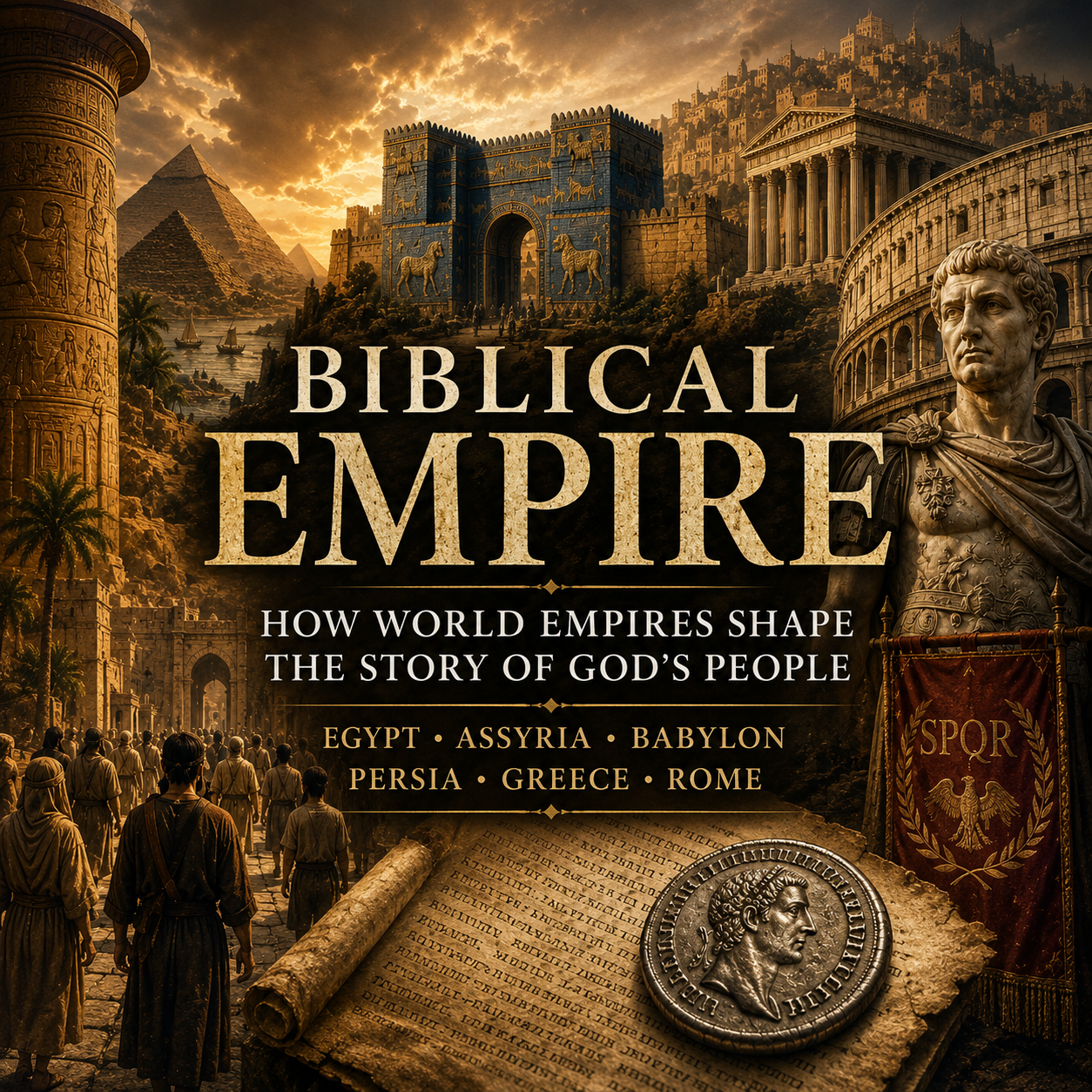
Empire Overview
- The Bible unfolds in a world shaped by powerful empires. Egypt, Assyria, Babylon, Persia, Greece, and Rome ruled enormous territories, controlled economies, moved populations, influenced cultures, and shaped the everyday lives of the people we encounter in Scripture.
- Understanding empire gives us another layer of context for reading the biblical story. Questions about military power, wealth, political security, worship, cultural pressure, and allegiance appear repeatedly from Exodus through Revelation.
- The biblical writers do not respond to every empire in exactly the same way. Some oppress Israel, some destroy or exile it, and others unexpectedly provide opportunities for restoration. That complexity is worth paying attention to.
- Babylon is especially important. It begins as a historical empire that conquered Judah and destroyed Jerusalem and the Temple, but the name eventually carries significance beyond the historical city, most dramatically in Revelation.
- Reading Revelation within the Roman imperial world of its original audience has led many scholars to see critique of empire as an important part of the book's message. That does not settle every question about Revelation, but it may cause us to notice things that prediction-centered readings sometimes overlook.
Introduction: What Is an Empire in the Biblical Story?
An empire is a powerful kingdom or political system that extends control over other peoples, territories, economies, and cultures. Egypt, Assyria, Babylon, Persia, Greece, and Rome all fit this description at different points in the biblical world. Each exercised enormous influence in its time, and each left its mark on the people, places, and writings we encounter in the Bible.
Much of the biblical story takes place in the shadow of these empires. From the world of Abraham to the churches addressed in Revelation, people lived with imperial realities that included taxes, military power, cultural pressure, political alliances, exile, and competing claims of allegiance. Once we begin paying attention to that setting, familiar biblical stories can start to look different. Empire isn't simply happening somewhere in the background. At times, it becomes part of the question the biblical writers are asking.
This article isn't simply a timeline of ancient civilizations. Instead, we'll ask how the biblical story interacts with empire, and what it reveals about power, domination, wealth, violence, worship, cultural pressure, and the search for security. We'll follow that thread from Egypt through Assyria, Babylon, Persia, Greece, and Rome before arriving at Revelation and its provocative image of “Babylon the Great.”
Defining “Empire”: Power, Control, and Worship
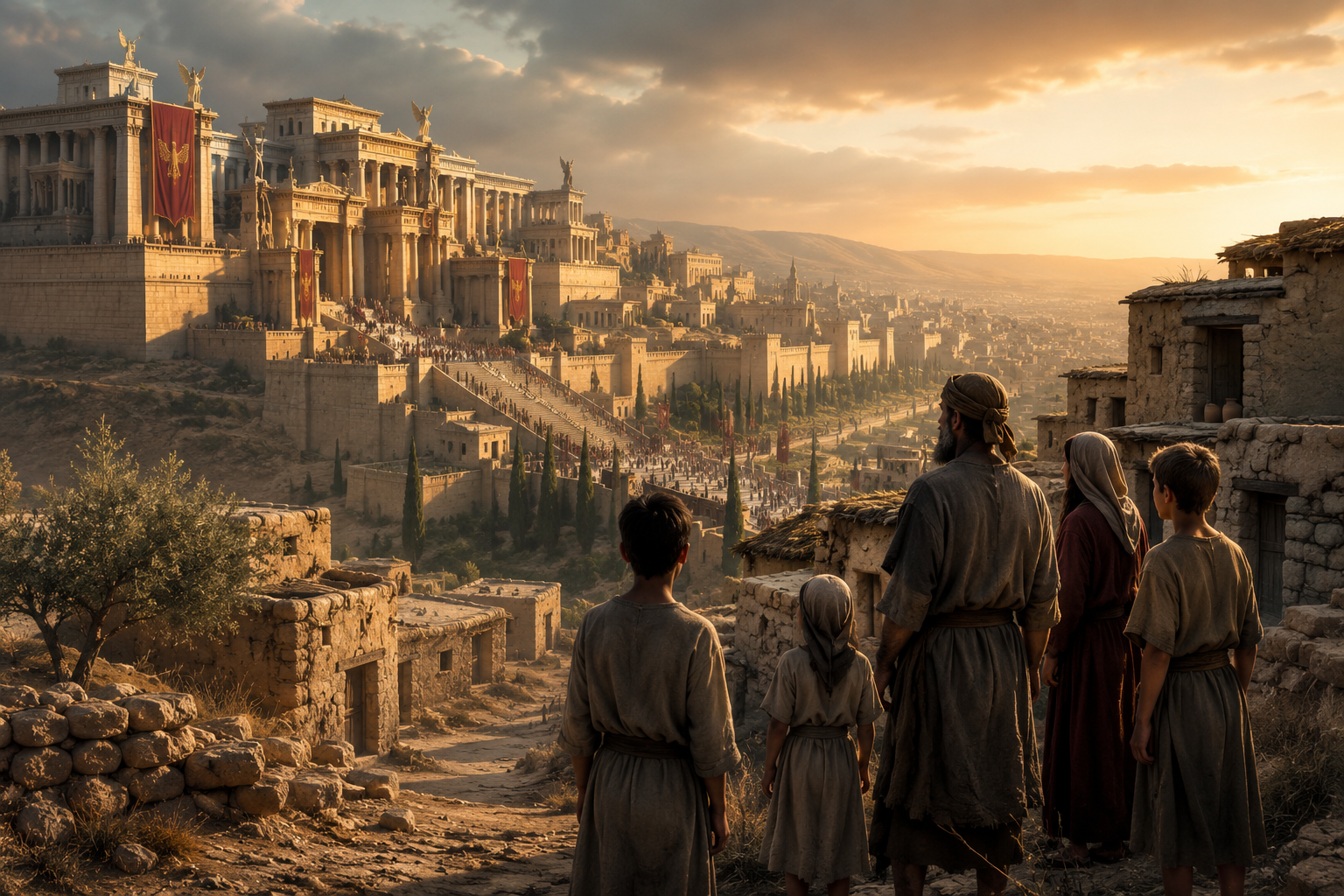
Empire is a system in which one power extends military, political, and economic control over multiple peoples and territories. When Rome ruled Judea in the first century, for example, it wasn't simply governing one city. Rome commanded armies, collected taxes, imposed laws, built infrastructure, appointed or supported local rulers, and exercised influence over the political and religious world in which people lived.
Certain features appear repeatedly as we encounter empires in the biblical story: military strength and conquest, centralized authority, taxation and economic extraction, cultural pressure, and sometimes the close relationship between political and religious power. The Bible doesn't normally use “empire” as we use the term today, but Egypt, Assyria, Babylon, Persia, Greece, and Rome form an important part of the world behind its stories, prophetic writings, and visions.
That raises an interesting question. What happens when political power begins asking for more than obedience to laws or payment of taxes? In the ancient world, rulers could be surrounded by religious claims, divine associations, temples, sacrifices, titles, and public expressions of loyalty. Those realities become especially important when we reach the Roman world of Jesus and the early church. They also give us something to watch for as the biblical story begins speaking about another kind of rule, the Kingdom of God.
Empire in the Old Testament: Living in the Shadow of Great Powers
From Abraham's world in Mesopotamia through the post-exilic period, Israel and Judah repeatedly find themselves living alongside and often under the influence of much larger powers. After Solomon's death, the kingdom divided into the northern kingdom of Israel and the southern kingdom of Judah, leaving both increasingly vulnerable as powerful empires competed for control of the region.
Egypt, Assyria, Babylon, and Persia each become part of Israel's story, but not in exactly the same way. Assyria conquered the northern kingdom. Babylon destroyed Jerusalem and carried many of Judah's people into exile. Persia, by contrast, created the political circumstances that allowed exiles to return and the Temple to be rebuilt. Already, that should caution us against treating “empire” as a simple biblical synonym for evil.
The prophets add another layer. Isaiah, Jeremiah, Ezekiel, Amos, Micah, and others speak into a world of military threats, political alliances, economic inequality, conquest, and exile. They challenge foreign powers, but they also turn their attention toward injustice within Israel and Judah themselves. That raises a question worth carrying forward: Is the biblical concern simply about which nation holds power or also about what people do with power once they have it?
Egypt and the Exodus: Empire as Enslaver
Ancient Egypt, centered along the Nile River, was one of the great powers of the ancient Near East. During portions of the second millennium BC, Egyptian influence extended into Canaan and the surrounding region. Against that larger historical backdrop, Exodus introduces Pharaoh not simply as an individual ruler but as the head of a powerful system capable of controlling labor, determining who belongs, and deciding who lives and dies.
The Exodus story portrays Egypt through the experience of an enslaved people. The Israelites are forced into labor and compelled to build the storage cities of Pithom and Rameses (Exodus 1:11). When Pharaoh becomes concerned about their growing population, he orders Hebrew sons to be killed. Whatever else we eventually conclude about empire in the Bible, this is one of its earliest and clearest portraits of what concentrated power can become when human beings are treated as resources rather than people.
The plagues then become a confrontation between Pharaoh's power and the God of Israel. Some interpreters have connected individual plagues with particular Egyptian deities, although Exodus itself does not explicitly make most of those connections. What the narrative does make unmistakable is Pharaoh's repeated refusal to release the Israelites and Yahweh's determination to bring them out of slavery.
That experience becomes part of Israel's memory long after the Exodus itself. Egypt can later represent not only a place Israel once lived, but a source of military and political security Israel is tempted to trust again. Isaiah, for example, warns Judah about looking to Egypt for horses and chariots rather than trusting Yahweh (Isaiah 31:1). The irony is difficult to miss: the people who were once delivered from Egypt could still be tempted to look back toward Egypt when they became afraid.
Assyria: Military Terror and the Fall of the Northern Kingdom
By the eighth century BC, the Neo-Assyrian Empire had become the dominant military power of the ancient Near East. From its heartland in what is now northern Iraq, Assyria expanded through military conquest, demanded tribute from subject peoples, and frequently deported conquered populations. Assyrian kings also celebrated their victories in inscriptions and reliefs that portrayed the brutal consequences of resisting them. For the small kingdoms of Israel and Judah, Assyria was an enormous and increasingly unavoidable presence.
Several Assyrian rulers appear directly in the biblical story. Tiglath-Pileser III expanded Assyrian control into the region and deported populations from the northern kingdom of Israel. Shalmaneser V began the siege of Samaria, and the city fell around 722 BC during the transition to the reign of Sargon II. The northern kingdom ceased to exist as an independent state, and portions of its population were relocated throughout the Assyrian Empire.
But the biblical writers do something interesting with Assyria. Isaiah 10 describes Assyria as “the rod of my anger,” presenting the empire as an instrument of judgment against Israel. Yet the same passage turns around and condemns Assyria for its arrogance and destructive ambition. That creates a tension worth noticing: being used within the biblical story to accomplish something does not necessarily mean that God approves of the character, motives, or methods of the one doing it.
Assyria's pressure eventually reached Jerusalem. Around 701 BC, Sennacherib invaded Judah and captured many of its fortified cities before threatening Jerusalem during the reign of Hezekiah. Second Kings 18–19 tells the story from Judah's theological perspective, emphasizing Hezekiah's dependence on Yahweh and the failure of Sennacherib to take Jerusalem. More than a century later, Assyria itself collapsed. Nineveh fell in 612 BC to forces led by the Babylonians and Medes, and Babylon soon emerged as the next dominant empire in the region.
Babylon: Historical Empire and Lasting Symbol
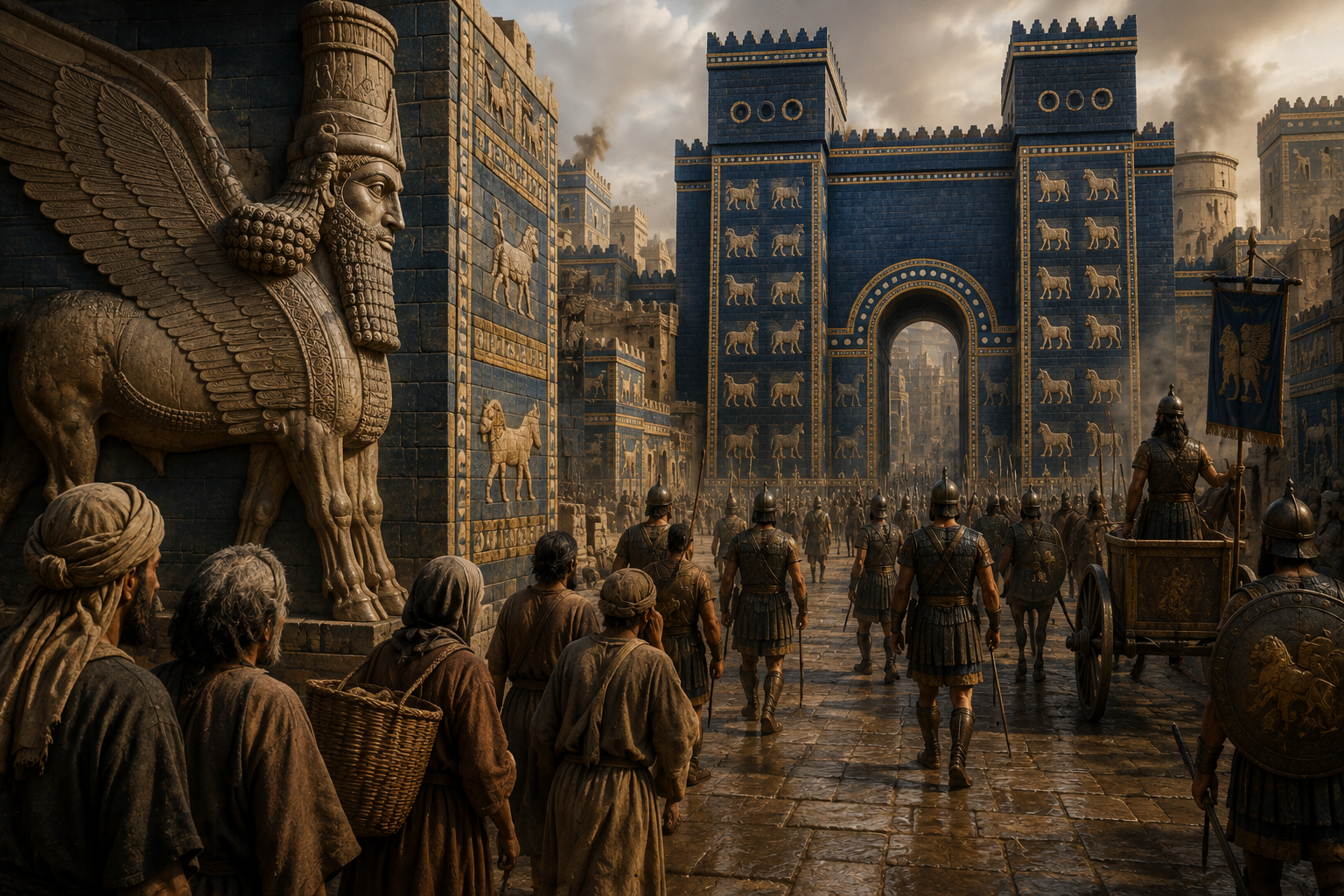
The Neo-Babylonian Empire rose to power under Nabopolassar in the late seventh century BC and reached its height under his son Nebuchadnezzar II, who reigned from 605 to 562 BC. After defeating an Egyptian army at Carchemish in 605 BC, Babylon became the dominant power in the region. For Judah, that shift would eventually have devastating consequences.
Judah's fall to Babylon happened in stages rather than all at once. Jerusalem was subjected to Babylonian control, and significant deportations occurred in 597 BC and again after Jerusalem was destroyed in 587/586 BC. The Temple was burned, the monarchy collapsed, and many Judeans were carried into exile. Ezekiel was among those taken to Babylon, while the book of Daniel places Daniel's arrival there earlier, during the reign of Jehoiakim. The precise chronology surrounding an initial 605 BC deportation is debated, so it is worth distinguishing the biblical account from what can be independently established historically.
The prophets also present Babylon in a surprisingly complicated way. Jeremiah describes Nebuchadnezzar as an instrument through whom judgment comes upon Judah, yet Jeremiah 50–51 turns toward Babylon itself and announces judgment against the empire. Once again, the biblical story resists an easy equation between being used by God and being approved by God. (much like modern prayer= righteousness) Babylon can function within the story of Judah's judgment while remaining accountable for its own violence, arrogance, and actions.
Babylon's dominance ended in 539 BC when the city came under the control of Cyrus the Great and the Persian Empire. But Babylon did not disappear from the biblical imagination when its political power ended. Later biblical writers draw upon Babylon's imagery and memory in ways that extend beyond the historical Neo-Babylonian Empire. By the time we reach Revelation, “Babylon” has become something more than a location on a map.
Persia: Imperial Tolerance, Return, and New Questions
When Cyrus the Great conquered Babylon in 539 BC, Judah's exiles suddenly found themselves living under a new empire. Persian imperial policy differed in important ways from what Judah had experienced under Babylon. Cyrus permitted displaced peoples to return to their homelands and supported the restoration of local temples and religious practices. Ezra 1 and 2 Chronicles 36 remember Cyrus specifically for allowing the Judean exiles to return to Jerusalem and rebuild the Temple.
Persian rulers continued to shape the story that followed. During the reign of Darius I, work on the Temple resumed and was completed around 516 BC, forming the historical setting for Haggai and Zechariah. Later, Ezra and Nehemiah operate under Persian authority during the reign of Artaxerxes I as they address the religious and civic life of Jerusalem. Esther offers yet another perspective, placing Jewish people inside the Persian court itself and showing them navigating both the opportunities and dangers of life within imperial power.
Persia complicates the picture of empire we've seen so far. The same kind of concentrated imperial power that had previously brought conquest and exile now creates the conditions for return and rebuilding. The biblical writers can even speak positively about Cyrus; Isaiah famously calls him God's “anointed” in Isaiah 45:1. Yet Cyrus remains the ruler of an empire, and Judah does not suddenly become an independent kingdom.
Greek and Hellenistic Empires: Culture, Language, and Resistance
Alexander the Great defeated the Persian Empire during a series of campaigns beginning in 334 BC, with the decisive victory at Gaugamela coming in 331 BC. Within a remarkably short period, his conquests stretched from Greece and Egypt through the former Persian territories and into parts of Central and South Asia. But Alexander's influence extended beyond military conquest. The Hellenistic world that followed spread Greek language, education, customs, institutions, and ideas across an enormous region.
Alexander died in Babylon in 323 BC, and the empire he had created did not remain unified. After years of conflict among his successors, several Hellenistic kingdoms emerged. Two became especially important for Jewish history: the Ptolemaic kingdom centered in Egypt and the Seleucid kingdom that eventually controlled Syria and much of the eastern territories. Judea found itself caught between these competing powers.
This period also forms an important backdrop for the book of Daniel. Daniel 8 explicitly identifies Greece and describes a powerful ruler followed by a divided kingdom. Jewish and Christian interpreters have long connected this imagery with Alexander and the kingdoms that emerged after his death. Rather than simply saying history happened “just as Daniel predicted,” however, it is worth noticing what the text says and then recognizing where historical identification and interpretation enter the discussion.
Hellenization created another kind of imperial pressure. Greek education, gymnasiums, civic institutions, and cultural practices became increasingly influential, including among some Jewish elites. The issue was no longer simply whether a foreign army controlled the land. Jewish communities also had to wrestle with questions of identity, assimilation, worship, and what faithfulness looked like while living within a dominant culture.
The Roman Empire: Setting for Jesus and the Early Church
Rome entered Judea's story dramatically in 63 BC when the Roman general Pompey captured Jerusalem. Roman influence over the region developed through a combination of local rulers and direct administration. Herod the Great ruled as a Roman client king, and after further political changes Judea came under direct Roman administration in AD 6. By the time Jesus began his ministry, Roman authority was an unavoidable part of everyday life.
The New Testament unfolds almost entirely within this Roman imperial world. Augustus ruled around the time of Jesus's birth, Tiberius during his public ministry, and later emperors such as Claudius and Nero form part of the political setting behind Acts and Paul's letters. Paul himself was a Roman citizen, a status that gave him legal protections and eventually allowed him to appeal his case to Caesar. Rome isn't simply mentioned occasionally in the New Testament; it is the political world in which the New Testament takes place.
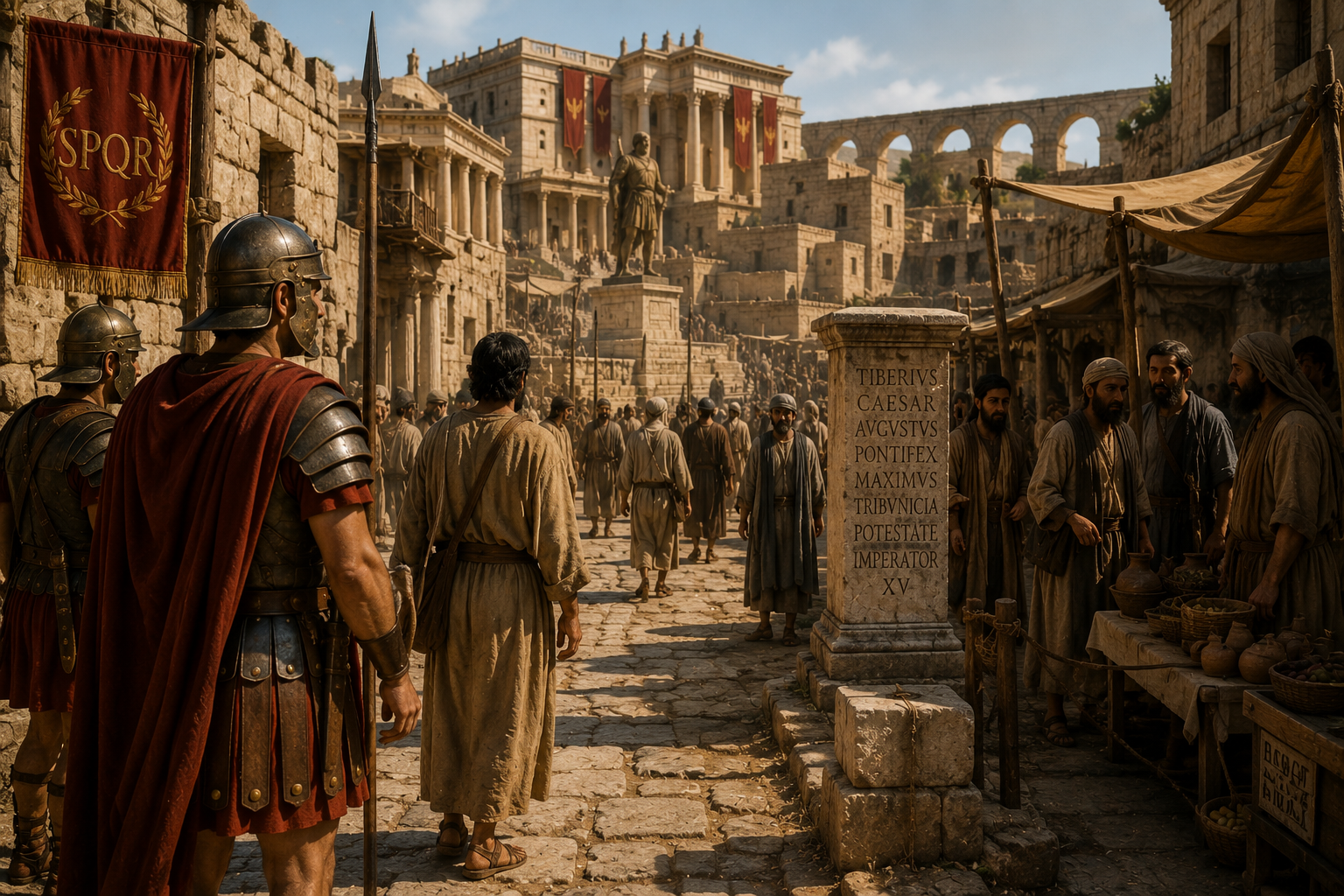
Roman power also appears directly in the story of Jesus. Taxes collected under Roman authority were a recurring source of tension. Crucifixion was a Roman form of execution designed not only to kill but also to publicly humiliate and deter. Jesus was ultimately executed under the authority of the Roman governor Pontius Pilate. A few decades later, Roman forces destroyed Jerusalem and the Second Temple in AD 70, an event with enormous consequences for Jewish life and identity.
At the same time, the Roman world created conditions that helped the early Jesus movement travel. Roads, shipping routes, cities connected through trade, and the widespread use of Greek allowed people and ideas to move throughout the Mediterranean. Once again, empire presents us with a complicated picture: the same imperial system that crucified Jesus also contained the networks along which news about Jesus spread.
Questions of allegiance become especially interesting in this setting. Early Christians called Jesus “Lord” while living in a world where emperors received extraordinary titles, honors, sacrifices, and expressions of loyalty. Some scholars see phrases such as “Jesus is Lord” as carrying an implicit challenge to Roman imperial claims, while others caution against reducing early Christian language to a direct political slogan against Caesar. Either way, knowing the imperial setting gives us an important question to consider: What would allegiance to Jesus have meant for people already living within a system that made its own claims upon their loyalty?
From Human Empires to the Kingdom of God
Against this long history of kingdoms and empires, the Bible also develops another vision of rule: the reign of God. Psalms such as 2 and 72, the prophetic visions of Isaiah, and the kingdoms of Daniel all wrestle with questions of kingship, justice, power, and God's authority over human rulers. By the time Jesus begins announcing the Kingdom of God, his listeners already have centuries of experience living under kings, foreign armies, occupation, taxation, and empire.
That context makes Jesus' language about power particularly interesting. When his disciples argue about status and greatness, Jesus points to the rulers of the Gentiles, who “lord it over” others and exercise authority over them. Then he tells his followers, “Not so with you” (Mark 10:42–43). Greatness in the community Jesus is forming is expressed through service rather than domination. Whatever else we conclude about the relationship between God's Kingdom and human political systems, Jesus clearly asks his followers to think differently about what power is for.
The same context can change the way we hear familiar teachings such as the Sermon on the Mount. “Blessed are the meek,” “blessed are the peacemakers,” and “love your enemies” were spoken in a world shaped by Roman military power, social hierarchy, honor and shame, patronage, and public displays of strength. These sayings weren't abstract principles delivered outside history. They were spoken to actual people living under an empire.
None of this requires us to conclude that the Bible treats every government or even every empire in exactly the same way. As we've already seen, Persia doesn't function like Babylon, and Rome itself creates both pressures and opportunities within the New Testament story. The more interesting question may be what happens when human power begins to demand the kind of trust, allegiance, security, or devotion that belongs to God.
Babylon as Symbol: From Genesis to the Prophets
Babylon's biblical significance reaches further back than Nebuchadnezzar and the exile. Genesis 11 tells the story of Babel—a name connected to Babylon in Hebrew where people gather to build a city and tower and “make a name for ourselves.” The story raises questions about human ambition, concentrated power, security, and the desire to resist being scattered. Whether we should read Babel as the beginning of a fully developed biblical theology of empire is another question, but the connection becomes difficult to ignore as Babylon reappears later in the biblical story.
Historical Babylon eventually gave the name much greater weight. Babylon conquered Judah, destroyed Jerusalem and the Temple, ended the Davidic monarchy, and carried people into exile. Prophets such as Isaiah and Jeremiah also portray Babylon as wealthy, powerful, confident, and ultimately vulnerable to judgment. In Isaiah 47, Babylon is pictured as a woman who believes her position is secure: “I am, and there is none besides me.” The problem isn't simply that Babylon possesses power. The prophetic critique asks what happens when power begins to imagine itself as secure, self-sufficient, and beyond accountability.
For generations that remembered Jerusalem's destruction and exile, “Babylon” therefore carried far more meaning than the name of an ancient city. It could evoke conquest, displacement, lost security, imperial power, and the destruction of the Temple. That accumulated memory matters when the name appears again centuries later in the New Testament. By the time Revelation calls another great power “Babylon,” its readers aren't encountering an empty symbol. They are encountering a name with a history.
Revelation's Use of Babylon and Empire
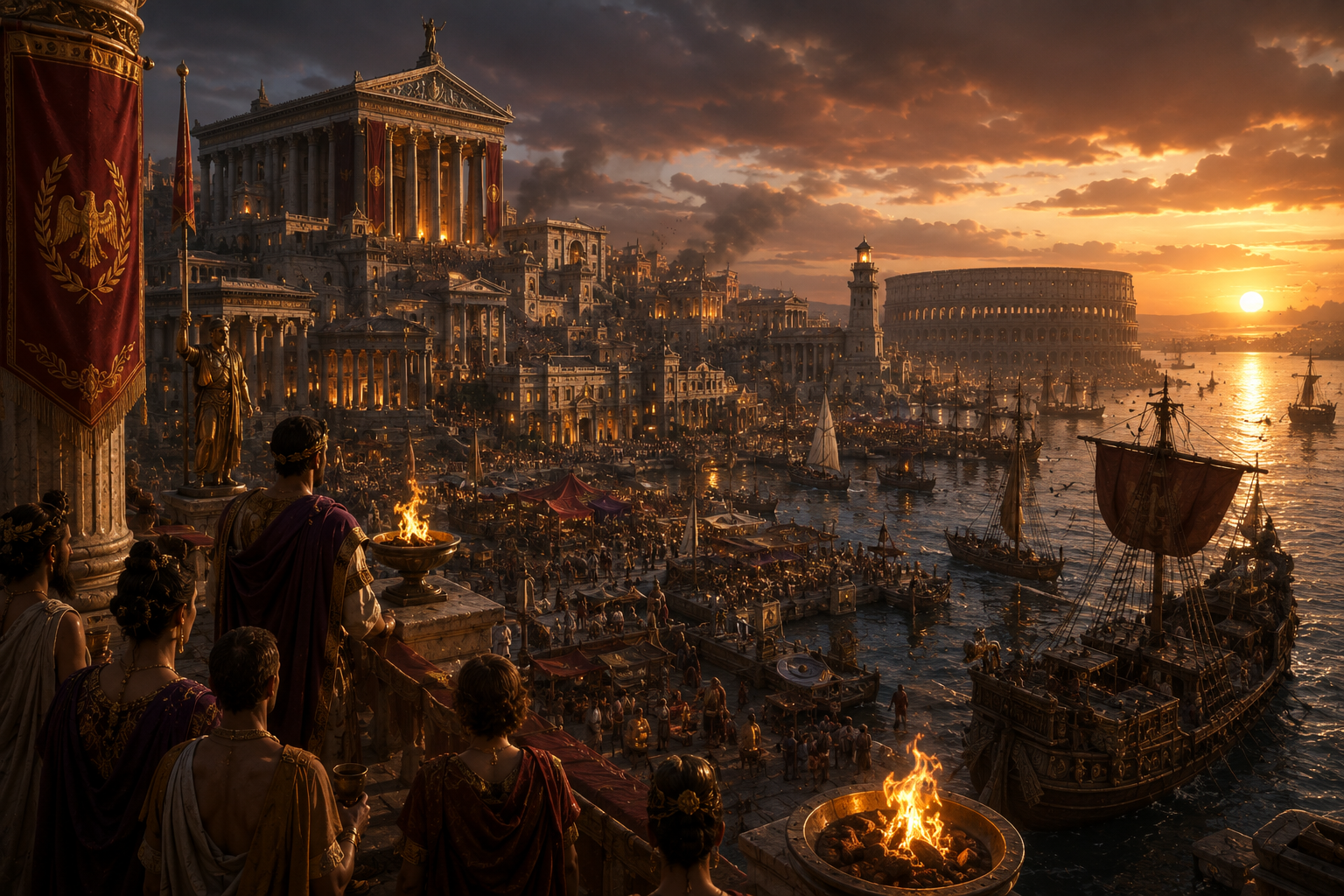
Revelation identifies itself as prophecy while also functioning as an apocalyptic work and a letter addressed to seven churches in the Roman province of Asia. Many scholars date the book near the end of the first century, often during the reign of Domitian, although an earlier date is also argued. Whatever date we choose, its original readers lived within the Roman imperial world. Rome shaped their politics, economics, public life, social relationships, and the religious environment of the cities in which they lived.
Revelation also doesn't invent its strange imagery from nothing. Its visions repeatedly draw upon Daniel, Isaiah, Jeremiah, Ezekiel, Exodus, and other earlier biblical texts. Beasts, horns, kingdoms, plagues, judgment, and Babylon already had histories before John used them. Recognizing those connections matters because Revelation's first readers may have heard echoes that modern readers especially those beginning with an end-times chart can easily miss.
Then Revelation introduces some extraordinary images. Revelation 13 describes beasts associated with authority, worship, coercion, and the ability to participate in economic life. Revelation 17 presents “Babylon the Great” as a wealthy and powerful woman associated with kings, violence, luxury, and corruption. Revelation 18 expands the picture as kings and merchants mourn Babylon's collapse because the economic system from which they benefited has suddenly fallen apart.
Why call this power Babylon when historical Babylon had fallen centuries earlier? That question has led many interpreters to look closely at Rome. Revelation 17's seven mountains, its relationship with kings, its wealth and commerce, and its violence toward God's people all make the Roman imperial setting difficult to ignore. Many scholars therefore understand Babylon, at least at the level of Revelation's first-century context, as imagery directed toward Rome and the imperial order surrounding John's original audience.
That doesn't automatically answer every question about Revelation's meaning beyond the first century. Christians disagree about how its visions relate to later history, future events, and the eventual culmination of God's purposes. Before asking what Revelation predicts about our world, we should first ask what Revelation communicated to people living in theirs.
Revelation 13: Beasts, Worship, and Imperial Allegiance
Revelation 13 introduces two beasts. The first rises from the sea with ten horns and seven heads, imagery that deliberately recalls the beasts and kingdoms of Daniel 7. The second rises from the earth, performs signs, directs worship toward the first beast, and participates in a system in which the “mark of the beast” becomes connected with the ability to buy and sell. Political authority, worship, and economic participation appear together in the vision.
Interpreters have understood these two beasts in different ways. Many see the first beast as representing imperial or political power and the second as supporting or legitimizing that power through religious or ideological means. In Revelation's Roman setting, that interpretation deserves serious consideration, particularly because political authority and religious practice were not neatly separated in the ancient world. But Revelation itself gives us imagery rather than a modern organizational chart, so we should be careful not to make the symbols more precise than the text does.
That distinction matters when we consider the imperial cult. Cities throughout Roman Asia expressed loyalty to Rome and its emperors through temples, festivals, sacrifices, public honors, and other civic practices. Religion, commerce, politics, and social belonging frequently overlapped in ways that can be difficult for modern readers to imagine. Revelation's connection between worship, allegiance, and buying and selling would therefore have been heard by people for whom those parts of life were not necessarily separate categories.
Perhaps that is where Revelation 13 becomes more challenging than simply identifying who the beast represents. The vision asks what happens when power demands allegiance, when worship becomes entangled with that power, and when participation in ordinary life creates pressure to compromise. Starting there allows us to hear something of the challenge faced by Revelation's original audience before asking how or whether those patterns might appear again.
Revelation 17: Babylon the Great and the Kings of the Earth
Revelation 17 introduces another striking image: a woman called “Babylon the Great” sitting on a scarlet beast with seven heads and ten horns. She is dressed in purple and scarlet, adorned with gold and precious stones, and holds a golden cup. She is associated with kings, wealth, sexual immorality, and violence, and John sees her “drunk with the blood of God's holy people.” The picture is deliberately extravagant wealth, power, seduction, worship, and brutality appear together.
The chapter itself provides some interpretation of the imagery. The seven heads represent both seven mountains and seven kings, while the ten horns represent kings who receive authority with the beast. The reference to seven mountains has understandably led many interpreters to see Rome in the background. Rome was famously associated with seven hills, and the wider description of a powerful city exercising influence over kings fits naturally within the first-century Roman setting. Revelation 17:18 adds another important clue: the woman represents “the great city that rules over the kings of the earth.”
But John doesn't simply call the city Rome. He calls it Babylon. That choice brings the history we've already traced into the vision. Babylon had conquered God's people, destroyed Jerusalem, accumulated enormous wealth and power, and eventually fallen. John now reaches backward into that biblical memory to describe a great power in his own world.
That may be more important than trying to assign a precise modern identity to every head, horn, and king. Revelation's Babylon is attractive as well as violent. Kings participate with her. People benefit from her. Her wealth is impressive. Her influence is enormous. The danger of empire in Revelation isn't presented only as something that threatens people from the outside; it can also be something people are drawn toward, participate in, and profit from.
And then Revelation introduces an uncomfortable twist: the beast and the kings eventually turn against Babylon and destroy her. The system begins consuming itself. Whatever conclusions we ultimately reach about the symbolism, John's vision does not portray Babylon's wealth, power, or apparent security as permanent.
Revelation 18: Economics, Luxury, and the Fall of Empire
Revelation 18 announces the fall of Babylon and then does something remarkable: it shows us who mourns when Babylon falls. Kings lament her collapse. Merchants weep because no one buys their cargo anymore. Shipmasters and sailors grieve because the enormous commercial system from which they benefited has suddenly disappeared. Babylon's fall is not mourned by everyone because they loved Babylon; some mourn because Babylon was profitable.
The list of merchandise is striking. John names gold, silver, precious stones, fine linen, spices, wine, oil, livestock, horses, and other signs of extraordinary wealth and consumption. Then, at the end of the list, comes something far more disturbing: “human beings sold as slaves” (Revelation 18:13). People themselves have become part of Babylon's inventory. Whatever else John's symbolism may mean, Revelation deliberately places human lives alongside the commodities being bought and sold.
John isn't creating this imagery from scratch. Revelation 18 draws heavily from earlier prophetic judgments, particularly Jeremiah's words against Babylon and Ezekiel 27's lament over the wealthy trading city of Tyre. Ezekiel also describes merchants, ships, luxury goods, and nations mourning the collapse of a commercial power. John takes imagery his readers may have recognized from Israel's Scriptures and brings it into his vision of Babylon.
That makes Revelation's critique of empire broader than military conquest or political oppression. Babylon is also a place people can prosper from. Its merchants become rich. Its luxury is desirable. Its commercial reach is enormous. And when it collapses, the people who benefited from the system mourn not necessarily because they have lost something good, but because they have lost something valuable to them.
Perhaps that is why Revelation 18 includes the unsettling command, “Come out of her, my people.” The question is no longer simply whether God's people can survive an empire that threatens them. Revelation asks whether they can recognize and separate themselves from, a system they might also be tempted to benefit from.
Reading Revelation as a Critique of Empire: Approaches and Debates
Reading Revelation as a critique of empire begins with its first-century setting. Rather than starting with modern nations or future events, this approach asks how Revelation's images might have spoken to churches living within the Roman imperial world. Its beasts, kings, Babylon imagery, economic warnings, calls to worship, and questions of allegiance can then be read alongside the political, religious, and economic realities those communities already knew.
This approach also recognizes that Revelation builds upon a much older biblical vocabulary. Daniel had already portrayed kingdoms as beasts. Isaiah and Jeremiah had spoken against Babylon. Ezekiel had described the spectacular wealth and collapse of Tyre. Revelation draws these older images into the Roman world, which raises an intriguing possibility: perhaps John is using the memory of earlier empires to help his readers recognize something about the empire surrounding them.
That doesn't require us to conclude that Revelation is only about Rome or has nothing to say about the future. Preterist, futurist, idealist, and historicist approaches understand the relationship between Revelation's first-century setting and its larger meaning differently. Reading Revelation through the lens of empire is one historically informed approach among them, not an interpretive trump card that settles every debate.
What it does give us is a useful order for asking questions. What does the text actually say? What would its images have communicated within the world of its original audience? What conclusions are interpreters drawing from that evidence? And only then, what might those conclusions mean for us? Keeping those questions separate doesn't weaken Revelation's message. It helps us see where the text ends and our interpretation begins.
Why the Theme of Empire Matters for Reading the Bible Today
Once we begin noticing empire in the Bible, some familiar stories take on another dimension. Exodus isn't only happening in Egypt; it is happening among an enslaved people confronting Pharaoh's power. The prophets speak from a world of military threats, political alliances, conquest, and exile. Jesus announces the Kingdom of God while Rome controls Judea. Revelation addresses churches living inside an imperial system of extraordinary political, economic, and military power. Empire isn't merely background scenery in the Bible. It may be one of the recurring forces the biblical story is responding to.
But the story we've traced also resists easy conclusions. Egypt enslaves. Assyria conquers. Babylon destroys Jerusalem. Persia allows exiles to return. Greek culture creates enormous pressure on Jewish identity while the Greek language later helps carry Jewish Scripture and the message about Jesus throughout the Mediterranean world. Rome executes Jesus, yet its roads, cities, and networks become part of the world through which the early Jesus movement spreads. The biblical picture is more complicated than simply declaring every empire evil.
That complexity may help us ask better questions. What kinds of power does Scripture challenge? What happens when political, economic, or religious systems begin demanding ultimate allegiance? When does the pursuit of security become misplaced trust? What happens when people become commodities or when our prosperity depends upon someone else's exploitation? And how does Jesus' announcement of the Kingdom of God change the way we think about greatness, power, service, and allegiance?
Revelation adds perhaps the most uncomfortable question of all. Rather than identifying “Babylon” only with someone else's nation, religion, political system, or future enemy, what happens if we first ask what made Babylon Babylon? What characteristics does Revelation want its readers to recognize? And would we recognize those characteristics if they appeared somewhere we weren't expecting them?
That doesn't give us a neat checklist for identifying empire today, and perhaps that's a good thing. The goal isn't to turn Revelation into a new system for labeling our enemies. It's to become better readers of the biblical story and perhaps more attentive to the ways power, wealth, security, worship, and allegiance can become entangled.
Before asking who Babylon is, perhaps we should ask whether we've learned to recognize what Babylon does.
FAQ
Is every large nation in the Bible considered an “empire”?
No. “Empire” is a modern term historians use to describe powers that extended control over multiple peoples, territories, and cultures. Egypt, Assyria, Babylon, Persia, Greece, and Rome fit that description at different points in the biblical story, while smaller kingdoms such as Israel and Judah generally do not.
But size isn't the only issue the biblical writers care about. The prophets also criticize Israel and Judah for injustice, exploitation, misplaced trust in military power, and failures to protect the vulnerable. That suggests the Bible's concern isn't simply whether a nation is large enough to be called an empire, but how power is being used.
Does seeing Revelation as a critique of the Roman Empire mean it has nothing to say about the future?
No. Recognizing Revelation's Roman context doesn't require us to conclude that its message ended in the first century. Many scholars understand its images of beasts, Babylon, worship, wealth, violence, and allegiance as speaking first to real churches living within the Roman imperial world while also raising questions that may extend beyond it.
Starting with that first-century context doesn't settle the debate about Revelation's future significance. It simply gives us a better starting point: first ask what these images communicated to their original audience, and then ask what patterns or warnings might still be relevant in other times and places.
How is the Kingdom of God different from empires like Rome or Babylon?
Jesus describes a kind of power that looks strikingly different from the domination often associated with ancient empires. He teaches enemy-love, mercy, care for the vulnerable, humility, and service, and tells his disciples that greatness should not look like rulers who “lord it over” others (Mark 10:42–45).
The contrast isn't simply God's Kingdom good, human government bad. It raises a deeper question about what power is for. Where empires can use power to secure, dominate, accumulate, or demand allegiance, Jesus repeatedly redirects power toward service—and places ultimate allegiance with God rather than any human ruler or system.
Are Christians commanded to reject all governments because of the Bible's critique of empire?
No. The New Testament doesn't present faithfulness to Jesus as requiring the rejection of all human government. Passages such as Romans 13 recognize a role for governing authorities, while other texts—including Revelation—can be sharply critical of political power when it becomes oppressive, idolatrous, or demands allegiance that conflicts with faithfulness to God.
That tension is important. The biblical response to political authority isn't simply unquestioning obedience or automatic resistance. Christians are repeatedly faced with questions of discernment: What does faithfulness require here? What is this authority asking of me? Is my allegiance to God being compromised? And am I participating in something that harms others?
Why does it matter that Jesus lived and died under the Roman Empire?
Jesus didn't teach, live, or die outside of a political context. His ministry took place in Roman-controlled Judea, among people who experienced taxation, military occupation, local rulers backed by Rome, and the enormous political and economic influence of the empire. Crucifixion itself was a Roman form of execution, and Jesus was ultimately sentenced to death under the authority of Pontius Pilate.
That context can also change how we hear the New Testament's language about kingship, kingdoms, power, and allegiance. Early Christians proclaimed “Jesus is Lord” in a world where Roman emperors received extraordinary titles, honors, and expressions of loyalty. Understanding that world doesn't automatically make every statement Jesus made a political protest against Rome, but it helps us hear questions and tensions that are easy to miss when the imperial setting disappears from the story.
When Outsiders Became Family: The Conflict That Shaped the Early Church