When Outsiders Became Family: The Conflict That Shaped the Early Church
Imagine belonging to a community whose identity has been shaped by generations of shared history, religious practices, and a deeply held understanding of its relationship with God. Your ancestors preserved their traditions through conquest, exile, foreign occupation, and the constant pressure of surrounding cultures. The practices that distinguish your community are not simply customs you happen to prefer. They represent faithfulness to a covenant, continuity with your ancestors, and participation in a story that stretches back centuries. Now imagine being told that people who have never shared those practices, whose ancestors worshiped different gods, and whose cultures have often stood outside your community are being welcomed as equal participants in the promises you have inherited.
This was part of the extraordinary tension surrounding the emergence of the early Jesus movement. The inclusion of Gentiles was not merely a question of allowing outsiders to attend religious gatherings. It raised fundamental questions about identity, covenant, Scripture, religious obligations, and the boundaries of God's people. The earliest followers of Jesus were Jewish, and their understanding of God's purposes was rooted in Israel's Scriptures. As increasing numbers of Gentiles responded to the message about Jesus, these communities faced a difficult question: Did Gentiles need to become Jewish, adopting practices such as circumcision and observance of the Mosaic law, to belong fully to the people of God?
Much of Paul's ministry unfolded within this controversy. His letters reveal a movement attempting to understand the implications of Gentile inclusion while navigating disagreements that could fracture its communities. When we read Paul's arguments about law, faith, freedom, and life in the Spirit without appreciating this background, we risk treating his words as abstract theological statements disconnected from the people and conflicts that prompted them. Recovering that historical setting allows us to see the New Testament not merely as a collection of religious teachings, but as the record of communities struggling to understand what God was doing among them.
A People Shaped by Covenant and History
To appreciate the controversy, we need to understand why Jewish identity mattered so deeply. Israel's Scriptures tell the story of a people whose relationship with God was understood through covenant, beginning with the promises made to Abraham and continuing through the history of Israel. Circumcision became a sign of the covenant in Genesis 17, while the Torah provided instructions shaping worship, communal life, justice, purity, and relationships with surrounding nations. These practices were not merely arbitrary rules. They helped express what it meant to belong to a people who understood themselves as called to live in a distinctive relationship with God.
That identity had been tested repeatedly. The destruction of Jerusalem, the Babylonian exile, the return from exile, and subsequent periods of foreign domination profoundly shaped Jewish life. By the first century, Jewish communities existed both in Judea and throughout the Mediterranean world, often surrounded by populations whose religious practices and cultural expectations differed from their own. Practices such as Sabbath observance, dietary distinctions, and circumcision could serve as visible expressions of faithfulness and continuity. For many Jews, maintaining these practices was closely connected to preserving the identity of their community.
We should be careful, however, not to imagine first-century Judaism as a single, uniform religious system. Jewish communities differed in their interpretations of Scripture, approaches to the law, relationships with Gentiles, and expectations about God's future purposes. The Pharisees, Sadducees, Essenes, and other groups represented different perspectives within a diverse religious world. Jews also interacted with Gentiles in commerce, civic life, and sometimes religious settings. The controversy surrounding Gentile inclusion did not emerge because every Jewish person rejected outsiders. It arose because the question of how Gentiles could participate in Israel's covenant promises had profound implications for Jewish identity and religious practice.
Were Gentiles Always Excluded From God's Purposes?
It would be misleading to suggest that the possibility of Gentile participation appeared for the first time with Paul or the early church. Israel's Scriptures already contained significant expectations concerning the nations. In Genesis 12:3, the promise to Abraham includes the prospect that all the families of the earth will be blessed through him. Isaiah 49:6 describes God's servant as a light to the nations, while Isaiah 56:6–7 envisions foreigners who join themselves to the Lord participating in worship. These passages demonstrate that the relationship between Israel and the nations was already part of the biblical story.
Yet the existence of these promises did not settle every question about how Gentiles would participate. Would they need to adopt Jewish covenant practices? What relationship would they have to the Mosaic law? Would they be incorporated into Israel through conversion, or could they participate while remaining Gentiles? Different Jewish interpretations and expectations could lead to different answers. The emergence of Gentile believers in the Jesus movement brought these questions into immediate practical focus.
This distinction is essential. Paul was not attempting to persuade Jewish people that God had suddenly developed an interest in the nations. Rather, he was arguing about how God's promises were being fulfilled through Jesus and what that fulfillment meant for Gentiles. His claim that Gentiles could belong through faith in Christ without first becoming Jewish challenged particular assumptions about covenant membership. The controversy was therefore not simply about whether outsiders could be welcomed. It concerned the terms on which they belonged and the implications for the identity of the entire community.
When the Boundaries Began to Change
The book of Acts portrays the expansion of the Jesus movement beyond its original Jewish setting as a significant development. In Acts 10, Peter encounters Cornelius, a Roman centurion described as devout and God-fearing. The narrative includes Peter's vision involving animals traditionally considered unclean and his subsequent visit to Cornelius's household. Peter comes to understand that he should not regard another person as common or unclean, and the Spirit's activity among Cornelius's household becomes evidence that Gentiles are being received by God.
The significance of the episode becomes especially clear in Acts 11, where Peter faces criticism for entering the home of uncircumcised men and eating with them. Notice what provokes the objection. It is not merely that Peter spoke to Gentiles or told them about Jesus. The concern involves entering their household and sharing a meal. The controversy had moved from theological possibility into ordinary human relationships. People who had previously been separated by important religious and social boundaries were now being brought together in ways that challenged established expectations.
Acts presents Peter's experience as a turning point, but it does not suggest that every question was immediately resolved. As the movement expanded, disagreements continued over the place of Gentiles and the obligations they should observe. The narrative in Acts 15 describes a major discussion in Jerusalem concerning whether Gentile believers needed to be circumcised and instructed to keep the law of Moses. The participants were attempting to determine how the growing Gentile presence should be understood within the purposes of God.

Imagine the Human Difficulty of That Change
Modern readers can easily underestimate the emotional and social weight of these developments. We are accustomed to encountering the phrase "Jew and Gentile" as a familiar biblical distinction, often without considering the generations of history behind it. Yet religious identity is rarely confined to private belief. It becomes intertwined with family traditions, communal memory, food, festivals, marriage, social relationships, and assumptions about who belongs. Changes to those boundaries can feel like changes to the community's very identity.
Consider, as a limited modern comparison, the experience of communities emerging from generations of racial segregation. A legal declaration of equality does not automatically erase inherited attitudes, social divisions, or discomfort with sharing institutions and leadership. People may formally acknowledge equal standing while continuing to behave according to older patterns of separation. The historical circumstances are different, and the Jewish–Gentile controversy should not be equated with modern racial segregation. Nevertheless, the comparison helps illustrate an important distinction: recognizing equality in principle and living together as equals are not necessarily the same experience.
We can observe similar tensions when communities with long histories of religious rivalry are asked to cooperate or share institutional life. In Northern Ireland, for example, Catholic and Protestant identities have been intertwined with historical, political, and communal divisions that extend beyond differences in doctrine. Such comparisons must be handled carefully because every historical conflict has its own causes and complexities. Their value lies in helping us recognize how deeply inherited identities can shape human relationships, even when people are presented with reasons to reconsider established boundaries.
The early Jesus movement faced its own distinctive version of this difficulty. Gentiles were not merely being invited to observe Jewish believers from a distance. They were being recognized as participants in the same community through Christ. That recognition raised practical questions about meals, fellowship, religious obligations, and mutual acceptance. The theological claim was profound, but its consequences became visible in the ordinary experience of living together.
The Dinner Table That Exposed the Conflict
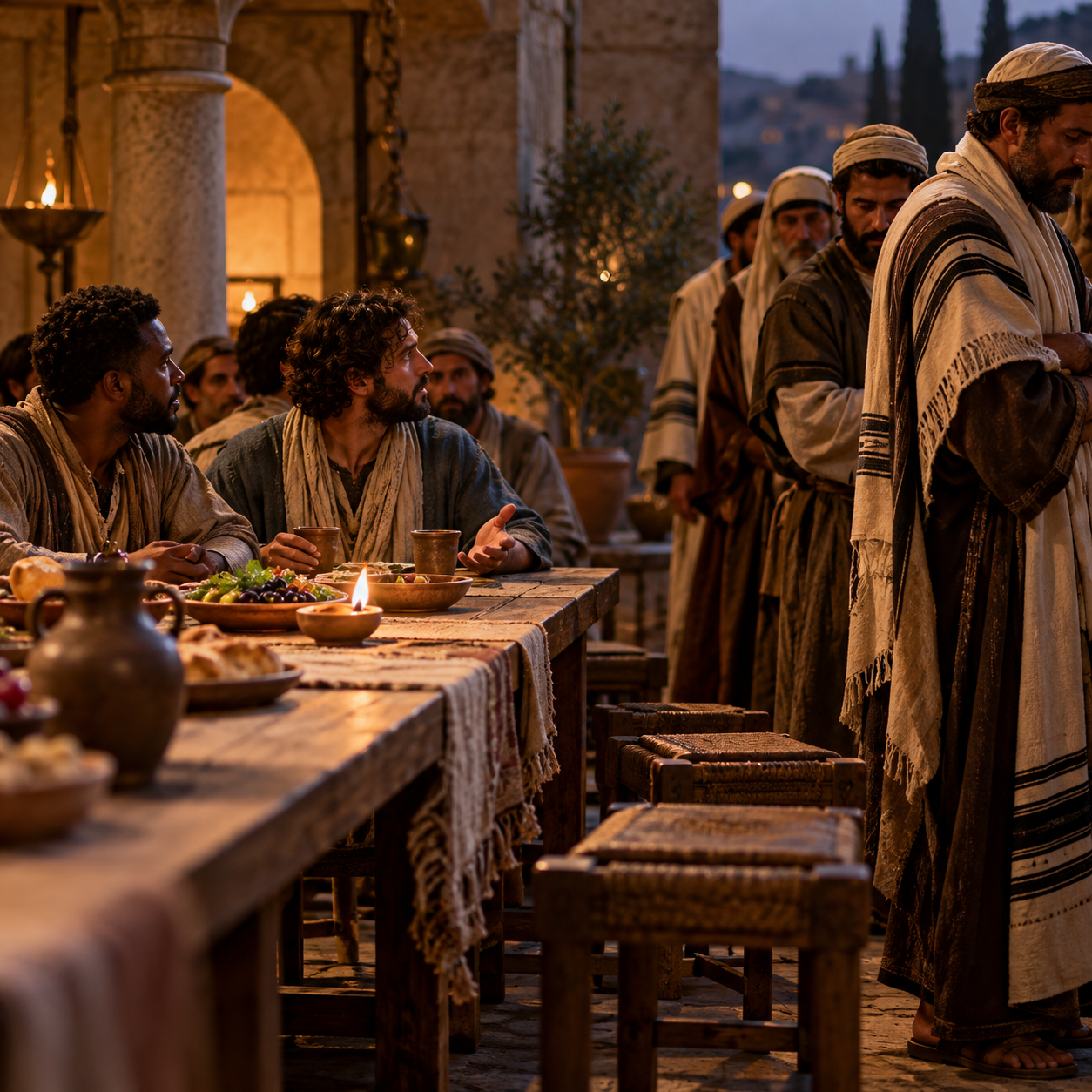
One of the clearest windows into this tension appears in Galatians 2:11–14. Paul recounts an incident in Antioch involving Peter, whom he calls Cephas. According to Paul's account, Peter had been eating with Gentile believers. However, when certain people associated with James arrived, Peter withdrew from those shared meals because he feared those identified with the circumcision group. Other Jewish believers followed his example, and even Barnabas became involved in the withdrawal.
It is difficult to overstate the significance of this episode. Sharing meals was an important expression of social relationships and communal belonging. The text does not provide every detail about the meals, the precise practices involved, or the motivations of those who arrived from James. Scholars continue to debate aspects of the incident, including the relationship between dietary observance and the broader controversy over Gentile inclusion. Nevertheless, Paul's account makes clear that he regarded Peter's behavior as inconsistent with the truth of the gospel.
Imagine the experience from the perspective of the Gentile believers. They had been sharing meals with Peter, a respected figure within the movement and one of Jesus' closest disciples. Their participation at the table communicated a degree of acceptance and fellowship. Then, when certain other people arrived, Peter withdrew. Whatever his personal intentions, the visible consequence was that Gentile believers were no longer being treated in the same way.
This is where the theological controversy becomes deeply human. The question was no longer simply whether Gentiles could be included in God's promises. It was whether Jewish and Gentile believers could actually share life together without one group being treated as religiously inferior or required to adopt the identity of the other.
Why Did Paul Confront Peter?
Paul tells the Galatians that he opposed Peter publicly because Peter's conduct was not consistent with the truth of the gospel. In Galatians 2:14, Paul asks why Peter, who had been living in a manner associated with Gentile fellowship, would now effectively compel Gentiles to live like Jews. The question exposes the contradiction Paul believed was present in Peter's behavior. If Gentiles were genuinely accepted through Christ, withdrawing from fellowship in response to pressure from those emphasizing circumcision communicated something different.
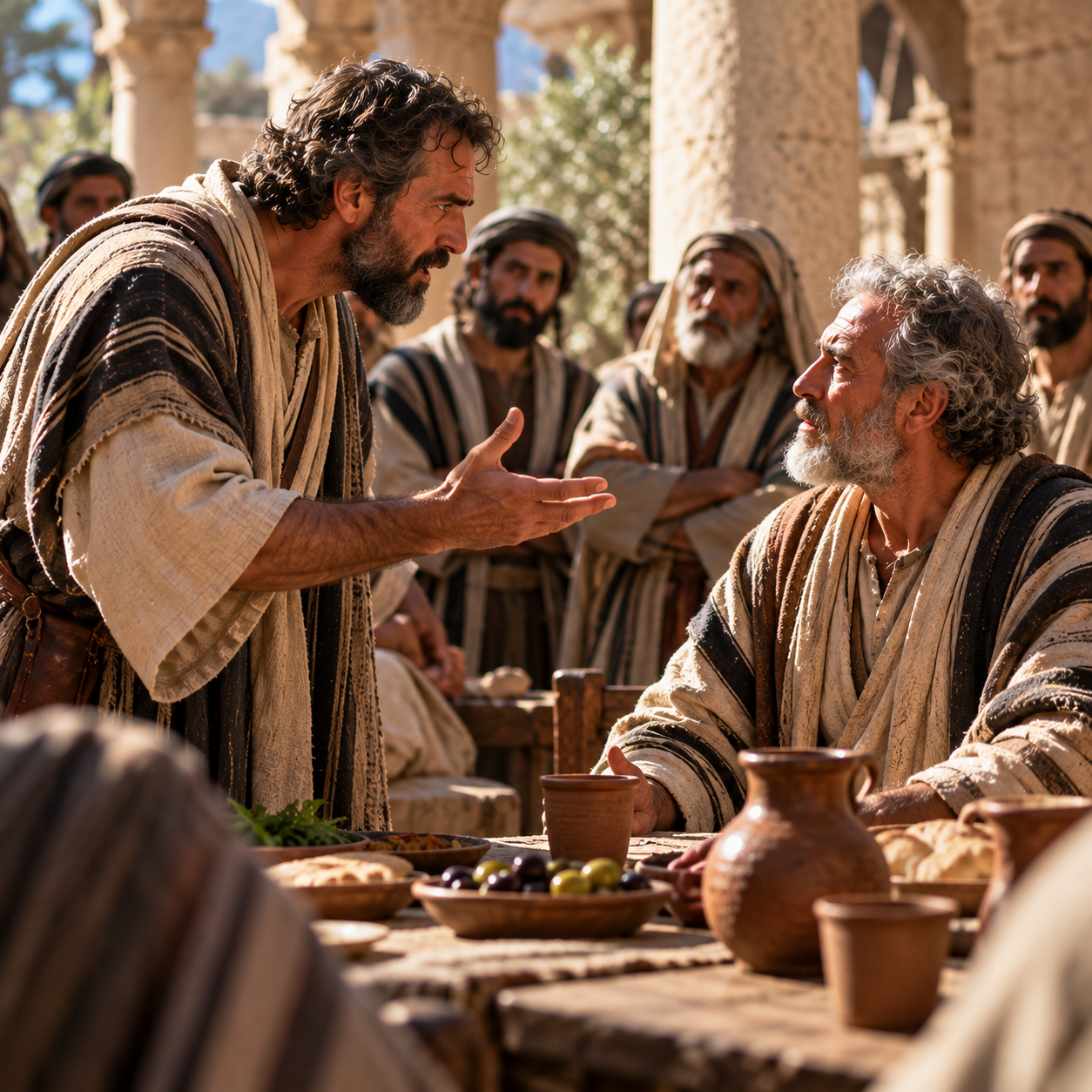
Paul's confrontation was not simply a personal disagreement between two prominent leaders. It concerned the implications of the gospel for the identity and relationships of the community. Peter's behavior had influenced others, including Barnabas, demonstrating how the actions of respected leaders could reinforce social divisions. Paul understood the incident as serious enough to challenge openly because the practical treatment of Gentile believers was undermining the theological position he defended.
This episode also complicates any simplistic picture of the early church as a community that immediately achieved unity after recognizing Gentile inclusion. Even Peter, who is portrayed in Acts as having participated in a significant encounter with Gentile believers, could struggle with the social consequences of that inclusion. The movement was learning to live with implications that were not always easy to accept or consistently practice. Agreement about a theological principle did not automatically eliminate the influence of inherited expectations.
The Jerusalem Meeting and the Question of Belonging
Acts 15 provides another important account of the controversy. According to the narrative, some individuals from Judea were teaching that Gentile believers needed to be circumcised according to the custom of Moses to be saved. Paul and Barnabas disputed this teaching, and the matter was brought before the apostles and elders in Jerusalem. The discussion involved Peter, James, and others as they considered what God had been doing among Gentiles and how the Scriptures should inform their response.
The resulting decision, as presented in Acts, did not require Gentile believers to undergo circumcision or adopt the full obligations of the Mosaic law. Instead, the letter sent to Gentile communities included a limited set of instructions concerning idolatry, sexual immorality, blood, and food associated with strangled animals. Scholars debate the precise relationship of these requirements to Jewish law and the practical circumstances of mixed communities. One important possibility is that they were intended, at least in part, to make fellowship between Jewish and Gentile believers possible while maintaining certain boundaries.
We should also recognize that the relationship between Paul's account in Galatians and the narrative in Acts is historically complex. Scholars disagree about how the Jerusalem visit described in Galatians 2 relates chronologically to the meeting in Acts 15. The two accounts have different emphases, and they should not be combined into a seamless reconstruction without acknowledging those difficulties. What both sources demonstrate, however, is that Gentile inclusion generated significant controversy requiring serious engagement from the movement's leaders.
The controversy was not resolved simply by announcing that everyone should get along. It required examining Scripture, considering the significance of God's activity among Gentiles, and deciding how communities with different religious backgrounds could share a common identity. These were difficult questions because they touched practices and convictions that had shaped Jewish life for generations.
Paul Was Doing More Than Explaining Theology
When we read Paul's letters through this historical setting, we begin to recognize how frequently his theological arguments address practical problems within communities. His discussions of law, faith, freedom, and the Spirit were not detached philosophical exercises. They were part of his effort to explain the implications of the gospel for people attempting to live together across established boundaries. The letters reveal a teacher, missionary, and sometimes forceful mediator addressing communities whose disagreements threatened their relationships and shared identity.
In Galatians, Paul argues that Gentiles are not required to adopt circumcision as the basis for belonging to God's people. In Romans, he explores the relationship between Israel, the nations, faith, and God's faithfulness to the promises. Romans 14–15 also addresses disagreements involving food, observance, and mutual acceptance, although the precise identities and circumstances of the groups involved remain debated. In 1 Corinthians, Paul confronts divisions, status competition, and practices that undermine the shared life of the community. Not every conflict in these letters can be reduced to Jewish–Gentile tensions, but questions about belonging and communal relationships recur throughout his ministry.
Paul was certainly a theologian, but he was not merely producing theological material for future generations to study. He was writing to actual people whose circumstances required instruction, correction, encouragement, and sometimes confrontation. Understanding those circumstances helps us recognize why particular arguments appear where they do and why Paul sometimes speaks with such urgency.
How This Changes the Way We Read the Fruit of the Spirit
Consider Paul's discussion of the fruit of the Spirit in Galatians 5:22–23. These verses are frequently presented as a list of nine qualities individual Christians should cultivate. Love, joy, peace, patience, kindness, generosity, faithfulness, gentleness, and self-control become characteristics we are encouraged to develop through personal spiritual discipline. While such reflection may be worthwhile, the original context reveals a much larger concern.
Immediately before discussing the fruit of the Spirit, Paul warns the Galatians against using their freedom as an opportunity for the flesh and urges them to serve one another through love. In Galatians 5:15, he cautions that their behavior toward one another risks becoming mutually destructive. His list of the works of the flesh includes hostility, strife, jealousy, anger, rivalries, dissensions, factions, and envy. These are behaviors that damage relationships and fracture communities.
Against this background, the fruit of the Spirit describes qualities that directly challenge those destructive patterns. Patience, kindness, gentleness, and self-control become especially significant when people are navigating disagreement, competing expectations, and tensions over identity and belonging. Paul is not merely offering an abstract description of admirable personal characteristics. He is explaining the kind of life that should emerge among people who understand themselves as living by the Spirit.
The Jewish–Gentile controversy forms an essential part of the larger argument in Galatians, although we should not assume that every conflict described in chapter 5 arose directly from ethnic or cultural differences. Paul's concerns extend to the broader patterns of behavior that can destroy communal life. Nevertheless, understanding the controversy helps us appreciate why freedom, love, and the Spirit were so closely connected in his teaching.
Did Gentile Inclusion Mean Jewish Identity No Longer Mattered?
One of the dangers in telling this story is portraying the inclusion of Gentiles as though Christianity simply replaced Judaism or rendered Jewish identity meaningless. Such a reading fails to appreciate both the Jewish origins of the Jesus movement and the complexity of Paul's own arguments. Paul was Jewish, as were Peter, James, and the earliest disciples. Their Scriptures, worship, and understanding of God's promises emerged from Israel's history. The debate about Gentile inclusion took place within that setting.
In Romans 9–11, Paul wrestles extensively with the relationship between Israel and God's promises. He does not treat Israel's history as irrelevant or casually dismiss the significance of Jewish identity. In Romans 11, he uses the image of an olive tree to describe Gentiles being grafted into a cultivated tree and warns Gentile believers against arrogance toward the branches. The imagery challenges any assumption that Gentile inclusion provides grounds for superiority over Jewish people.
Paul's argument was not that Jewish identity needed to disappear, but that Gentiles did not need to become Jewish to participate in the promises fulfilled through Christ. This distinction is fundamental. The controversy concerned how different peoples could belong together without making one group's covenant practices the required condition for the other's acceptance. Recognizing this helps prevent the story from becoming a simplistic narrative in which Judaism represents exclusion and Christianity represents inclusion. The historical reality was considerably more complicated.
The Difficult Work of Becoming One Community
It is easy to celebrate the idea of unity when it remains an abstract theological principle. It becomes more difficult when unity requires people to reconsider inherited assumptions, share authority, change familiar practices, and recognize others as equal participants. The early Jesus movement was confronting these challenges in real time. Jewish believers were being asked to reconsider what Gentile participation meant for practices they associated with covenant faithfulness. Gentile believers were entering a movement whose Scriptures, central figures, and understanding of God were rooted in Israel's history.
Neither group entered this relationship without cultural expectations or inherited assumptions. The New Testament preserves evidence of disagreements, misunderstandings, and behavior that threatened the emerging communities. Yet these tensions were not incidental distractions from the theological story. They were part of the circumstances through which the movement attempted to understand the implications of its message.
The Antioch incident illustrates this difficulty with unusual clarity. Peter's withdrawal from shared meals demonstrated that recognizing Gentile inclusion in principle did not guarantee consistent acceptance in practice. Paul's confrontation revealed that he considered the social consequences of the gospel inseparable from its theological claims. The question of who belonged could not be answered only through statements of belief. It also had to be answered through the way people treated one another.
Why This Story Still Matters
Modern Christians encounter Paul's letters from a remarkably different historical position. Christianity eventually became a predominantly Gentile movement, and many believers today have little awareness of the controversies surrounding Gentile participation in its earliest communities. We read Paul's letters as people who already assume Gentiles belong, often without recognizing how disruptive that conclusion was within the first-century setting. The historical controversy can disappear from view precisely because its outcome has become so familiar.
Recovering this context does not mean that every instruction Paul gave the Galatians should be transferred directly into contemporary religious life. We are not the original audience, and our circumstances differ significantly from theirs. The application of Paul's words belonged first to the communities he addressed. Our responsibility as later readers is to understand their story before considering what it may reveal about our own assumptions, relationships, and interpretations.
Yet the historical investigation raises questions that are difficult to ignore. What happens when a community discovers that its understanding of belonging may have been too narrow? How do people respond when longstanding traditions are challenged by new developments they believe God is bringing about? What happens when theological convictions about equality are not reflected in ordinary relationships? These questions emerge naturally from the story without requiring us to pretend that Paul was writing directly to our modern circumstances.
Perhaps the most revealing aspect of this history is that the early church's struggle was not simply about whether outsiders could enter. It was about what happened after they were recognized as belonging. Could people with different histories, practices, and expectations share a common life without requiring one group to become the other? Could religious convictions produce relationships characterized by love rather than rivalry? Could leaders recognize when their own behavior contradicted the message they proclaimed?
These were not theoretical questions for Paul and the communities he served. They were the difficult realities of a movement attempting to understand the implications of the gospel across deeply rooted boundaries.
Most Christians today are Gentiles reading letters written by a Jewish apostle who devoted much of his ministry to defending their inclusion in God's people. Perhaps one of the most important things we can do before interpreting those letters is to remember just how extraordinary, controversial, and deeply human that story was.
And perhaps the question worth carrying forward is this:
What happens when God's invitation turns out to be larger than the boundaries people have constructed around it?
Questions Worth Wrestling With
-
Why is it so easy for modern Christians to overlook how controversial Gentile inclusion was within the early Jesus movement?
-
How did circumcision, dietary practices, and the Mosaic law shape Jewish identity in ways modern readers may struggle to appreciate?
-
What does Peter's withdrawal from shared meals in Antioch reveal about the difference between accepting someone theologically and treating them as an equal participant?
-
How might our understanding of Paul's letters change if we recognized how much of his ministry involved addressing real conflicts within developing communities?
-
Why is it important to distinguish Paul's argument for Gentile inclusion from the mistaken idea that Jewish identity had become irrelevant?
-
How does the historical controversy surrounding Gentile inclusion illuminate Paul's discussions of freedom, love, and the fruit of the Spirit?
-
What assumptions about belonging might we overlook when we read ancient texts primarily through the circumstances of our own communities?
-
What happens when people recognize that others belong equally in a community, but their inherited traditions and behavior have not yet caught up with that recognition?
SEO Information
SEO Title: When Outsiders Became Family: Jews and Gentiles in the Early Church
Meta Description: Why did Gentile inclusion cause conflict in the early church? Explore Paul, Peter, Antioch, Jewish identity, and the tensions that shaped the New Testament.
Suggested URL Slug: jews-gentiles-conflict-early-church
Primary Keyword: Jews and Gentiles in the early church
Secondary Keywords: Gentile inclusion early Christianity, Paul and Gentiles, Galatians 2 Antioch, Jewish Gentile conflict early church, Acts 15 Jerusalem council, early church history
Suggested Category: Biblical History & Context
Suggested Internal Links
-
Why Did Paul Teach About the Fruit of the Spirit? — Explores how Paul's teaching about life in the Spirit addressed the relationships and conflicts of the Galatian communities.
-
Why Is Historical Context Important When Reading the Bible? — Explains why the original audience and circumstances matter for interpretation.
-
What Is Transformation? — Examines how the New Testament describes changes in understanding, character, and relationships.
-
What Is Intellectual Humility? — Considers the willingness to reconsider inherited assumptions and recognize the limits of our understanding.
-
How Did Jesus Teach His Disciples? — Connects the development of the earliest followers of Jesus with the challenges they later encountered in the expanding movement.

The Problem With Certainty