The Problem With Certainty
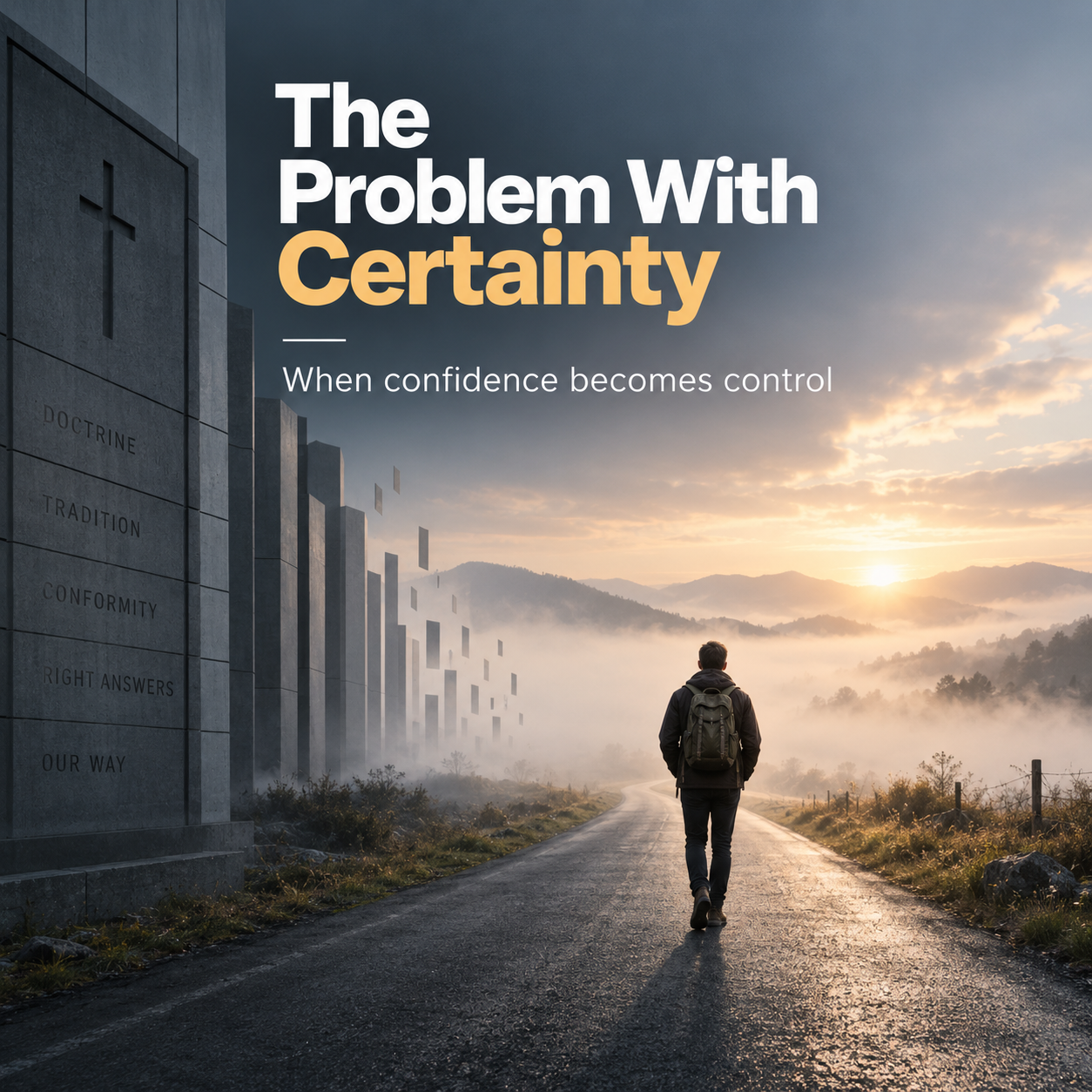
Certainty feels good. It gives us solid ground, tells us where we stand, and removes the need to keep investigating something we believe we have already settled. There are plenty of things we should be certain about. The earth orbits the sun. Gravity works whether we believe in it or not. We do not need to wake up every morning and reconsider everything we learned yesterday.
The problem is that there is an important difference between something being certain and feeling certain about something. Those two things are remarkably easy to confuse. We can feel absolutely convinced that we remember a conversation correctly, that we understand someone else's motives, or that our interpretation of an event is the only reasonable one. We can even feel certain about things we later discover were wrong. So perhaps the first question worth asking is not simply, “How certain am I?” but, “What exactly is my certainty based on?”
Why We Like Certainty
Human beings have good reasons for wanting certainty. Uncertainty requires effort. If every decision required us to reopen every previous conclusion, life would become exhausting. We depend on assumptions, habits, experience, and previously learned information simply to function. Our minds are constantly predicting what will happen next, and most of the time that is incredibly useful.
But the same efficiency that helps us navigate life can also make us resistant to information that challenges what we already believe. Once we have reached a conclusion, we naturally notice evidence that confirms it. We interpret new information through what we already think we know. We remember some things more clearly than others, and emotion, experience, relationships, fear, loyalty, and familiarity all influence how we understand what we see.
We call part of this confirmation bias, but you do not need to understand the psychology to recognize the experience. You believe something, you begin noticing evidence that supports it, that evidence makes you more confident, and greater confidence makes contradictory evidence easier to dismiss. Eventually, you are no longer asking whether you are right. You are collecting reasons why you are right. Because certainty feels strong, doubt can begin to feel like weakness.
Curiosity Lives Somewhere Else
Curiosity requires a different posture. It exists in the space between what we know and what we do not know yet. That space can be uncomfortable because uncertainty means the answer has not been settled, but uncertainty can also become an invitation. There is something here I do not understand. There is something I have not considered. There may be another way of seeing this.
That changes uncertainty from a threat into a possibility. Instead of asking, “How quickly can I make this uncertainty disappear?” we can ask, “What might I discover if I stay with the question for a while?” That is one of the dangers of certainty: certainty closes the case, while curiosity keeps the investigation open.
That does not mean every question has to remain unanswered forever. Sometimes the investigation really is over. But there is a difference between reaching a conclusion after careful investigation and declaring the investigation finished because uncertainty makes us uncomfortable.
Then We Bring Certainty Into Faith
This becomes especially interesting when certainty enters faith. Christians frequently associate strong faith with being certain. We know what we believe. We stand firm. We do not doubt. We do not waver. Those can all describe healthy conviction, but somewhere along the way confidence in God can become confused with certainty about everything we believe about God.
Those are not the same thing. We can be confident in God's love while remaining humble about our interpretation of a difficult passage. We can trust God while admitting we do not understand exactly what God is doing. We can believe something deeply while acknowledging that other sincere Christians have reached a different conclusion. Faith does not require us to pretend that every question has been answered.
Hebrews 11 famously describes faith as assurance concerning what we hope for and conviction regarding what we do not see. That is interesting because the unseen remains unseen. Faith does not make every uncertainty disappear. Faith exists in the middle of it. Perhaps faith is not the elimination of uncertainty as much as learning where to place our trust when certainty is unavailable.
Emmaus and the Problem of Expectations
The road to Emmaus may be one of the best pictures of this problem. Two disciples are walking away from Jerusalem after the crucifixion. Jesus joins them, but they do not recognize him, and they begin explaining what has happened. They had believed Jesus was the one who would redeem Israel, but then he was killed. Their expectations and reality no longer fit together.
Their words say everything: “We had hoped…” They had a framework for what redemption was supposed to look like. Jesus was supposed to do something, but something completely different happened, so from their perspective the story had failed.
The irony is extraordinary. Jesus is walking beside them while they explain to Jesus why Jesus has failed to meet their expectations. Their problem is not simply that they lack information. Their existing interpretation of the information prevents them from seeing what has actually happened. They knew what Messiah was supposed to do, and Jesus did not fit the expectation.
Rather than condemning them for getting it wrong, Jesus walks with them. He opens the story again. He reframes what they thought they understood. Their certainty has to become pliable before they can see what has been in front of them all along. That feels remarkably similar to the journey of faith.
A Faith That Can Still Be Formed
There is a difference between conviction and rigidity. Conviction says, “This is what I believe.” Rigidity says, “There is nothing left for me to learn.” If faith is formative, then we should probably expect to be changed by it.
I hope I do not understand everything exactly the same way five years from now that I understand it today. Not because truth changes, but because I am still learning. I encounter people I have not encountered before. I discover context I did not know. I notice assumptions I had never questioned. I learn that something I thought came directly from Scripture may have come partly from tradition. I realize that a conclusion I once considered obvious depends upon assumptions I had never examined.
That does not make faith weaker. It may make faith more honest. Being open to revision does not mean believing nothing. It means acknowledging that I am capable of being wrong even when I feel certain.
When Certainty Becomes a System
The problem becomes larger when certainty moves from individuals into institutions. A person might say, “I believe this is the wisest way to lead a church.” A system can say, “This is the biblical model of leadership.” A person might say, “I prefer this kind of worship service.” A system can say, “This is what faithful worship looks like.” A person might say, “This is how I currently understand salvation.” A system can say, “These are the people who are in, and these are the people who are out.”
The same thing can happen with leadership. A person might say, “I trust these leaders.” A system can say, “These leaders have God-given authority, therefore faithful people should align with them.” That change matters because once a conclusion has been elevated from an interpretation to a biblical certainty, disagreement changes meaning. It is no longer simply disagreement. It can begin to look like rebellion, questioning can begin to look like disloyalty, and a different interpretation can begin to look like spiritual danger. At that point, certainty has acquired power.
The Leadership Example
Leadership is an obvious place to see this. Churches (members) choose leaders. Committees nominate people. Members vote. Elders appoint other elders. Organizations hire pastors. People choose people. That does not mean God is absent from the process, but sometimes we move very quickly from “We selected these leaders” to “God placed these leaders over us.”
Those are not necessarily identical statements. Human beings can choose well, and we can choose poorly. We can appoint wise people and foolish people, humble people and controlling people, people of great integrity and people who turn out to be cheats and liars. Sometimes those failures eventually become obvious, but the fact that someone was allowed to occupy a leadership position does not necessarily mean God personally selected that individual or endorsed everything that individual did.
God allows human beings to make real choices. We are not puppets. If human freedom means anything, it must include the possibility that communities sometimes make bad decisions. So perhaps the healthier posture is not, “God placed these leaders here, therefore we must align with them,” but, “We chose these leaders. We hope we chose wisely. We should continue evaluating their leadership by its character, fruit, wisdom, humility, and faithfulness.”
That leaves room for accountability, and it also leaves room for questions. But there is another side of the equation that is easier to overlook. Sometimes followers prefer certainty too. We trust leaders partly because trust is easier than investigation. Someone else has studied the question. Someone else has reached the conclusion. Someone else carries the responsibility.
Questioning can also be costly. What if I speak up and I am wrong? What if people think I am difficult? What if asking the question damages a relationship? What if I am the only person who sees the problem? Silence can feel safer. Alignment can feel safer. Certainty can feel safer.
So leadership systems can be reinforced from both directions. Leaders benefit from trust, and followers benefit from not having to continually investigate everything. The danger comes when our human decision to appoint leaders becomes transformed into certainty that God appointed them, and that certainty is then used to protect their authority from examination.
Now the question is no longer, “Is this leadership wise?” It becomes, “Why are you resisting the people God placed over you?” The conclusion protects itself, and the structure can begin to treat questioning the structure as evidence that the questioner is the problem.
When Familiarity Becomes Biblical
Worship provides another example. A church may worship in essentially the same format for decades: opening song, welcome, announcements, more music, communion, sermon, invitation, closing prayer. There is nothing inherently wrong with any of that.
The problem begins when familiarity becomes authority. “This is what our church does” slowly becomes “This is what church looks like,” then “This is what worship looks like,” and eventually, “This is the biblical way to worship.”
Nobody necessarily decided to make that transition. It simply happened. Habit became tradition, tradition became expectation, and expectation began to feel like truth. Because everyone is familiar with the pattern, few people think to investigate it.
We stop asking questions such as: Why do we do this? What is this practice forming in us? What did Christian gathering look like at other times and places? Could there be other faithful ways of doing this? Familiarity can quietly kill wonder, not because the familiar is bad, but because once something becomes certain, we stop looking at it.
The Boundaries We Draw
Churches also develop certainty about who belongs, who is faithful, who is orthodox, who is saved, and who is outside. Those are serious questions, and they deserve serious thought. But the seriousness of the question should probably make us more humble, not less.
Our conclusions are still interpretations. They may be careful interpretations. They may be rooted in Scripture. They may have centuries of tradition behind them. But they are still conclusions reached by human beings trying to understand God. That should give us some pause before casually declaring exactly where God has drawn every boundary.
There is an extraordinary amount of confidence required to say, “These are the people who make it, and these are the people who do not.” Especially when Christians who all claim Scripture as their authority have drawn those boundaries differently throughout history.
The question is not whether beliefs matter. They do. The question is whether we can distinguish between trusting what we believe to be true and imagining ourselves incapable of misunderstanding it.
Who Has Authority—and What Kind?
The same problem appears when churches talk about authority. We often say, “These people have authority.” That statement immediately raises another question: authority to do what?
Authority to teach? Authority to organize? Authority to make certain decisions for the community? Authority to manage finances? Authority to provide pastoral care? Authority to define another person's conscience? Authority to demand agreement? Authority to determine whether someone's questions are legitimate?
Those are very different kinds of authority, but certainty has a tendency to collapse them together. “We have leaders” can quietly become “Those leaders possess spiritual authority.” Then “Spiritual authority requires alignment.” Then “Disagreement with leadership threatens unity.” Eventually, the person asking the question may become the problem that needs to be solved.
Again, none of this requires malicious people. That is what makes it worth examining. Good people can participate in systems they have never thought to question. Leaders can sincerely believe they are protecting the church. Members can sincerely believe submission is faithfulness. Everyone can be acting from conviction, and everyone can still be wrong.
A Question Churches Should Be Able to Survive
Perhaps one of the simplest tests of certainty is what happens when someone asks a sincere question. What beliefs in our church are genuinely central to the Christian story? Which conclusions have become unquestionable mainly because they are familiar? Which structures do we call biblical when they may actually represent one faithful interpretation among several?
What happens when someone asks a question about leadership, authority, worship, doctrine, or belonging? Do we investigate the question, or do we diagnose the person asking it?
That may tell us something important. A healthy community should be capable of surviving questions. A system dependent upon certainty may experience the question itself as a threat.
The Alternative Is Not Doubt
None of this requires us to become suspicious of everything. The alternative to unhealthy certainty is not endless doubt. It is humility.
It is the ability to say, “This is what I believe, and I have reasons for believing it. This is where I currently land. I believe this strongly.” And also, “I am still capable of learning something.”
That posture does not abandon conviction. It simply refuses to confuse conviction with infallibility. There are things we can know. There are things we can trust. There are things worth building our lives around. But there are also interpretations, traditions, assumptions, habits, structures, and inherited conclusions that deserve to remain open to examination.
The difficulty is learning the difference.
From Anxiety to Curiosity
Maybe the most useful change is simply learning a different response when something challenges what we believe. Instead of immediately defending the conclusion, we can become curious.
Why does this bother me? What assumption is being challenged? Where did I learn this? Have I ever actually investigated it? Is this explicitly in the text, or have I always heard the text explained this way? What evidence would cause me to reconsider my conclusion? What would happen if I were wrong?
Those are uncomfortable questions, but they are also deeply freeing questions. They turn uncertainty from an enemy into a teacher.
Certainty Can Become a Journey Killer
There is something appealing about arriving. I know what Scripture says. I know what God thinks. I know what this passage means. I know how church should operate. I know who should lead. I know who should follow. I know who is in. I know who is out. I know which questions have already been settled.
And if I know all of that with absolute certainty, there is not much left to wrestle with. There is not much reason to listen, investigate, wonder, or change.
Certainty can become a journey killer.
Maybe that is why the Emmaus story matters so much. Two people believed they understood what God was supposed to do. Reality shattered their certainty. Jesus did not hand them a list of approved conclusions and send them home. He walked with them. He reopened the story. He showed them things they had not seen. Eventually, they recognized that the story was far larger than the one they had been certain about.
Perhaps faith requires something similar from us. Not believing nothing. Not questioning everything simply for the sake of questioning. But holding enough confidence to walk and enough humility to keep learning.
Because perhaps the most dangerous certainty is not being convinced that something is true. It is becoming convinced that there is nothing left for us to see.
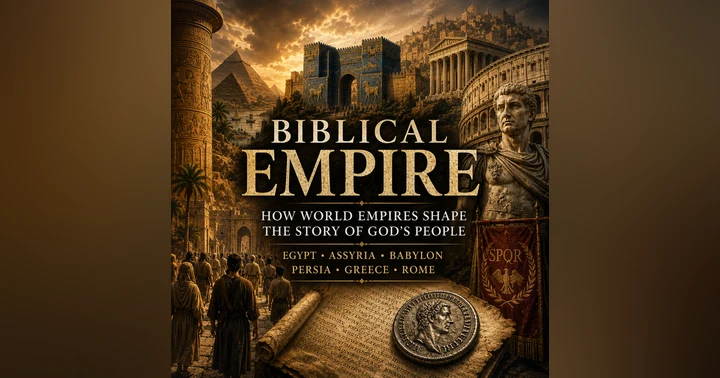
What Is Empire in the Bible and Why Does It Matter?