What Was the Second Temple and Why Does It Matter for Understanding Jesus?
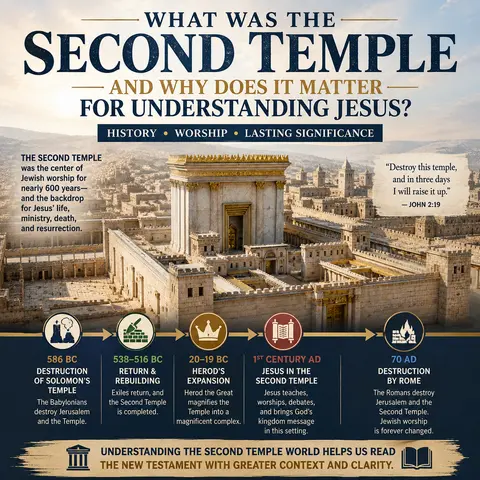
The Second Temple stood at the heart of Jerusalem for nearly six centuries, shaping the worship, identity, and destiny of the Jewish people. From its humble rebuilding after the Babylonian exile to its breathtaking expansion under King Herod and its violent destruction by the Romans in 70 CE, this sacred building witnessed the rise and fall of empires. Understanding its story is essential for anyone studying the Hebrew Bible, the New Testament, or the roots of Jewish and Christian tradition.
Temple Takeaways
-
The Second Temple in Jerusalem was rebuilt after the Babylonian exile, with construction beginning in 535 BCE and the temple building completed around 516 BCE. It was massively expanded by Herod the Great beginning around 20 BCE and ultimately destroyed by the Romans in 70 CE.
-
The Second Temple stood on the Temple Mount as the center of Jewish worship, sacrifice, and pilgrimage for nearly six centuries under Persian, Hellenistic, and Roman rule.
-
The Second Temple matters for understanding Jesus Christ, whose ministry took place in and around Herod's Temple, including his symbolic actions and teachings there.
-
The terms Second Temple period, Second Temple Judaism, and Second Temple literature overlap but carry distinct meanings, covering chronology, religious practice, and textual traditions respectively.
-
The Western Wall and ongoing Jewish memory of the Temple keep its religious and cultural legacy alive long after the temple's destruction.
What Was the Second Temple and Why Does It Matter for Understanding Jesus?
The Second Temple was the rebuilt Jewish temple in Jerusalem, raised on the Temple Mount after the Babylonian captivity. It was dedicated around 516 BCE and remained standing until Rome tore it down in 70 CE. The Second Temple defined a significant period in Jewish history from 516 BCE to 70 CE, one that saw dramatic shifts in politics, theology, and communal identity.
During the lifetime of Jesus of Nazareth, the temple building he walked through was Herod's Temple, a greatly enlarged and beautified version of the earlier sanctuary. This ancient temple was not simply a place of prayer. It was the Second Temple that served as the central place of worship for the Jewish people in Jerusalem, combining religious authority, economic activity, and political power under one roof.
The Jerusalem temple shaped daily Jewish religious life through sacrifices, ritual purity, and pilgrimage festivals. Three pilgrimage festivals, Passover, Weeks (Shavuot), and Tabernacles (Sukkot), drew Jewish pilgrims from across Judea, Galilee, and the wider Jewish diaspora to offer sacrifices and celebrate communal rites. These festivals appear as important settings in the Gospels.
Many key New Testament scenes take place in the temple in Jerusalem. Jesus' presentation as an infant, his dialogue with teachers at age twelve, and his prophetic action of driving out money changers all assume a functioning temple complex with priests, courts, and pilgrims. Understanding these episodes requires knowing that the temple stood as the focal point of Jewish life, not merely as a backdrop.
To understand Jesus' criticism of temple practices, his parables about judgment, and early Christian claims about his death and resurrection, readers must grasp the central religious, political, and symbolic role of the Second Temple. Without that context, much of the New Testament reads like a story missing its stage.
From First Temple to Exile: How the Story of the Second Temple Begins
The story of the Second Temple begins with the loss of the First. King Solomon built the First Temple in the 10th century BCE as a royal and religious center for ancient Israel, housing the Ark of the Covenant in its Holy of Holies and serving as the place of sacrifice and worship for the united kingdom. King David had envisioned this sacred building, but it was King Solomon who brought it to completion on the heights of Jerusalem.
In 587 or 586 BCE, Nebuchadnezzar II's Babylonian forces destroyed Solomon's Temple, laid waste to the city, and carried many Judeans into the Babylonian exile. The loss was shattering. The Davidic monarchy fell, the holy place was ruined, and the visible sign of divine presence among the Jewish nation was gone.
Biblical prophets such as Jeremiah and Ezekiel interpreted the destruction as divine judgment for unfaithfulness, yet they also prophesied eventual return and renewed worship. Memories of the First Temple's Holy of Holies, the Ark of the Covenant, and past glory created deep expectations for restoration. The longing for a second temple built on the same holy site became a defining feature of Jewish identity during and after exile. Those memories would color everything that followed.
Persian Rule and the Temple Rebuilt: Cyrus, Zerubbabel, and Jeshua
In 539 BCE, the Persian king Cyrus the Great conquered Babylon, ending its control over Judah and opening the door for Jewish exiles to return home. Cyrus issued a decree permitting the rebuilding of the temple in Jerusalem and the return of temple vessels taken by Nebuchadnezzar. This policy reflected Cyrus's broader practice of allowing deported peoples to restore their sanctuaries.
Two leaders emerged among the first returnees. Zerubbabel, a Davidic descendant serving as Persian appointed governor, and the high priest Jeshua (also called Joshua) led the effort to re establish sacrificial worship in Jerusalem. Construction of the Second Temple began in 535 BCE with the laying of the altar and foundations, though opposition from neighboring groups and political obstacles caused significant delays.
The Second Temple was completed in 516 BCE during the reign of Darius I. This structure, often called Zerubbabel's Temple, was far more modest than Solomon's Temple, reflecting the limited resources of the returned Jewish exiles. Yet it reestablished the connection between the Jewish people and the holy place where their ancestors had worshipped.
The Temple Built: Features and Early Worship in Zerubbabel's Sanctuary
The early Second Temple building was humble compared to the grandeur of the First Temple, yet it served as the indispensable center of renewed worship for the restored community. Scholars and ancient sources describe a structure of hewn stone, a wooden roof, and the presence of inner and outer courts, all reflecting a modest but functional sanctuary.
The Holy of Holies in this period was an empty inner sanctuary. The Ark of the Covenant, the most sacred object from Solomon's Temple, was not present. The separation between the inner room and the rest of the temple was marked by a veil or curtains rather than thick walls, and the high priest entered this space under strict ritual conditions.
Sacrificial worship according to Torah prescriptions resumed within these walls:
-
Daily morning and evening burnt offerings
-
Festival sacrifices during the three pilgrimage festivals
-
Priestly routines and Levitical duties reestablished according to Jewish law
The emotional response of the community was deeply mixed. Younger returnees celebrated the rebuilding with joy. Elders who remembered the earlier, more glorious First Temple wept, mourning what had been lost. This tension between hope and sorrow would echo through the centuries of the Second Temple period.
Second Temple Period: Politics and Empires from Persia to Rome
Historians use the term "Second Temple period" for the centuries between the dedication of the temple around 516 BCE and its destruction in 70 CE. This span covers several major phases of imperial control, each leaving its mark on the temple and the people who worshipped there.
| Era | Approximate Dates | Ruling Power |
|---|---|---|
| Persian period | 539 to 333 BCE | Persian Empire |
| Hellenistic period | 333 to 164 BCE | Alexander and successors |
| Hasmonean period | 164 to 37 BCE | Jewish autonomy |
| Herodian and Roman period | 37 BCE to 70 CE | Roman Empire |
Each empire influenced the temple's finances, priestly appointments, and security. Tribute, taxation, and pilgrim dues shaped the economics of the temple precincts, while foreign rulers sometimes intervened in the selection of the high priest. Conflicts over who held legitimate priestly and political authority often sparked wider social and religious tensions.
The temple served not only as a place of worship but as a political institution, entangled with the ambitions of empires and the resistance of the Jewish population. This makes the Second Temple period one of the most complex chapters in Jewish history.
Second Temple Judaism, Second Temple Period, and Second Temple Literature: What Is the Difference?
These three terms overlap in conversation, but they do not mean the same thing. Readers who encounter them in biblical studies or ancient history often confuse their boundaries. Here is a clear breakdown.
Second Temple period refers to the historical era from roughly 516 BCE to 70 CE. It is a chronological label tied directly to the standing of the temple building in Jerusalem. Any event, person, or text that falls within this window belongs to the Second Temple period.
Second Temple Judaism describes the diverse forms of Jewish religion and practice that flourished during this era. This includes priestly groups, Pharisees, Sadducees, Essenes, and other movements centered on the temple and Torah. The Second Temple period saw the emergence of various Jewish sects such as the Pharisees and Sadducees, each interpreting Jewish tradition differently. Religious life during this time was far from monolithic.
Second Temple literature is the wide range of texts composed roughly between the late sixth century BCE and the first century CE. Beyond canonical parts of the Hebrew Bible such as Ezra, Nehemiah, and Chronicles, this category includes works like the Dead Sea Scrolls, 1 Enoch, Jubilees, the Wisdom of Ben Sira, and 1 and 2 Maccabees. The Temple Scroll, found among the Dead Sea Scrolls, offers detailed prescriptions for temple worship and construction.
A useful example of how these categories intersect: 1 Enoch is Second Temple literature that reflects apocalyptic strands within Second Temple Judaism, all produced within the broader Second Temple period. The Greek word for "revelation" (apokalypsis) that names this genre shows the cross cultural influence at work in these texts.
Temple Mount and Temple Complex: Layout and Sacred Zones
The Temple Mount was the raised platform in Jerusalem on which the temple complex stood. Over time it was enlarged repeatedly, most dramatically under Herod the Great, who expanded the Temple Mount from 7 to 14.4 hectares, creating one of the largest sacred precincts in the ancient world.
The layout followed a principle of concentric holiness. The outermost courts were accessible to many, including gentile visitors and Jewish communities arriving on pilgrimage. Inner courts were restricted to Israelites. Beyond those, only priests could enter. At the very center stood the Holy of Holies, reserved exclusively for the high priest on Yom Kippur. The Temple Mount walls were up to 16 feet thick, supporting a massive platform that dominated the landscape.
The temple complex included surrounding walls, gates, porticoes, storage chambers, and open temple courtyards where teaching, Jewish prayer, and commercial exchange connected to sacrifices took place. Temple officials managed daily operations, and a thousand priests served in rotation to maintain the cycle of offerings.
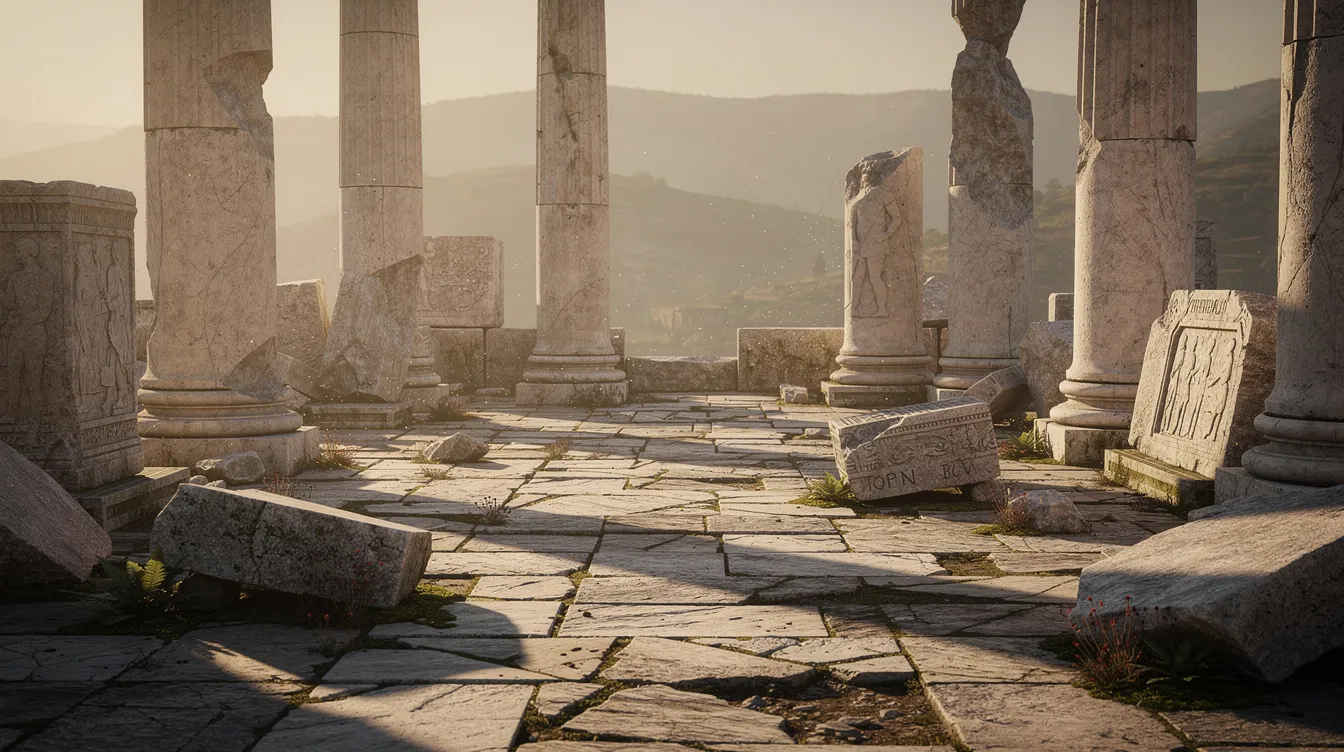
Archaeological work, including Temple Mount excavations, has focused mainly on the retaining walls and surrounding structures, since direct excavation of the Temple Mount itself remains extremely limited. Surviving architectural elements, combined with descriptions by the historian Josephus and the Babylonian Talmud, help scholars reconstruct the likely appearance of the Second Temple's courts and buildings.
Hasmonean Rule, Roman Conquest, and Growing Tensions
In the second century BCE, the Seleucid ruler Antiochus IV desecrated the Jerusalem temple by installing pagan altars and forbidding Jewish religious practices. The Maccabean Revolt that followed led to the cleansing and rededication of the temple in 164 BCE, an event commemorated by Hanukkah.
The victorious Hasmonean family combined priestly authority and royal power, expanding the temple's influence across the region. They reshaped the surrounding countryside to supply the temple with ritually pure produce and sacrificial animals, and they pushed the boundaries of Jewish autonomy under foreign pressure.
Internal conflicts within the Hasmonean dynasty, particularly the rivalry between Hyrcanus II and Aristobulus II, opened the door for Roman intervention. Roman intervention in Judea led to growing tensions and eventual rebellion. In 63 BCE, the Roman general Pompey conquered Jerusalem and entered the Holy of Holies, an act of sacrilege in Jewish eyes. Yet the destroyed temple was not the outcome of Pompey's visit. The temple building remained standing and sacrifices resumed under Roman rule.
The Roman conquest marked a turning point. From this moment forward, the ancient temple remained central to Jewish life yet increasingly entangled with Roman taxation, local power struggles, and a simmering unrest that would eventually ignite revolt.
Herod's Temple: Expansion of the Temple Building and Platform
King Herod, a Roman client king of Judea, initiated the most ambitious rebuilding project the temple had ever seen. Herod's renovation began around 20 or 19 BCE, transforming a modest sanctuary into one of the most impressive structures in the Roman Empire. Herod's Temple was one of the largest construction projects of the first century BCE.
Herod vastly enlarged the Temple Mount platform through monumental retaining walls, creating a grand sacred precinct that rivaled major sanctuaries elsewhere in the ancient world. The Temple Mount was expanded to 14.4 hectares under Herod, a staggering feat of engineering.
Key features of the expanded temple complex included:
-
A Temple building standing 60 cubits high, approximately 90 feet
-
A golden vine adorning its gates, symbolizing the fruitfulness of the Jewish nation
-
The Royal Stoa along the southern edge, featuring 162 columns arranged in a massive colonnade
-
Courts, porticoes, and ritual baths (mikvaot) for purification before entry
The temple building itself was rebuilt quickly, but work on porticoes, courts, and the outer parts of the complex continued for decades. Construction was still ongoing in the first century CE. Herod balanced loyalty to the Roman emperor with attempts to win favor among his Jewish subjects by beautifying their holiest sacred space, all without interrupting daily sacrifices.
Many New Testament references to the temple, including comments about its magnificence and long construction time, refer specifically to this refurbished sanctuary known as Herod's Temple.
Worship, Pilgrimage Festivals, and the Holy of Holies
Picture a festival morning in Jerusalem: tens of thousands of pilgrims stream through the gates of the temple complex, carrying offerings, leading animals, filling the temple courtyards with the sounds of prayer and preparation. The temple served as a central gathering place for Jewish communities from every corner of the ancient world.
The temple served as the site for ritual animal sacrifices and major pilgrimage festivals. Three pilgrimage festivals drew tens of thousands of pilgrims to Jerusalem each year:
| Festival | Hebrew Name | Key Practices |
|---|---|---|
| Passover | Pesach | Sacrifice of several thousand sheep; remembrance of the Exodus |
| Weeks | Shavuot | Grain offerings; celebration of Torah |
| Tabernacles | Sukkot | Harvest celebration; regarded as the preeminent Jewish festival |
Pilgrims brought offerings from the seven species to the temple, and pilgrimages to the temple occurred during major Jewish festivals on the Jewish calendar. Animal sacrifices were central to the temple's religious practices, including daily morning and evening burnt offerings, personal offerings, and special communal sacrifices carried out by priests and Levites.
The Holy of Holies was the innermost, most sacred space. During the Second Temple period, the Holy of Holies did not contain the Ark but remained symbolically central as the place of divine presence. Only the high priest entered this inner courtyard on Yom Kippur to perform rites of atonement for the people, making it the most restricted holy place in the ancient world.
Under Roman Rule: Daily Life, Conflict, and Caligula's Crisis
Under Roman rule from the first century BCE onward, the temple remained the recognized center of Jewish religion and a major economic hub through offerings and donations. Temple treasures, accumulated from generations of giving, made the sanctuary both a religious symbol and a financial target.
Jewish leaders navigated a delicate balance. Priestly elites, local rulers, and Roman officials shared power uneasily. Rome controlled appointments of high priests and supervised security on the Temple Mount. Many Jews resented these arrangements, seeing Roman presence and local collaboration as defilement of their sacred precinct.
One episode illustrates the danger particularly well. Around 40 CE, the Roman emperor Caligula ordered his statue to be placed inside the temple, a command that provoked outrage and near revolt. The plan was averted only by Caligula's death in 41 CE.
Different Jewish groups held competing visions for the temple's purity, leadership, and future. Some movements saw the situation as intolerable. This atmosphere of unrest and religious zeal, combined with heavy taxation during the Roman period, contributed directly to the outbreak of the first Jewish revolt in 66 CE.
Jesus and the Second Temple: Ministry in Herod's Sanctuary
Jesus Christ lived and ministered entirely within the Second Temple period. Herod's Temple framed many of his actions and teachings, and the Gospels return again and again to the sacred building as a setting for pivotal moments.
The narrative begins early. Mary and Joseph bring Jesus to the temple as an infant for presentation according to Mosaic law. At twelve, Jesus debates teachers in the courts during the Passover festival. In his adult ministry, he teaches crowds in the temple courtyards during pilgrimage festivals, drawing on the Holy Spirit in his encounters with both ordinary worshippers and religious authorities.
Perhaps the most dramatic episode is Jesus' symbolic demonstration often called the cleansing of the temple. He confronts money changers and sellers of sacrificial animals, challenging what he perceives as corruption and economic exploitation in the temple complex. This action was not merely a disruption. It was a prophetic statement about the meaning of sacred space and the future of the sanctuary.
Jesus frequently alludes to the temple and its destruction in his prophetic sayings, including the declaration that "not one stone shall be left on another." Early Christians later connected these words to the Roman destruction of 70 CE. Many New Testament writings go further, reinterpreting sacrifice, priesthood, and divine presence with reference to the temple. They present Jesus himself as the holy place where God's presence dwells and atonement is made, shifting the locus of holiness from a building to a person.
Destruction of the Temple in Jerusalem and the Fate of the Western Wall
The first Jewish revolt began in 66 CE, fueled by decades of taxation, Roman abuses, and apocalyptic fervor. The Jewish war that followed was devastating. Roman soldiers under Titus besieged Jerusalem, tightening their grip over months of brutal fighting. The destruction occurred during the First Jewish Roman War.
Infighting among Jewish factions weakened defenses during the siege, allowing Roman forces to breach the walls. In the summer of 70 CE, the Second Temple was destroyed. The historian Josephus provides the most detailed ancient account of the burning and demolition, though scholars debate whether Titus intended full destruction or lost control of events. Tens of thousands of Jews were killed or enslaved during the conflict.
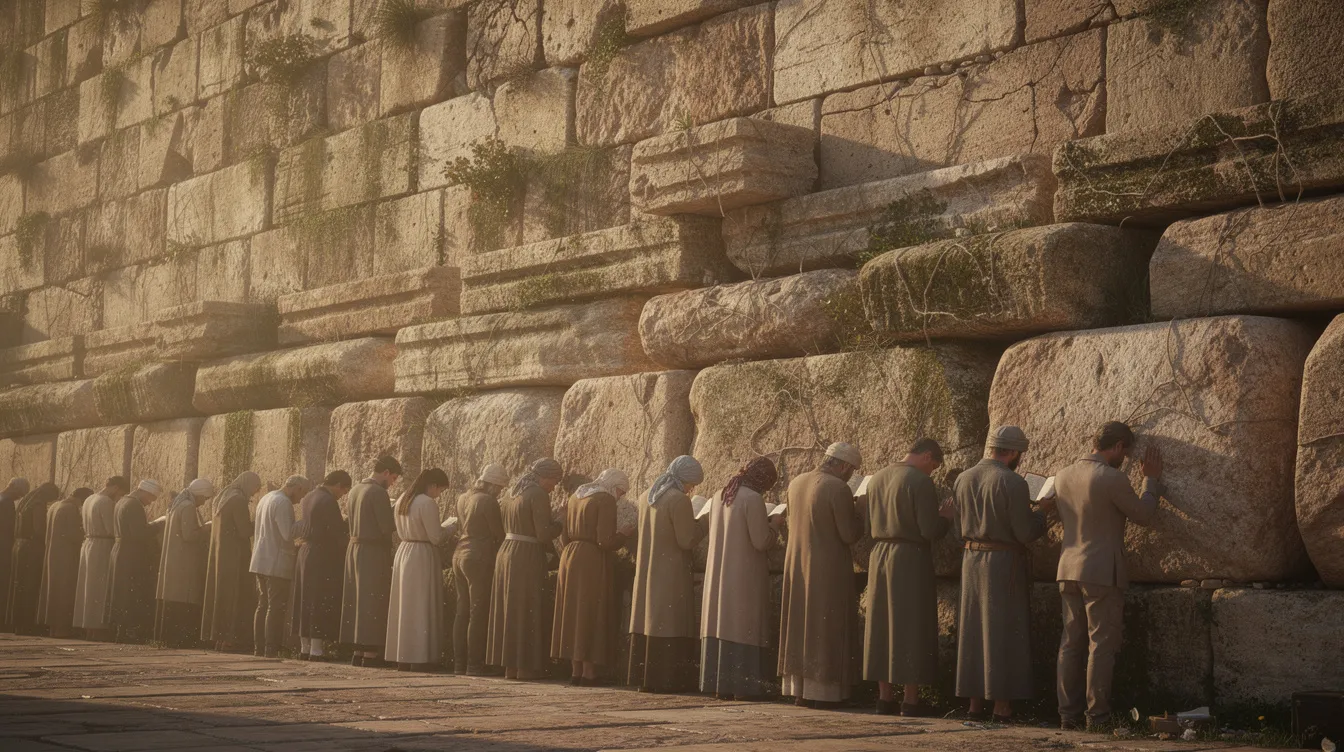
Much of Jerusalem was ruined, but sections of the Temple Mount retaining walls survived, including what is known today as the Western Wall. The Western Wall is a surviving part of the Second Temple's retaining wall, not a wall of the destroyed temple sanctuary itself. Yet it became a powerful site of mourning, Jewish prayer, and hope for future restoration.
After the Bar Kokhba revolt in the 130s CE, Rome barred the Jewish population from Jerusalem, and new Roman buildings rose on and near the former temple site. The sacred precinct that had once drawn tens of thousands of Jewish pilgrims now belonged to a different world.
Archaeology, Memory, and the Legacy of the Second Temple
Direct excavations on the Temple Mount are extremely limited due to religious and political sensitivities, so archaeological knowledge of the Second Temple comes largely from study of retaining walls, gates, streets, and nearby structures. Significant discoveries include warning inscriptions in Greek that marked boundaries for non Jews, a "place of trumpeting" stone, ritual baths around the southern entrances, and massive stonework associated with Herod's expansions.
Jewish tradition has preserved the memory of the temple through powerful means. Its destruction is commemorated on Tisha B'Av, the ninth day of the Hebrew month of Av. Prayers still include yearning for restoration. Customs like breaking a glass at weddings recall the loss. These practices ensure that the destroyed temple remains woven into Jewish identity and communal memory.
Christian and Muslim traditions also engage with the site of the former temple, making it a focal point of overlapping sacred histories and ongoing sensitivity. The legacy of the Second Temple remains central to Jewish identity, biblical interpretation, and historical understanding of the land and city of Jerusalem.
Conclusion: Why the Second Temple Still Matters Today
The story of the Second Temple runs from post exilic rebuilding under Persian kings, through Hellenistic and Roman rule, to its destruction in 70 CE. Across those centuries, the temple stood as the center of sacrificial worship, communal identity, and political contest for the Jewish nation.
Grasping the temple's role clarifies key themes in the Hebrew Bible, Second Temple literature, and the New Testament, including sacrifice, holiness, atonement, and divine presence. Distinguishing between Second Temple period, Second Temple Judaism, and Second Temple literature helps readers situate texts and traditions in their proper historical context.
The surviving Western Wall and enduring liturgical memories show that although the temple building is gone, its spiritual, cultural, and theological influence continues to shape Jewish and Christian thought. Jewish life transitioned to focus on prayer and study after the temple's destruction, and that transformation remains one of the most significant pivots in the history of the ancient world.
Studying the Second Temple offers insight into questions of worship, community, and identity that remain as relevant today as they were two thousand years ago. Whether you approach the subject as a student of history, a reader of scripture, or someone curious about the roots of religious practice, the Second Temple repays close attention.
Frequently Asked Questions
How long did the Second Temple stand from dedication to destruction?
The Second Temple was completed in 516 BCE and destroyed by the Romans in 70 CE, meaning it functioned for roughly 586 years. Some rabbinic traditions present slightly different figures, such as 420 years, because they use alternative dating methods. During this entire span the temple endured major regime changes, from Persian to Roman rule, while remaining the core of sacrificial worship and the center of Jewish communal life.
Did the Second Temple contain the Ark of the Covenant?
Most ancient and later Jewish sources agree the Ark of the Covenant was not present in the Second Temple. The Holy of Holies during the Second Temple period was an empty inner room, separated by a veil, where the high priest performed Yom Kippur rituals without an Ark. The absence of the Ark heightened both a sense of loss and a renewed focus on ritual, prayer, and Torah as ways to experience God's presence.
Who was allowed to enter the Temple and its courts?
Access to the temple complex was graded by concentric zones of holiness. Outer courts were open to Israelites and proselytes, while the inner courtyard was restricted to Jewish men. Priestly areas were reserved for priests alone. Non Jews were allowed in certain outer areas but were warned by inscriptions not to pass inner boundary markers on pain of death. Only the high priest entered the Holy of Holies, and only once a year on the Day of Atonement, after extensive purification.
How did the destruction of the Second Temple change Judaism?
The loss of the temple in 70 CE ended the entire system of animal sacrifice and priestly service centered on Jerusalem. The destruction of the Second Temple led to the development of rabbinic Judaism, as Jewish communities gradually reorganized around synagogues, study of Torah, and prayer. Rabbinic leadership replaced the central role of temple priests, and later Judaism preserved detailed memories of temple rituals in texts and liturgy while developing new forms of religious practices suited to life without a standing temple.
What are examples of Second Temple literature besides the Bible?
Major Second Temple writings include the Dead Sea Scrolls, 1 Enoch, Jubilees, the Wisdom of Ben Sira, and 1 and 2 Maccabees. These texts reveal diverse beliefs about angels, law, wisdom, and the end times within Second Temple Judaism. Reading these works alongside the Hebrew Bible and New Testament gives a fuller picture of the religious world shaped by the Second Temple, and helps explain the theological diversity that characterized the Jewish communities of that era.
When Outsiders Became Family: The Conflict That Shaped the Early Church