Biblical Marginalization: Rejection, Jesus Christ, and God's Heart for the Outcast
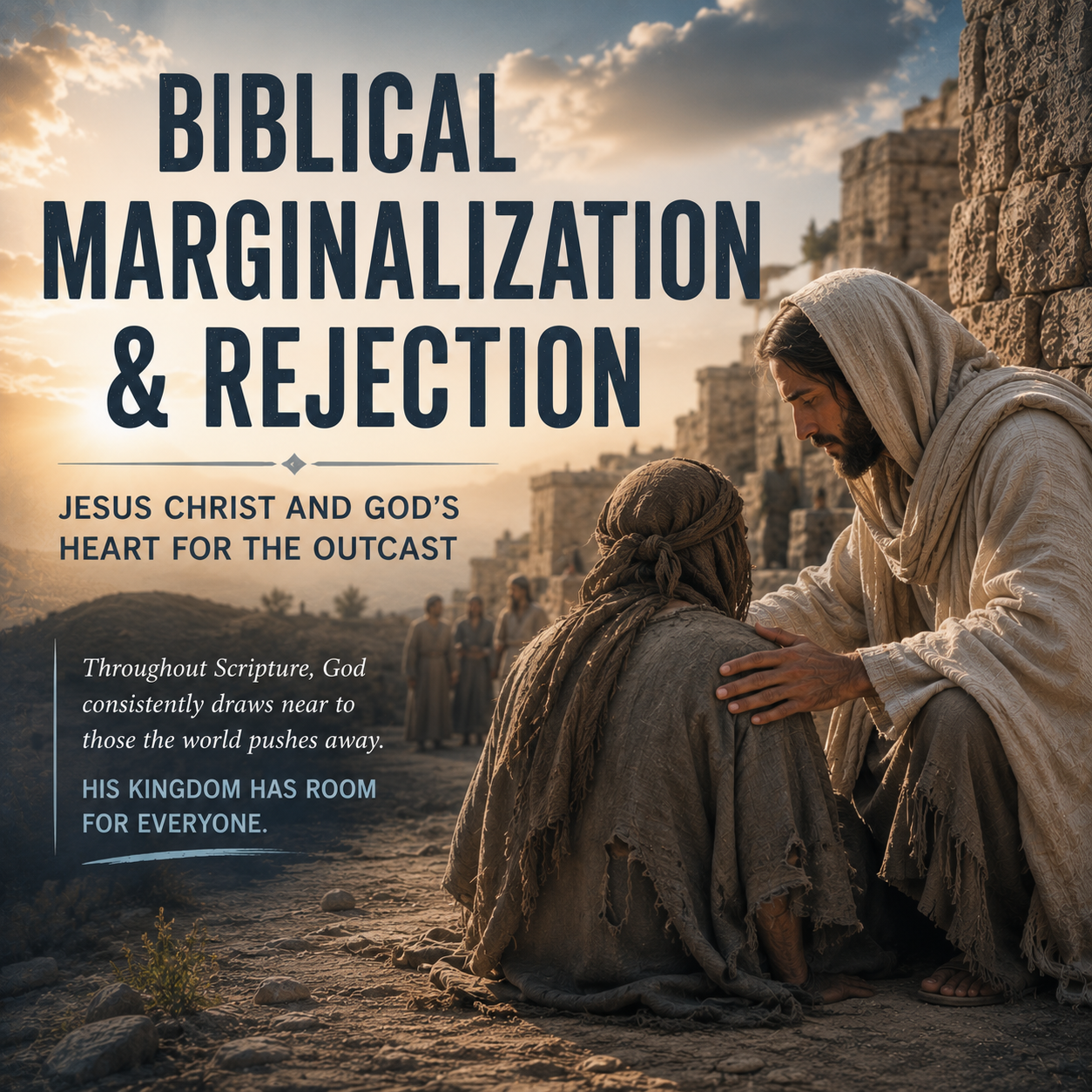
Biblical Marginalization: Rejection, Jesus Christ, and God's Heart for the Outcast
Rejection is one of the most universal human experiences, and it runs through nearly every page of the bible. From Hagar wandering the desert to the Canaanite mother begging Jesus for mercy, scripture is filled with people who were pushed aside, overlooked, and written off. But the story never ends there. God consistently meets the marginalized at the edges and draws them toward the center of His redemptive purposes. This article explores what biblical marginalization teaches us about rejection, identity, faith, and how the church can respond today.
At a Glance
-
Biblical marginalization refers to the social exclusion of certain groups in scripture, including women, foreigners, the poor, and those with disabilities, and God consistently responds with justice and compassion.
-
Rejection is a liar: it distorts identity and worth, but God's declarations in Christ override every human verdict.
-
Jesus Christ personally experienced rejection and remained steadfast in His mission, transforming the cross from a place of shame into the center of salvation history.
- God does not automatically "side" with every marginalized person but always calls His people to protect, dignify, and love the vulnerable while judging all by righteousness, not status.
-
Overcoming rejection is a process rooted in scripture, community, and the Holy Spirit's work, not a quick fix.
- The bible both describes and confronts marginalization, pointing to Jesus Christ as the One who bears and heals rejection.
- This article moves from defining marginalization, to key biblical case studies, to practical guidance for overcoming rejection and caring wisely for marginalized people today.
Understanding Biblical Marginalization
Marginalization, in plain language, means being pushed to the social, economic, or religious edges. It means being unseen, unheard, and unprotected. In society both ancient and modern, marginalized people lack voice, influence, and often the basic safeguards that others take for granted. Marginalized groups often lacked legal and economic protection in biblical society, making them especially vulnerable to exploitation and neglect.
Biblical marginalization refers both to the actual marginalized people recorded in the bible and to how scripture theologically interprets rejection, exclusion, and belonging. The marginalized in biblical texts include women, foreigners, and individuals with disabilities, along with widows, orphans, the poor, lepers, prisoners, and those labeled as demon-possessed. These categories overlap frequently: a foreign widow, for example, faced compounded vulnerability.
It helps to distinguish marginalization from oppression. Marginalization involves being pushed to the margins, while oppression involves active harm and exploitation. They often overlap, but not every excluded person is being deliberately abused; sometimes the cause is stigma, ignorance, or structural neglect.
Rejection is not neutral in the biblical world. It can be weaponized by the Enemy to distort identity, producing shame, fear, and isolation. Yet God intended something different for every person He created. Even rejection can become a doorway into deeper grace and belonging when it is brought before Jesus Christ. What the world discards, God often elevates, and that pattern runs through the entire biblical narrative.

Rejection Is a Liar: The Spiritual Anatomy of Being Pushed Aside
Rejection feels like being erased or canceled. It whispers that you are unwanted, invisible, fundamentally deficient. If you have ever felt rejected, you know the pain is not abstract. Research confirms that rejection activates brain regions similar to physical pain, making it a viscerally real painful experience. Rejection can lead to emotional devastation and identity crises, leaving people unsure of who they are and whether they belong anywhere.
But rejection is a liar. Where human verdicts declare someone worthless, God's voice says otherwise. Isaiah 43:1 rings out: "I have called you by name; you are Mine." Psalm 139 reveals a God who knows every word before it reaches your tongue, who formed you with deliberate care. In God's eyes, no person is disposable. Keep in mind those scriptures are part of God's story.
Scripture is filled with people who were rejected and then elevated. Joseph was sold by his own family members, forgotten in prison for many years, and then raised to save a nation. David was overlooked by his father, the youngest and least regarded, yet God called him a man after His own heart. Experiencing rejection did not disqualify them. It became the stage where God revealed their true identity and purpose.
When rejection remains unhealed, it hardens into shame, bitterness, striving, or constant people-pleasing. Rejection can cause feelings of unworthiness and isolation, blocking the life of freedom God offers. But overcoming rejection is not denial of hurt. It means learning to interpret your story through the cross and resurrection rather than through human verdicts. The pain is real. The verdict of rejection is not.
Old Testament Portraits of the Marginalized
The Old Testament repeatedly centers stories of people society pushed aside, revealing that God pays fierce attention to those with little power. Biblical stories highlight the systemic injustice that leads to marginalization, and many of these narratives contain many lessons for believers today.
Consider Hagar in Genesis 16 and 21. She was an Egyptian servant, powerless in Abraham's household, mistreated by Sarah, and eventually cast out into the wilderness with her son. Yet God met her there. An angel appeared and spoke a prophetic promise over Ishmael, whose name means "God hears." Hagar responded by naming God "El Roi," the God who sees me. She is the first person in scripture to give God a name born from personal suffering. Even in the margins, God made His presence unmistakable. He will hear, and He does see.
Tamar, in Genesis 38, was a widow trapped by injustice. Denied her legal rights by Judah, she was forced to act from the margins to secure what was owed to her. Judah himself admitted, "She is more righteous than I." Her offspring became ancestors of King David and, ultimately, of Jesus. A neglected widow became part of God's Messianic line.
The Old Testament contains laws that protect the rights of marginalized individuals. Deuteronomy 10:18–19 declares that God "defends the cause of the fatherless and the widow, and loves the foreigner." Isaiah 1:17 commands God's people to "learn to do right; seek justice." Foreigners were required to be treated fairly under Israelite law, and the bible teaches that God defends the vulnerable, including the poor and needy. The bible emphasizes care for the poor, widows, and orphans as a moral obligation, not optional charity.
Israel itself spent many years in bondage in Egypt and later in exile in Babylon. This corporate memory of being outsiders shaped their law: "You were slaves in Egypt; do not oppress the foreigner." God's people are to remember their own marginalization when they encounter vulnerable others.

Canaanites, Tamar, Rahab, and the Breaking of Ethnic Barriers
Canaanites were historically marginalized enemies of Israel, frequently associated with idolatry and moral corruption. To intermarry with or even associate with Canaanites was considered contaminating. They occupied the wrong side of Israel's story for generations.
Yet God wove Canaanite women into the very genealogy of the Messiah. Rahab, recorded in Joshua 2, embodies multiple layers of marginalization: Canaanite, woman, and prostitute. She hid Israelite spies, expressed remarkable faith in Israel's God, and was spared when Jericho fell. She is later listed in Matthew 1:5 among Jesus' ancestors and praised in Hebrews 11:31 for her faith. Many biblical narratives challenge social hierarchies and advocate for inclusion, and Rahab's story is among the most striking.
Tamar, the Canaanite associated with Judah in Genesis 38, was another foreign woman entangled in injustice whose offspring became part of the line leading to Jesus Christ. Canaanite women Tamar and Rahab are in Jesus's genealogy, a fact that should stop every reader in their tracks. Tamar and Rahab, Canaanites, are in Jesus's genealogy, signaling that ethnic stigma does not disqualify people from God's redemptive purposes.
The theological point is sharp: God intentionally places women once considered outsiders and enemies at the center of His Messianic family tree. This undermines both ethnic pride and ethnic shame. In God's story, marginalized outsiders become central witnesses of faith, foreshadowing the inclusion of all nations in Christ. The kingdom has always been wider than human boundaries.
Jesus Christ and the Marginalized: The Canaanite Woman in Matthew 15:21–28
In Matthew 15:21–28, Jesus withdraws to the region of Tyre and Sidon. A nameless Canaanite woman approaches Him, crying out: "Lord, Son of David, have mercy on me! My daughter is severely oppressed by a demon." Jesus healed the Canaanite woman's daughter from demon possession, but the path to that healing was anything but straightforward.
Her layers of marginalization are stacked: Gentile ethnicity in a Jewish context, a woman in a male-centered society, a mother whose child suffered from demon possession, a condition carrying intense spiritual and social stigma. She is nameless in the text, which only amplifies her invisibility.
The disciples' response was dismissive. They urged Jesus to send her away. Jesus' initial words seemed to echo cultural boundary language: "I was sent only to the lost sheep of Israel." She knelt and said, "Lord, help me." He responded, "It is not right to take the children's bread and throw it to the dogs." Her answer was extraordinary: "Yes, Lord, but even the dogs eat the crumbs that fall from their masters' table."
Jesus' public commendation was immediate: "O woman, great is your faith! Let it be done for you as you wish." Her daughter was healed at that moment. Jesus intentionally engaged with marginalized individuals such as the sick and the outcast, and Jesus's ministry subverted societal boundaries that kept people marginalized. Here a Gentile mother's persistent faith, refusal to be silenced, and humble boldness turned her into a model for the entire kingdom. The table, it turns out, has room for those once treated as dogs beneath it.

Stigma and Demon Possession in the New Testament
In the first-century context, demon possession carried not only spiritual torment but intense social stigma and fear. Families of the afflicted, like the Canaanite woman's household or the father in Mark 9:14–29, often lived in isolation, shame, and despair. The father in Mark 9 described his son being thrown into fire and water by an unclean spirit, a situation that had devastated his family for years.
Consider the Gerasene demoniac in Mark 5:1–20. This man lived among tombs, naked, uncontrollable, shunned by his entire community. After Jesus cast out the legion of demons, the man was found "sitting, clothed, and in his right mind." Jesus performed acts of healing for those excluded because of illness and spiritual torment, reversing marginalization in a single encounter. The man who had been written off as hopeless became a witness to God's power among his own people.
In Mark 9, a boy seized by an unclean spirit was restored and returned to his father after the disciples had failed to help. Jesus lifted him by the hand, a gesture of dignity and personal care.
Scripture takes the spiritual reality of demons seriously, but it also exposes how fear-based stigma can dehumanize sufferers. Jesus refused both denial of spiritual warfare and dehumanization of the afflicted. He treated every person with authority and compassion, reminding us that the afflicted are not objects of fear but souls worthy of restoration.
Does God Always Side With the Marginalized?
This is a question worth asking honestly. Modern assumptions sometimes equate "marginalized" with "morally right," but scripture offers a more nuanced picture. Liberation theology interprets the bible from the perspective of the oppressed, and while this lens has yielded important insights, the biblical witness resists reducing justice to any single ideological framework.
In the bible, some marginalization arises from oppression and injustice, while some arises from personal sin, folly, or morally neutral circumstances. God judges both Egyptian oppressors and idolatrous Israelites. He confronts wealthy exploiters through prophets like Amos (Amos 5) but also calls poor people to righteousness and repentance. Doing wrong is never excused by one's social position.
God shows no partiality (Deuteronomy 10:17; Romans 2:11). He defends the vulnerable as a justice priority while still evaluating every person by repentance, righteousness, and faith, not by status. He is righteous in all His dealings, whether with the powerful or the powerless.
God desires us to defend the marginalized from oppression, but followers of Jesus Christ are called to hold together compassion and moral clarity. We protect and honor marginalized people without romanticizing them or excusing sin. We love mercy and pursue justice, but we do not collapse the distinction between mercy and indifference to truth. The answer to injustice is never more injustice; it is the character of God Himself.
Jesus' Own Rejection and the Redemption of the Margins
Jesus Himself experienced radical marginalization. Born in a feeding trough, raised in Nazareth, a village so despised that Nathanael asked, "Can anything good come out of Nazareth?" His life unfolded far from the corridors of power.
Specific episodes of rejection punctuate His ministry. In Luke 4, His own people in Nazareth tried to throw Him off a cliff after He preached in their synagogue. Religious leaders accused Him of blasphemy and collusion with demons. His followers deserted Him at Gethsemane. The crowd chose Barabbas. On the cross, He cried, "My God, My God, why have You forsaken Me?" entering into the deepest experience of abandonment ever recorded. Jesus experienced rejection and remained steadfast in His mission, never wavering from the Father's will.
The cross is the apex of marginalization: shame, exclusion, judgment. But in Christian theology, it becomes the center of salvation history. The place of "outside" becomes the place where God meets humanity. A Roman instrument of shame becomes the instrument of glory and salvation for the entire world.
Because Jesus carried rejection, no believer's marginalization is the final word. In Him, the rejected are named, adopted, and seated with Him in heavenly places (Ephesians 2:6). The shame is swallowed by grace. The edges become a meeting place with God. Hope is not wishful thinking; it is the reality of who Christ is and what He has accomplished.
Overcoming Rejection with Belonging in Christ
Overcoming rejection is often a slow journey, not a quick fix. If you have felt rejected in the last few months or carried wounds for decades, know that scripture serves as both mirror and medicine for wounded hearts. Trusting God can help individuals respond to rejection positively, not by minimizing pain but by reframing identity.
Meditate on identity-forming passages. Isaiah 43:1 declares you are called by name. Ephesians 1 describes you as chosen, adopted, and redeemed before the foundation of the world. Peter writes in 1 Peter 2:9–10 that believers are "a chosen people, a royal priesthood... once not a people, but now the people of God." These are not motivational slogans; they are declarations of identity in Christ, and they carry the weight of God's unfailing love. (even though they are not written to you, it can shape you)
The Holy Spirit plays a direct role in healing rejection wounds. The spirit convicts us of lies, comforts in grief, and empowers believers to forgive, risk love again, and embrace their place in the Body of Christ. Acceptance is not something we earn; it is something we receive through the gospel.
Christ-centered community becomes the practical context of healing. When believers practice hospitality, listen to each other's stories, and intentionally make room for overlooked voices, belonging becomes tangible. A small group where people share honestly can be more transformative than a thousand sermons. This is where friends become family and where the truth of the gospel is lived, not just spoken.
Name the lies rejection has planted: "I am unlovable," "I will always be on the outside," "I don't belong." Then answer them with God's promises. Speak those promises out loud. Let scripture become your counter-narrative. Rejection does not get the final word. The Father does. And His word is peace, relationship, and belonging.

The Church's Call: Caring Wisely for Marginalized People Today
The church, as the Body of Christ, is called not only to pity marginalized people but to embody God's justice, mercy, and welcome in concrete ways. Ethical interpretation of the bible often calls for advocacy for vulnerable populations, and that advocacy begins within our own congregations.
Christians must examine whether their communities unconsciously mirror the disciples' reaction to the Canaanite woman. Do we silence those who make us uncomfortable? Do we avoid the messy stories? When someone shares follow up comments about abuse, poverty, or mental illness, do we listen, or do we change the subject?
Practical ministry looks like this:
-
Cultivating spaces where women like modern Tamars and Rahabs can tell their stories safely.
-
Supporting single parents, immigrants, and people living with mental illness.
-
Creating pathways for the formerly incarcerated to participate fully in church life.
-
Addressing needs of those who have been neglected by institutions that should have protected them.
- Pushing others aside because their worldview is different than yours.
James 1:27 commands care for orphans and widows, calling believers to "visit orphans and widows in their affliction." Proverbs 31:8-9 urges speaking up for the rights of the destitute, demanding that we use whatever voice and influence we have. Believers are called to imitation and compassion towards those facing marginalization, not passive hand-wringing.
Where churches have wounded, ignored, or stigmatized marginalized people, repentance is necessary. This includes victims of abuse, racial minorities, and those associated with spiritual affliction. Spirit-empowered action through mentoring, advocacy, shared meals, financial generosity, and partnerships can move marginalized people from the church's outer edges into full, visible participation as co-laborers in the gospel and ministry of Christ.
Personal Practices for Walking with the Marginalized
Caring for marginalized people is not only an institutional task but a deeply personal, everyday calling for followers of Jesus Christ. It starts with how you move through ordinary life.
Some specific practices to consider:
-
Pray regularly: "God bless the ones no one sees today." Let that prayer reshape how you notice people.
-
Learn the names of overlooked people in your neighborhood or congregation. Names carry dignity.
-
Choose proximity over comfort. Sit with people whose life experience is different from yours.
-
Share meals with those from different ethnic, economic, or church backgrounds, and allow their stories to challenge your assumptions. These meals are a blessing you receive, not just give.
Many people feel paralyzed by fear of saying the wrong thing to someone dealing with trauma, poverty, or spiritual distress. The answer is not perfect words but presence, humility, and willingness to listen. You do not need to have a solution. You need to be willing to stay.
Walking with marginalized people is a school of discipleship. Jesus uses uncomfortable spaces (tension) to reshape hearts into His likeness. When you choose to be led into those spaces, you find Him already there. Your friends, neighbors, and even strangers become the context where faith grows and the gospel takes on flesh.
Prayer, Spiritual Warfare, and the Margins
Marginalization often has overlapping layers: social structures, personal choices, and unseen spiritual opposition. Recognizing the spiritual dimensions does not excuse social sin but acknowledges the reality of evil at work in the world.
The New Testament portrays spiritual warfare not as an excuse to ignore injustice but as a reminder that behind some patterns of bondage and despair stands a real Adversary. Paul's language in Ephesians 6 about "principalities and powers" and Jesus' repeated casting out of demons confirm this. The spirit of God empowers believers to stand against these forces.
Intercessory prayer, fasting, and the proclamation of the gospel can play a role in dismantling strongholds that keep individuals and communities trapped on the margins. When you pray for the oppressed, you are participating in spiritual work with eternal consequences for souls and communities alike.
Every act of Christlike love, truth-telling, and justice is also a form of resistance against the powers that dehumanize. Feeding the hungry, welcoming the stranger, and speaking truth to power are spiritual acts. Reminding the marginalized of who God says they are is warfare against the darkness that tells them they are nothing.
Conclusion: From the Edges to the Center of God's Story
The Bible does not romanticize marginalization. It exposes it, names it, and reveals God's fierce attention to those pushed aside. From Hagar in the wilderness to the Canaanite mother on the border of Tyre and Sidon, God moves toward the rejected with purpose and glory.
Jesus Christ, the rejected cornerstone, gathers the shamed, forgotten, and demonized into a new family where ethnicity, gender, and status no longer determine worth. His life, death, and resurrection form the foundation of every believer's identity. In Him, there is no permanent margin, only invitation.
If you have felt marginalized, your story is not over. In Christ, rejection can become a doorway into deeper belonging, purpose, and participation in God's mission. The cross took the worst the world could offer and turned it into salvation for everyone willing to receive it.
Pray today for the courage to receive God's healing of your own rejection wounds and to stand alongside the marginalized in His Name. The kingdom of God has always been built from the edges inward, and there is room at the table for you.
FAQ on Biblical Marginalization
These questions address common concerns not fully explored above, offering brief theological and practical guidance.
How can I tell if my own marginalization is mainly injustice, my choices, or both?
Most real-life stories are mixed. Some elements involve unjust treatment by others; some involve personal responsibility. This is not a reason for shame but for honest self-examination. Seek wise counsel from a trusted pastor, counselor, or mature friend. Ask the Holy Spirit to reveal where repentance, grief, or advocacy is needed. Regardless of cause, Jesus meets every person with mercy and truth, offering both forgiveness and restoration. The goal is clarity, not condemnation.
What should I do if my church has contributed to my sense of rejection?
Church-based wounds cut deeply because the church should be the safest place on earth. Validate the seriousness of this pain. Talk with a trusted leader or professional counselor, naming specific harms. Distinguish between Christ and the failures of His people. When possible, seeking reconciliation is good. But sometimes finding a healthier community is a necessary expression of wise stewardship. Not every congregation is a good fit for every person, and leaving one church for another is not a failure of faith.
How can a small congregation practically serve marginalized people without many resources?
Presence, reliability, and respect often matter more than money. Simple, low-cost practices make a real difference: shared meals, consistent friendship, offering rides, tutoring children, and faithful prayer. A small group that shows up week after week builds the kind of relational depth that larger programs sometimes lack. When specialized help is needed, partner with other churches or local ministries rather than trying to do everything alone.
Is it wrong to set boundaries with marginalized people who are manipulative or abusive?
Christlike love includes wisdom. Scripture does not require enabling harmful behavior or remaining in unsafe situations. Boundaries can protect both parties and may actually create space for genuine change, repentance, and healthier relationship. Seek pastoral and professional guidance when dealing with complex or dangerous situations. Love does not mean tolerating abuse.
How do I talk about demon possession without increasing stigma or fear?
Use biblical language carefully, focusing on Jesus' authority and compassion rather than sensational details. Express humility about what we do not fully understand. Prioritize the person's dignity, safety, and holistic care. Integrate prayer, scripture, and appropriate medical or psychological help, recognizing that God can work through multiple means to bring freedom. When you talk about spiritual realities, let the emphasis fall on Christ's victory, not on the darkness He has already overcome.

The Problem With Certainty