What If the Answer to Our Prayer Requires Us to Change?

Prayer occupies an important place in Christian life. We pray for wisdom, direction, healing, provision, forgiveness, courage, and help. Churches pray during worship, before meetings, over leaders, and when difficult decisions need to be made. So when someone says, “We prayed about it,” the statement usually sounds reassuring. It suggests that God was included in the process.
But what does that statement actually tell us?
It tells us that someone prayed. It does not necessarily tell us whether they listened, whether they were willing to reconsider their assumptions, whether they sought wisdom from others, or whether they were open to changing direction. Scripture contains some uncomfortable examples of people who remained deeply engaged in religious activity, including prayer, while God challenged the posture behind it.
That raises a question worth wrestling with: Does praying about something automatically make it spiritual?
What Does “We Prayed About It” Actually Mean?
There is nothing wrong with saying, “We prayed about it.” Hopefully prayer is part of how Christians approach important decisions. The problem begins when the statement moves from describing what happened to certifying the decision that followed.
“We prayed about it” can quietly become “therefore this is where God is leading.” From there, it is a short step to “therefore this must be God’s will.” Once God's authority becomes attached to a decision in that way, questioning the decision can begin to sound like questioning God.
That is a significant leap. Prayer may have been part of the process, but the presence of prayer does not prove the presence of God’s approval. The Bible itself gives us good reason to be careful about making that assumption.
Isaiah Describes People Who Were Praying
Isaiah 1 opens with a confrontation between God and Judah, but these were not people who had abandoned religion. They were bringing sacrifices, attending assemblies, observing religious festivals, and lifting their hands in prayer. From the outside, there was plenty of religious activity.
God’s response is startling. He says he has had enough of their sacrifices and assemblies. Then, in Isaiah 1:15, he tells them that even when they offer many prayers, he will not listen.
If we stop there, however, we risk turning Isaiah into another prooftext. The verses that follow explain what is happening. The people are told to stop doing wrong, learn to do right, seek justice, defend the oppressed, care for the fatherless, and plead the case of the widow.
The problem was not that they needed a better prayer strategy. Their religious activity had become disconnected from the way they were living and from things God had already told them mattered.
Isaiah gives us an important warning. Religious activity can continue even when something significant in our posture toward God has gone wrong.
Amos Confronts the Same Disconnect
Amos 5 presents a similar picture. Once again, God is addressing people engaged in worship. There are festivals, assemblies, offerings, songs, and music. Yet God says he despises their festivals, refuses their offerings, and will not listen to their songs.
Then comes the familiar line from Amos 5:24: “But let justice roll on like a river, righteousness like a never-failing stream!”
The problem was not insufficient worship. It was worship disconnected from justice and righteousness.
That matters because religious activity can easily become evidence we use to reassure ourselves. We prayed. We worshiped. We gathered. We sang. We gave. Therefore, surely God must be pleased with what we are doing.
Isaiah and Amos make that assumption difficult to maintain. Religious activity tells us that religious activity occurred. It does not, by itself, tell us what God thinks about it. (mic drop)
Zechariah Turns the Question Around
Zechariah 7 begins with what sounds like a legitimate religious question. People come asking whether they should continue a particular fast they had observed for many years. God's response is interesting because he doesn't simply answer their procedural question. Instead, he asks them to examine what was behind their religious practice: Was the fasting really for him?
The conversation then moves deeper. God reminds them of what the earlier prophets had already said: administer true justice, show mercy and compassion, and do not oppress the widow, the fatherless, the foreigner, or the poor.
Then Zechariah describes the response of earlier generations. They refused to pay attention. They turned their backs, stopped their ears, and hardened their hearts.
The problem was not simply that people lacked information. They had received instruction. The problem was their posture toward what they were hearing.
That creates an uncomfortable possibility for prayer: we can ask God to speak while simultaneously making ourselves unwilling to hear certain answers.
What If the Answer to Our Prayer Requires Us to Change?
We often imagine answers to prayer as God changing something around us. We ask God to change the circumstances, open a door, fix a relationship, grow a church, provide an opportunity, remove an obstacle, or show us which direction to take.
But what if the answer to our prayer requires God to change something in us?
What if the answer requires us to reconsider an assumption, admit we were wrong, hear someone we dismissed, ask a better question, surrender something we have been protecting, or change direction? What if God has already given us enough information to act and the problem is not that God hasn't spoken, but that the answer is inconvenient?
That changes the posture of prayer considerably. Prayer is no longer simply about asking God to act. It requires being genuinely receptive to where the answer might lead. And receptivity means we cannot decide in advance what God is allowed to say.
Can We Pray Without Really Listening?
Prayer is often described primarily as talking to God, but throughout Scripture relationship with God also involves hearing, responding, obeying, remembering, examining, and sometimes changing direction.
Proverbs 28:9 puts the tension sharply: “If anyone turns a deaf ear to my instruction, even their prayers are detestable.”
We should be careful with that verse. Proverbs is wisdom literature, and its sharp contrasts are intended to teach a way of living through probablities rather than provide a mechanical formula for determining which individual prayers God hears. But the contrast is still significant: someone can apparently participate in prayer while refusing instruction.
The act of praying, then, cannot prove that the person praying has a posture of listening. We can speak toward God while remaining remarkably closed to anything that challenges us.
Seeking God’s Direction or Seeking God’s Approval?
There is a subtle but important difference between praying, “God, what should we do?” and praying, “God, please bless what we have decided to do.” From the outside, those prayers may look almost identical. The difference is posture.
Seeking direction requires leaving open the possibility that our direction might change. Seeking wisdom requires admitting that our current thinking might be incomplete. Seeking correction requires accepting the possibility that we might actually be wrong.
Without that openness, prayer can become less about discernment and more about spiritual reassurance. We may not really be asking where God is leading. We may be asking God to accompany us where we have already decided to go.
When “We Prayed About It” Ends the Conversation
There is another potential problem with the phrase “We prayed about it.” Sometimes it can unintentionally end further examination.
Imagine someone raises a legitimate concern about a decision. Perhaps they introduce information that wasn't considered, describe consequences affecting people who weren't included in the conversation, or ask whether another course might be wiser. If the response is simply “We prayed about it,” it becomes difficult to know what can be said next.
Prayer should not make a decision immune from examination. If anything, a genuine desire for discernment should make us more willing to consider evidence, context, consequences, correction, and the voices of people affected by what we decide.
“We prayed about it” tells us prayer occurred. It does not tell us that every relevant question has been answered.
Sincere Prayer Does Not Guarantee a Correct Conclusion
Christians can pray sincerely and still be wrong. We know this simply because sincere Christians sometimes pray about the same questions and reach opposite conclusions. Both may love God, both may believe they are following his direction, and both cannot be correct about every conflicting conclusion.
That should produce some humility about attaching God's authority too quickly to our decisions.
There may be situations where “God told us to do this” claims more certainty than we actually possess. Saying, “We prayed, listened, considered what we know, and this is the decision we believe is wisest” can still express genuine conviction while leaving room for correction.
That isn't weaker faith. It is an acknowledgment that our ability to discern God's direction is still filtered through human understanding.
Sometimes More Prayer Is Not the Missing Ingredient
Christian communities frequently respond to problems by calling for more prayer, and sometimes that may be exactly what is needed. But Isaiah, Amos, and Zechariah complicate the idea that increased religious activity is always the solution to spiritual problems.
Sometimes the issue may not be that we haven't prayed enough. Perhaps we haven't listened enough. Maybe we haven't examined ourselves, considered evidence, heard people we should have heard, or confronted something we are determined to protect. Perhaps God has already given us enough information to take the next faithful step.
Prayer cannot simply become another religious activity we perform while everything else remains untouched. Prayer should make us available to God, and availability includes the possibility of change.
Prayer Does Not Eliminate Discernment
Prayer and discernment should not be competitors. Prayer doesn't eliminate the need to investigate, understand context, exercise wisdom, seek accountability, or listen to people who see something we don't. It certainly doesn't eliminate the possibility that we have misunderstood something.
In fact, prayer may be one of the places where we become most willing to acknowledge those limitations.
There is an important difference between asking, “God, confirm that we're right,” and asking, “God, show us what we're missing.”
The second prayer leaves the door open.
The Presence of Prayer Does Not Prove the Presence of God’s Approval
None of this diminishes prayer. It takes prayer seriously.
Isaiah, Amos, Zechariah, and Proverbs do not portray a God who is automatically impressed because religious activity occurred. In their particular contexts, they connect relationship with God to justice, mercy, righteousness, obedience, listening, and responsiveness.
Prayer belongs within that posture. It cannot substitute for it.
So when we say, “We prayed about it,” perhaps there are additional questions worth asking. Were we willing to change? Were we willing to discover that our assumptions were wrong? Were we willing to hear uncomfortable information? Were we willing to listen to people affected by the decision? Were we willing for the answer to interfere with our plans?
The presence of prayer does not prove the presence of God's approval. Prayer tells us we spoke. Our posture may tell us whether we were actually prepared to listen.
Questions Worth Wrestling With
Prayer can be an expression of trust, dependence, gratitude, lament, confession, hope, and a genuine desire for God's direction. But saying prayers and having a posture of prayer may not always be the same thing.
Isaiah describes prayer occurring alongside injustice. Amos describes worship continuing while justice and righteousness were being neglected. Zechariah describes religious practice alongside a refusal to listen. Proverbs warns about prayer disconnected from instruction.
Those passages don't give us permission to announce whether God accepts someone else's prayers. They give us something much more useful: reason to examine our own posture.
So perhaps before saying, “We prayed about it,” there is another question worth asking:
Were we genuinely seeking God's direction—or were we asking God to bless a direction we had already chosen?
And perhaps the harder question is the one we need most:
What if the answer to our prayer requires us to change?
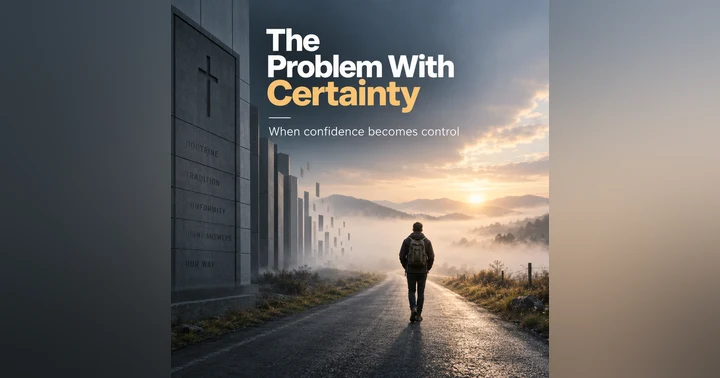
The Problem With Certainty