What Does It Mean to Thrive?
What Does It Mean to Thrive?
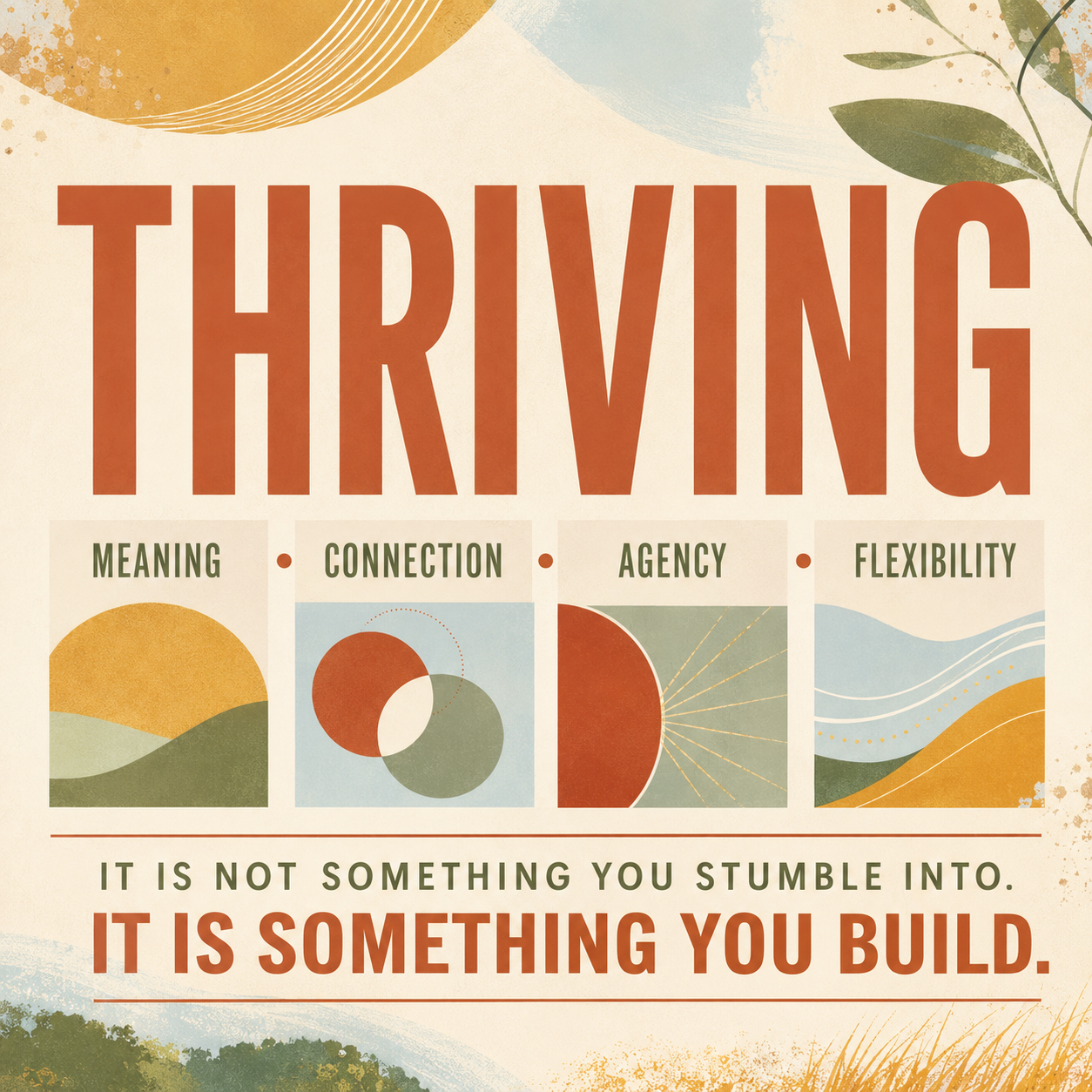
Thriving is the practice of building a life that supports meaning, connection, agency, and flexibility. It is not perfection. It is not constant happiness, endless productivity, or somehow becoming unaffected by pain. Thriving does not mean every relationship works, every decision is clear, or every day feels meaningful. It means you are developing the internal and external support necessary to remain engaged with your life, even when that life becomes difficult.
Thriving is not a destination you finally reach. It is a practice.
What Gives My Life Meaning?
Meaning is not the same as activity. A full calendar can keep us busy without making us feel that our lives are actually going anywhere. We can meet every obligation, complete every task, and still carry a quiet sense that something important is missing.
That dissatisfaction is not necessarily a sign that something is wrong with us. It may be an invitation to pay closer attention. What parts of life leave you with a deep sense of satisfaction? Which relationships, experiences, or contributions make you want to create more moments like them?
Meaning also requires us to examine the stories we tell about ourselves. Some of those stories were formed during seasons that no longer exist. Others were handed to us by families, churches, workplaces, or people who needed us to remain a particular version of ourselves.
What story about yourself needs to be updated?
Perhaps you are no longer the person who must keep everyone happy. Perhaps changing your mind does not make you unreliable. Perhaps the failure that once defined you has already taught you everything it needed to teach. Thriving sometimes begins when we stop organizing our present life around an outdated story.
What Gives Me Connection?
Connection is more than being surrounded by people. It is the experience of being known, valued, and able to participate without constantly performing.
Who makes you feel more like yourself?
That question can reveal a great deal. Some relationships make us smaller, more guarded, or increasingly unsure of ourselves. Others create room for honesty, curiosity, laughter, disagreement, and growth. Healthy connection does not require us to disappear in order to preserve the relationship. There is also another side to the question: How are you helping other people thrive?
Someone may feel connected because you remembered what they were carrying, asked a thoughtful question, listened without preparing an answer, or made room for them to speak honestly. Thriving is personal, but it is not private. We help create the conditions in which other people can become more fully alive.
Biblical community should do exactly that. It should not merely keep people present, agreeable, or involved. It should help them become known, supported, challenged, and equipped to participate meaningfully in the lives of others.
What Gives Me Agency?
Agency is the growing awareness that effective action is still possible. It usually does not arrive through a dramatic life overhaul, a perfect routine, or a 24 step morning ritual. It grows through small, repeated experiences that provide evidence that we are not completely powerless.
That evidence may sound ordinary:
- I made the call.
- I asked the question.
- I said no.
- I took the next step.
- I repaired what I could.
- I rested before I became frustrated
- I noticed a pattern and interrupted it.
None of these actions may change an entire life in a single afternoon. Together, however, they begin changing the story we believe about ourselves. The mind and nervous system receive repeated evidence that action is still possible, that every pattern is not permanent, and that we are capable of responding rather than merely reacting.
Rest can also be an act of agency. It does not have to involve a retreat, a vacation, or an elaborate self-care routine. Rest may look like a quiet moment, enough water, fewer transitions, a slower morning, a walk, a protected lunch, or boundaries around messages.
Resting before you collapse is not weakness. It is evidence that you have begun participating in your own care.
What Gives Me Flexibility?
Flexibility is the ability to adjust when circumstances change. More importantly, it is the willingness to change our minds when new understanding requires it.
Only you can fully answer what flexibility needs to look like in your life. It may mean releasing a plan that no longer serves its purpose. It may mean admitting that an old interpretation was incomplete. It may mean trying another approach instead of repeating something simply because it once worked or because it is what you have always done.
If we are genuinely trying to become more like Jesus, change should not frighten us. Transformation requires more than accumulating information. It requires allowing truth to correct us. Repentance itself involves a reorientation, a willingness to see differently and then live differently because of what we have seen.
Rigidity can sometimes masquerade as conviction. But refusing to reconsider anything is not necessarily faithfulness. Faithfulness may require holding firmly to what is true while remaining humble enough to recognize that our understanding of it can still grow.
What Is My Posture When Someone Interrupts My Version of Thriving?
It is easy to talk about growth until someone challenges the version of life we have already built.
Sometimes another person asks a question that exposes a contradiction. They notice a pattern we have normalized. They challenge an interpretation, relationship, habit, or system that provides us with comfort and stability. Our first instinct may be to defend ourselves, dismiss the person, question their motives, or protect what feels familiar.
That response is worth examining.
When someone interrupts your view of thriving, what is your posture? Are you curious or defensive? Do you listen for what might be true, or immediately gather evidence for why the other person is wrong? Are you willing to become uncomfortable long enough to consider that something you call healthy, faithful, or successful may no longer be producing life?
Not every challenge is wise, accurate, or offered with good intentions. Thriving does not require surrendering your judgment to every person with an opinion. But maturity does require enough security to examine a challenge without treating it as a threat. Sometimes the interruption is the gift.
This is particularly difficult in churches and communities that have confused stability with health. A person who raises an important question can quickly be labeled divisive, negative, rebellious, or spiritually unhealthy. But the disturbance may not be the problem. The disturbance may simply reveal a problem the community has learned not to see.
If our version of thriving can survive only by silencing questions, avoiding feedback, protecting leaders, or refusing to reconsider inherited assumptions, it is probably not thriving. It is preservation.
A healthy posture does not mean agreeing with every criticism. It means being willing to ask:
- Is there something here I need to hear?
- Why does this question make me defensive?
- Am I protecting something because it is true or because it is familiar?
- What would I have to admit if this person is even partly right?
- Is this interruption threatening my well-being, or merely disrupting my comfort?
Thriving requires more than building a life that feels good from the inside. It requires remaining open to the people, questions, and experiences that reveal where our lives have become too small, too rigid, or too carefully protected. The goal is not to become impossible to disturb. The goal is to become the kind of person who can be disturbed without immediately shutting down. That may be one of the clearest signs that thriving is actually taking place.
Thriving Has to Be Built
Meaning, connection, agency, and flexibility rarely appear by accident. They have to be built, practiced, and supported. This is similar to what we might call accidental holiness: the assumption that we will somehow drift into spiritual maturity simply by remaining near religious activity. We attend, listen, agree, and participate, expecting that proximity will eventually produce transformation. But people do not accidentally become deeply loving, emotionally healthy, wise, courageous, or responsive to God.
Those qualities are cultivated through practice. We can see a similar pattern in churches and communities. There are preservationists, renewal-minded people, and builders.
Preservationists protect the status quo. They may sincerely value what already exists and work hard to keep it functioning, but preservation can become the goal even when the existing structure no longer helps people thrive.
Renewal-minded people recognize that something needs to change. They feel the tension, talk about possibilities, and genuinely desire something better. But they can become trapped in a high noise-to-signal environment—surrounded by concerns, ideas, traditions, resistance, and competing priorities without being able to identify the next meaningful action.
Builders build. They do not necessarily possess all the answers. They are simply willing to take what they can see and begin creating something that supports life. They ask better questions. They test ideas. They notice what is helping people grow and what is quietly keeping them stuck. They repair what they can, release what no longer works, and take the next available step.
Thriving requires that same posture. We do not need to redesign our entire lives by next Monday. We need to notice what gives life meaning, which relationships create genuine connection, where effective action remains possible, and what we may need to reconsider. Then we build from there. Not perfectly. Not all at once. But deliberately.
Thriving is not something we accidentally stumble into. It is something we learn to participate in.

The Problem With Certainty