What Does Jesus Mean by the Kingdom?
What Does Jesus Mean by the Kingdom?
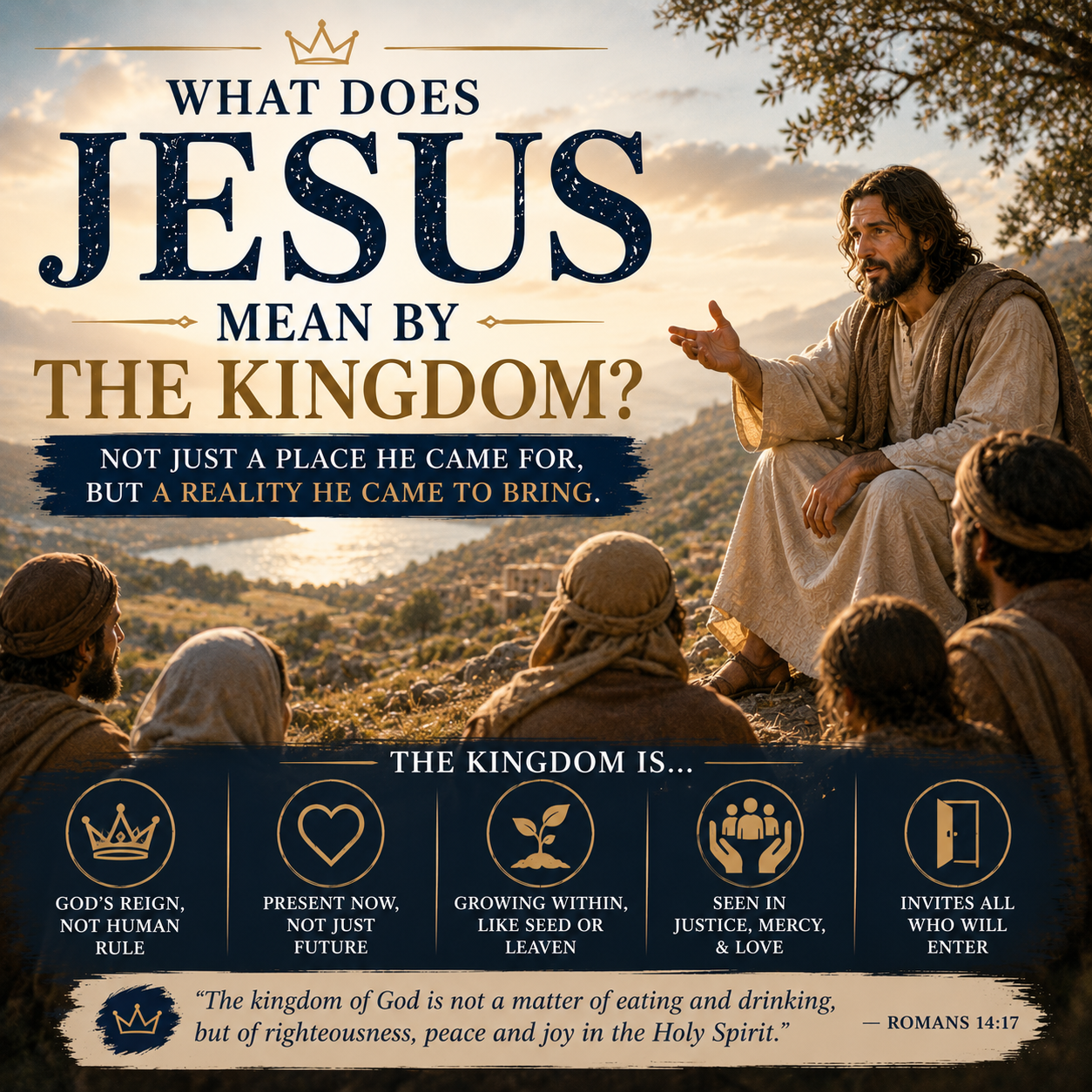
When Jesus speaks of the kingdom of God or the kingdom of heaven, He means something specific: God's saving, kingly rule breaking into history through Jesus Christ. This kingdom is present now in hidden form and will be fully revealed when He returns. Understanding what Jesus means by kingdom reshapes how we read the bible, follow Him, and live in the world today.
Overview
When Jesus announces the kingdom, He is declaring that God's reign has arrived in His person and work. Here is what that means at a glance:
-
The kingdom of God is God's sovereign reign. His active rule and authority more than a place or territory.
-
The kingdom is both present and future: already inaugurated through Jesus' life, death, and resurrection, yet not fully consummated until He returns.
-
Jesus Christ is the King at the center of the kingdom, and His cross and resurrection define what kind of rule God exercises.
-
The kingdom creates a new people, citizens who live under God's rule by repentance, faith, and the Spirit's power.
-
The kingdom will be completed at Christ's second coming, when sin, satan, and death are finally defeated.
The rest of this article unpacks what this kingdom is, why Jesus preached it so often, and what it means for our lives today.

What Did Jesus Mean by the Kingdom of God and Kingdom of Heaven?
The gospels use two phrases to talk about the same reality. Mark and Luke prefer "kingdom of God," while Matthew - writing for a Jewish audience sensitive to speaking God's name tends to use "kingdom of heaven." Both refer to God's sovereign rule revealed in and through Jesus Christ.
At its core, the phrase kingdom of God emphasizes God's active rule. The Greek word basileia means reign, authority, and kingship rather than a geographic province. God's kingdom is not a geographical territory but a spiritual reality, the dynamic exercise of God's power to save, judge, and restore.
In first century Jewish expectation, "kingdom" carried enormous weight. Jews under Roman occupation longed for God to step in, judge evil, and fulfill Old Testament promises like Daniel 2:44 and Isaiah 52:7. They anticipated a Davidic king who would set the world right.
Jesus redefines those expectations. Instead of a political revolt against Rome, the kingdom of God arrives through His teaching, healing, forgiving sins, casting out demons, and ultimately through His cross and resurrection. In Mark 1:15, Jesus proclaimed, "The kingdom of God is at hand; repent and believe in the gospel." In Luke 4:43, He declared, "I must preach the kingdom of God to other cities also, for therefore I have been sent."
The kingdom was the heart of Jesus' message - and understanding it requires distinguishing between God's universal rule and His saving kingdom.
God's Eternal Rule and His Saving Kingdom
Scripture reveals two dimensions of God's kingship. First, God already reigns over every star, nation, and era. His throne is established in the heavens (Ps. 103:19), and He is called King of kings and Lord of lords (1 Tim. 6:15). God's reign is God's sovereign governance over all things - nothing in the universe escapes His authority.
But Jesus' ministry announces a focused, saving dimension. God's reign implies a saving and redeeming activity: His royal power coming to forgive, restore, and renew, not merely to control or condemn. This is the good news of Luke 19:10 - the Son of Man came to seek and save the lost.
This saving rule creates a new people. Citizens of God's kingdom share in a new covenant, new birth, and a new way of life shaped by the King (Jer. 31:31–34; 1 Pet. 2:9–10).
Think of it this way: God's universal reign is like a king's legal right to rule an entire land. The kingdom of God, as Jesus preaches it, is the places and people where that rule is actually welcomed, loved, and lived out. When Jesus talks about "entering" the kingdom, He is not inviting escape from earth but inviting people into this saving, relational rule - a life under God's authority right here and now.
The Kingdom Announced: "The Time Is Fulfilled"
Around AD 27–30, in Galilee under Roman rule, Jesus launched His public ministry with a stunning declaration. Mark 1:14–15 records it: "The time is fulfilled, and the kingdom of God is at hand; repent and believe in the gospel."
Jesus' first words were, "The time is fulfilled." The Greek peplērōtai ho kairos signals that the long-promised redemptive era rooted in promises to Abraham (Gen. 12:1–3), David (2 Sam. 7:12–16), and the prophets (Isa. 40–66; Dan. 7:13–14) - was arriving. This was not a distant idea but a present reality stepping into history.
Jesus proclaimed, "The kingdom of God is at hand." The word "at hand" means the kingdom has drawn near in the person and ministry of Jesus, even if not yet visible in its fullness. Participation in the kingdom requires a response to its message - and Jesus' response was a command: repent and believe. Jesus began His ministry with the call to repent. Repentance is essential for entering the kingdom of heaven: a change of mind and direction, turning from self interest and rival kings to trust God's kingly grace.
This echoed John the Baptist, who had recently preached, "Repent, for the kingdom of heaven is at hand" (Matt. 3:2). Jesus continues and fulfills that same kingdom message. His very first recorded sermon centers on the kingdom of God, revealing how central this theme is to His identity and mission.
Already and Not Yet: The Timing of the Kingdom
Jesus described the kingdom as a present reality and a future hope. The kingdom of God is both present and future and the phrase "already and not yet" describes the tension of the kingdom being present and future simultaneously.
The "already" is concrete. Miracles performed by Jesus served as evidence of the kingdom's presence: demons driven out (Mark 1:23–28), diseases healed (Mark 1:29–34), sins forgiven (Mark 2:5–12). The Spirit poured out at Pentecost (Acts 2:1–4) confirmed that God's reign had begun. Jesus taught that the least in the kingdom is greater than John the Baptist (Matt. 11:11), showing that something radically new had arrived.
Jesus describes the kingdom as like a mustard seed and leaven (Matt. 13:31–33) small and hidden at first, quietly transforming everything over time. The kingdom of heaven is both present and future, growing toward its full expression.
The "not yet" is equally clear. The Lord's Prayer includes a request for God's kingdom to come: "Your kingdom come, your will be done, on earth as it is in heaven" (Matt. 6:10). Jesus pointed to His future return in glory (Matt. 25:31–34; Rev. 11:15).
Believers live in an overlap of ages: still surrounded by sin, suffering, and death, yet experiencing the powers of the age to come through the Holy Spirit (Heb. 6:5; Rom. 8:18–25). Holding both realities guards us from unrealistic triumphalism and from hopeless pessimism, shaping how we view mission, suffering, and hope.
What Kind of King Is Jesus Christ?
To understand the kingdom of God we must understand its King. Jesus Christ reveals His kingship most clearly in His life, cross, resurrection, and exaltation.
During His earthly ministry (c. AD 27–30), Jesus displayed a paradoxical kingship. He forgave sins (Mark 2:5), calmed storms (Mark 4:39), and raised the dead (Mark 5:41–42) exercising power that belongs only to God. Yet He refused political coronation (John 6:15) and entered Jerusalem on a humble donkey (Matt. 21:5), shocking those who expected human kings to ride war horses.
Jesus traded the throne for a cross. He accepted crucifixion under Pontius Pilate because the kingdom of God advances not by violent revolt but by His sacrificial death for sinners (Mark 10:45; Col. 1:13–14). His death defeated the power of sin and satan in a way no army ever could.
Jesus's resurrection reveals the kingdom of God most gloriously. On the third day, God declared Jesus "both Lord and Christ" (Acts 2:36), publicly vindicating Him as the world's true King. The new testament letters summarize kingdom language with the confession "Jesus is Lord" (Rom. 10:9; Phil. 2:9–11) - the kingdom of God is inseparable from the lordship of the crucified and risen Christ.
The practical implication is direct: to speak about entering or seeking the kingdom is to speak about bowing to Jesus' loving, sovereign rule in every area of life.
How Do People Enter and Live in God's Kingdom?
Entrance into the kingdom of God is not by ethnicity, moral achievement, or social status. Entering the kingdom requires a transformation of the heart and mind - new birth, repentance, and faith in Jesus Christ.
Jesus makes this plain to Nicodemus in John 3:3–5: "Unless one is born again he cannot see the kingdom of God." This refers to spiritual rebirth by the Holy Spirit, not self-improvement or religion. Jesus warned that rejecting the kingdom leads to eternal consequences.
-
The kingdom belongs to the "poor in spirit" and those persecuted for righteousness (Matt. 5:3, 10). Citizens of the kingdom must rely on God like children - with humble, dependent trust (Matt. 18:3–4).
-
The kingdom operates on principles opposite to worldly values, where the last are first and the least are greatest.
Kingdom life is marked by the fruit of the spirit and kingdom rules rooted in scripture: righteousness, peace, and joy in the Holy Spirit (Rom. 14:17), forgiveness and enemy-love (Matt. 5:43–48), generosity, justice, and mercy (Matt. 23:23). This is not a distant, abstract blessing - it is daily life under God's rule.
Citizens of God's kingdom represent their King in workplaces, families, neighborhoods, and civic engagement. They act as ambassadors (2 Cor. 5:20) whose lives point to a different allegiance not to comfort or self interest, but to the glory of the King.
Examine which kingdom governs your decisions today, self, culture, politics and respond by surrendering to Christ's reign through grace and faith.
Parables and Pictures: How Jesus Describes the Kingdom
Jesus used parables to illustrate the nature of the kingdom of God - everyday stories with a spiritual punch that both revealed and concealed its truth (Matt. 13:10–17). These vivid word pictures anchor what the kingdom means in concrete images.
Consider three parables from Matthew 13:
-
Mustard Seed (Matt. 13:31–32): The kingdom starts impossibly small - a single seed - but grows into a great tree. Tiny beginnings, massive outcomes.
-
Leaven (Matt. 13:33): A woman hides leaven in dough, and it silently transforms the whole batch. The kingdom works from the inside out.
-
Treasure and Pearl (Matt. 13:44–46): The kingdom of heaven is described as a hidden treasure and a pearl of great price. The kingdom is of supreme value, worth sacrificing everything to attain it. The kingdom of heaven is described as a treasure worth seeking - and the finder sells everything joyfully.
The parable of the wheat and weeds (Matt. 13:24–30) illustrates the present mixture of good and evil until the final judgment. The kingdom is present but not yet purged and perfected.
The workers in the vineyard (Matt. 20:1–16) stresses grace over human merit - citizenship in God's kingdom is a gift, not wages earned. And the Prodigal Son (Luke 15:11–32) reveals a father who runs to embrace repentant children, overturning both the pride of the pharisees and the distance of rebels.
These images teach that God's kingdom is valuable, disruptive, gracious, and ultimately unstoppable - even when it seems small or hidden in the world.
Kingdom Hope: Future Consummation and Present Confidence
The kingdom of God will one day be fully revealed when Jesus returns, bringing final justice, resurrection, and new creation. This is the hope that sustains believers through every season of suffering and loss.
Jesus taught this concretely in Matthew 25:31–34: the Son of Man coming in glory, sitting on His throne, gathering the nations, and welcoming the righteous into "the kingdom prepared for you from the foundation of the world." Key texts like 1 Corinthians 15:20–28, Revelation 11:15, and Revelation 21:1–5 portray the kingdom's consummation as Christ putting every enemy under His feet - sin, satan, and death - and renewing heaven and earth. There will be no more death, no more tears, only the presence of God filling all creation.
This future kingdom hope encourages christians who suffer persecution, injustice, or loss today. God's kingdom guarantees that evil will not have the final word, even if present circumstances look dark (Rom. 8:18–25). The answer to despair is not denial but the certain promise that the King is returning.
The church's mission flows from this hope. God's people are called to pray "Your kingdom come," to preach the gospel of the kingdom to all nations (Matt. 24:14), and to live now as previews of that coming reality through acts of healing, justice, mercy, and truth-telling.
Live as loyal citizens of God's kingdom anchored in Christ's finished work, empowered by the spirit, and oriented toward the day when the King is openly seen as Lord of all. That day is coming. Let it shape how you live, love, and hope right now.
FAQ: Common Questions About the Kingdom of God
Readers often have practical questions about God's kingdom that go beyond the main flow of this article. Here are answers to several of them.
Is the kingdom of God the same as heaven?
Not exactly. In scripture, "heaven" can refer to God's dwelling place or to the renewed creation. The terms kingdom of God and kingdom of heaven in the gospels refer to God's saving reign that begins now and will culminate in the new creation - a renewed heaven and earth. The kingdom is broader than "where we go when we die." It is God's rule invading history and ultimately transforming the whole cosmos. Believers who die before Christ's return are "with Christ" (Phil. 1:23; 2 Cor. 5:8), awaiting the full revelation of the kingdom in the bodily resurrection. The kingdom is not an escape from the physical kingdom of creation but its restoration.
How is the kingdom of God different from the church?
The church is the community of people who confess Jesus as Lord and are called to live under His rule. The kingdom of God is the broader reality of God's reign itself. The church is meant to be a visible outpost and preview of the kingdom - imperfect yet real - pointing beyond itself to the King and His coming world. No single denomination or local congregation equals the kingdom in its fullness, but the church plays a central role in God's kingdom plan. When a church practices forgiveness, justice, and sacrificial love, it displays the kingdom of heaven in miniature - a living testament to the King's character in the midst of a broken world.
Can someone experience God's kingdom without knowing Jesus' name?
God's common grace and moral law are at work in every culture. People may sense God's rule and moral claims through conscience and creation (Rom. 1:18–20; 2:14–15). But the new testament consistently ties entering the kingdom to explicit faith in Jesus Christ (John 14:6; Acts 4:12). The saving knowledge of God's kingdom - reconciliation, adoption, salvation, and eternal life - comes through the gospel of Christ. This is not narrowness but gracious clarity: God has made the way into His kingdom known in the person and work of His Son. Believers should respond by praying for and sharing Christ with neighbors and nations who have not yet heard the good news of the kingdom.
What does it mean to "seek first the kingdom of God" in daily life?
In Matthew 6:33, Jesus tells His disciples to seek first God's kingdom and righteousness instead of anxiously chasing material security. Seeking the kingdom first means ordering priorities - time, money, relationships, work - around God's will and the honor of King Jesus rather than around comfort, success, or public approval. Concretely, this looks like:
-
Choosing integrity over compromise at work
-
Valuing gathered worship, discipleship, and prayer
-
Practicing generosity and mercy even when it costs something
This is not about perfection but about allegiance: day-by-day, imperfect yet real surrender to God's reign, trusting His promise to provide what we truly need. The kingdom shapes every corner of life - not just the "spiritual" parts - because its King claims authority over the whole of creation.

The Problem With Certainty