What Is a Religious Creed? Meaning, History, and Christian Examples
What Is a Religious Creed? Meaning, History, and Christian Examples
If you have ever attended a church service and heard an entire congregation stand and declare, "I believe in God, the Father almighty," you have witnessed a creed in action. Religious creeds have shaped faith, worship, and identity for centuries, and understanding them unlocks a clearer picture of how billions of people organize their deepest convictions. This guide covers what a religious creed actually is, where creeds come from, and how the most influential christian creeds still function today.
Overview
-
A religious creed is a short, fixed statement summarizing the core beliefs of a faith community, such as the apostles creed in the christian church.
-
The English word "creed" comes from the latin word credo, meaning "I believe," which opens several classic christian creeds.
-
Christian creeds like the apostles creed, nicene creed, and athanasian creed emerged in the early church to teach the christian faith and defend it against heresy.
-
Creeds are formal statements of religious beliefs that unify communities, educate newcomers, and guard doctrine across generations.
-
Not all Christians or religions use formal creeds; some emphasize scripture, practice, or personal experience instead of fixed formulas of belief.
What Is a Religious Creed? (Fast, Simple Definition)
A religious creed is a formally recognized, relatively brief statement that summarizes the essential beliefs of a religious community. Creeds are usually memorized or recited in worship, serving as a shared declaration of what a group holds to be true about god, humanity, and salvation.
In Christianity, "creed" most often refers to historic, widely accepted formulas such as the apostles creed or nicene creed, recited in liturgy across many christian denominations. Creeds provide a clear statement of the essential teachings of a faith, distilling complex theology into language that ordinary believers can carry with them.
Creeds differ from longer confessions of faith or catechisms, which go into more doctrinal detail and are often specific to a particular denomination or region. A creed is compact by design. Consider this opening line from the apostles creed:
"I believe in God, the Father almighty, creator of heaven and earth."
That single sentence captures an entire worldview in under fifteen words.
Where Does the Word "Creed" Come From?
The word itself reveals what creeds are meant to do. The term creed comes from the latin word credo, traditionally translated "I believe" or "I trust." It appears as the opening word of the major christian creeds in their Latin versions.
This first-person format, whether "I believe" or the communal "We believe," marks the creed as a personal and corporate confession of faith, not merely an abstract list of theological ideas. In Latin liturgy, the apostles creed and nicene creed were known simply as the Credo, underscoring their central role in expressing christian beliefs.
Other religions use different native terms with a similar function. In Islam, the term aqīdah refers to formal statements summarizing belief. In Judaism, the Shema ("Hear, o israel: the LORD our God, the LORD is one") functions as a foundational declaration of faith. Though these are not usually translated as "creed," they serve parallel purposes.
Why Do Religions Develop Creeds?
Creeds do not appear by accident. They arise when a religious community faces specific historical pressures that demand clarity about what its members actually believe.
Expanding, missionary religions like the early christian church in the Roman Empire needed concise summaries of faith for teaching converts and maintaining unity across vast geography. When a new believer in Antioch and another in Rome both needed to understand the same gospel, a shared formula became essential. Creeds unify communities by articulating core doctrines that hold diverse groups together under a single shared identity.
Creeds also function as identity markers. In the pluralistic environment of the ancient Mediterranean world, where Christians lived alongside pagans, mystery cults, and competing sects, having a fixed creed clarified who belonged and who did not. Creeds promote shared identity among members of a religious community and serve to clarify doctrine and define what must be believed.
Beyond identity, creeds act as a summary of the most crucial non-negotiable points of doctrine, helping church leaders separate core orthodox teachings from conflicting ideas or heresies. Early formulas like "Jesus is Lord" (1 Corinthians 12:3) were already serving this purpose at baptisms and in worship during the earliest days of the faith.
Creeds in the Early Christian Church
From the first century onward, the early church used extremely short confessions in its daily life. Phrases like "Jesus is Lord" (Romans 10:9) or "Jesus Christ is the Son of God" appeared at baptisms, during persecution, and in fellowship. These were oral traditions, not yet written down as formal creeds.
By the second and third centuries, longer "rule of faith" summaries developed in centers like Rome and Antioch. The old roman symbol, an early baptismal formula, anticipated the structure of the later apostles creed. These formulas gave church leaders a clear standard for deciding who was ready for baptism and full participation in the christian faith.
Early creeds also served as educational tools for faith followers. Catechumens, the baptismal candidates preparing to enter the christian community, memorized these summaries as part of their instruction. Creeds help educate children and newcomers about the basics of faith, a function that has persisted from the earliest days through the present.
The pre-Pauline creed in 1 Corinthians 15:3–7 is a landmark example. Paul writes that Christ "died for our sins," was "buried," was "raised on the third day," and "appeared to Cephas, then to the Twelve." Scholars widely date this formula to within a few years of the resurrection itself, making it one of the oldest doctrinal statements in Christianity.
The Three Major Ecumenical Christian Creeds
The term ecumenical creeds refers to those statements of faith widely accepted across the major branches of Christianity, including Roman Catholic, Eastern Orthodox, and many Protestant churches. Three classic creeds hold this distinction:
-
The apostles creed
-
The nicene creed (more precisely, the Niceno-Constantinopolitan Creed)
-
The athanasian creed
These creeds emerged between the second and sixth centuries to clarify key doctrines about the trinity and the person of christ for the whole church. While wording may differ slightly between traditions and languages, these several creeds still shape christian beliefs globally, binding diverse groups under a single shared identity across continents and centuries.
Each creed has its own origin, structure, and continuing role, which the following sections explore in detail.
The Apostles' Creed: Earliest Summary of the Christian Faith
The apostles creed is one of the simplest and most widely used christian creeds, especially in Western churches. The apostles creed summarizes essential christian beliefs in a compact, memorable format that has been recited for over a millennium.
Despite its name, there is no historical evidence that the twelve apostles wrote this creed. Rather, it crystallized between the second and fourth centuries, growing out of earlier Roman baptismal formulas like the old roman symbol. The legend that the apostles wrote it appeared later as a pious tradition, not a historical claim supported by evidence.
Its structure is triadic, organized around belief in three persons of the trinity:
-
God the father almighty, creator of heaven and earth
-
Jesus christ, his only son, our one lord, born of the virgin Mary, who suffered death, died and was buried, rose again, and will return to judge the living and the dead
-
The holy spirit, the holy catholic church, the communion of saints, forgiveness of sins, resurrection of the body, and life everlasting
The creed's main uses include preparation for baptism, daily prayer, catechesis of new believers, and Sunday worship across many christian denominations. Both Roman Catholic and numerous Protestant communities, including Lutheran, Reformed, Anglican, and Methodist churches, regularly recite it as a shared confession of faith.

The Nicene Creed: Defining Orthodoxy in the Fourth Century
The nicene creed emerged from one of the most consequential theological disputes in Christian history. The arian controversy, in which a priest named Arius argued that Jesus Christ was a created being, not fully God, threatened to fracture the church in the early fourth century. Emperor Constantine convened the first council of Nicaea in AD 325, gathering bishops from across the empire to settle the question.
The council of nicaea produced a creed that decisively affirmed the divinity of Jesus Christ. The nicene creed was adopted in AD 325 at Nicaea and declared the Son to be "true god from true God, begotten, not made, of one being (homoousios) with the Father." This language made it impossible to reduce Christ to a lesser, created being.
The creed was revised and expanded at the First Council of Constantinople in AD 381, adding a fuller statement on the holy spirit as "the Lord, the giver of life," and affirming one baptism for the forgiveness of sins, the resurrection of the dead, and the life of the world to come. It also confesses belief in one holy, catholic, and apostolic church.
The nicene creed is central in the liturgy of the eastern orthodox church, Roman Catholic, Anglican, and many Lutheran churches, typically recited at Sunday Eucharist. It affirms that jesus christ is fully god, of one substance with god the father, a claim that remains the cornerstone of Christian orthodoxy.
One lasting source of disagreement deserves mention. Western churches later added the phrase "and the Son" (Filioque) to the article on the holy spirit, asserting that the Spirit proceeds from both the Father and the Son. The Eastern Orthodox church never accepted this addition, and the dispute contributed to the Great Schism of 1054 between Eastern and Western Christianity.
The Athanasian Creed: A Detailed Trinitarian Formula
The athanasian creed offers the most detailed classic statement of the trinity and the person of Christ among the ecumenical creeds. It was probably composed in the fifth or sixth century in Latin, likely in southern Gaul (modern France), reflecting mature Western Trinitarian theology developed after the Council of Chalcedon in 451.
Despite its name, the creed was almost certainly not written by Athanasius of Alexandria. Scholars regard its attribution as honorary rather than historical. Its earliest definite liturgical use appears at the Fourth Synod of Toledo in 633.
The creed contains two major sections:
-
A careful definition of the trinity as one god in three co-equal, co-eternal persons, a holy God who is Father, Son, and Holy Spirit without division or confusion
-
An explanation of Christ as one person with two natures, fully God and fully human, echoing the chalcedonian definition
The athanasian creed also includes solemn warnings, known as "damnatory clauses," about the necessity of holding the catholic faith. Because of its length and these stern declarations, it is less frequently recited today than other creeds, sometimes appearing only on Trinity Sunday in certain Anglican or Lutheran services. Nevertheless, it remains influential as a theological guide in formal doctrinal discussions among Western christian denominations.
How Creeds Shape and Protect Christian Beliefs
Creeds are not simply relics of ancient church councils. They actively shape how christians understand and practice their faith across time and culture however they are grossly misunderstood.
In both ancient and modern contexts, creeds serve as a measuring stick for orthodoxy. Creeds establish orthodoxy against false teachings, helping churches discern whether new teachings align with the historic christian faith. Such declarations have historically been invoked in church discipline: when members publicly denied central articles of the creed and refused to repent, excommunication or other forms of correction followed to guard the community's witness.
Creeds are often recited in public worship to show unity, reminding a congregation that its beliefs are not private opinions but shared convictions rooted in scripture and christian tradition. At the same time, many churches distinguish between essential creedal doctrines, such as the trinity, incarnation, and resurrection, and secondary issues like church governance or end-times timelines, where legitimate diversity of opinion is allowed.
Christian Traditions With and Without Formal Creeds
Not all Christian groups relate to creeds in the same way, and the differences reveal important things about how various traditions understand authority and identity.
Roman Catholic, Eastern Orthodox, Anglican, Lutheran, and many Reformed churches, including the christian reformed church, officially affirm the ecumenical creeds and include them in catechisms and worship services. The eastern orthodox church particularly emphasizes the nicene creed, recited without the Western Filioque addition, as a core expression of the christian faith in its liturgy and theology.
Other creeds and confessional documents supplement the ecumenical creeds in various traditions. Lutheran churches hold the Book of Concord; Reformed churches subscribe to documents like the Westminster Confession or the Belgic Confession. These function as extended statements of faith that build on the foundations laid by the classic creeds.
On the other end of the spectrum, some traditions are "non-creedal" or even "anti-creedal." Certain Anabaptist groups, Quakers, and parts of the Restoration Movement prefer slogans like "No creed but Christ" or "No creed but the Bible," viewing formal creeds as potential obstacles to the authority of scripture alone.
Groups such as Jehovah's Witnesses or Latter-day Saints reject the classic ecumenical creeds while still publishing their own summaries of belief, demonstrating that some form of doctrinal statement is nearly universal even when historic creeds are refused. Creeds function, in one form or another, in virtually every organized religious community.
Creeds Beyond Christianity: Other Religious Parallels
While the word "creed" is most commonly used in Christian contexts, similar such declarations exist across the world's major religions.
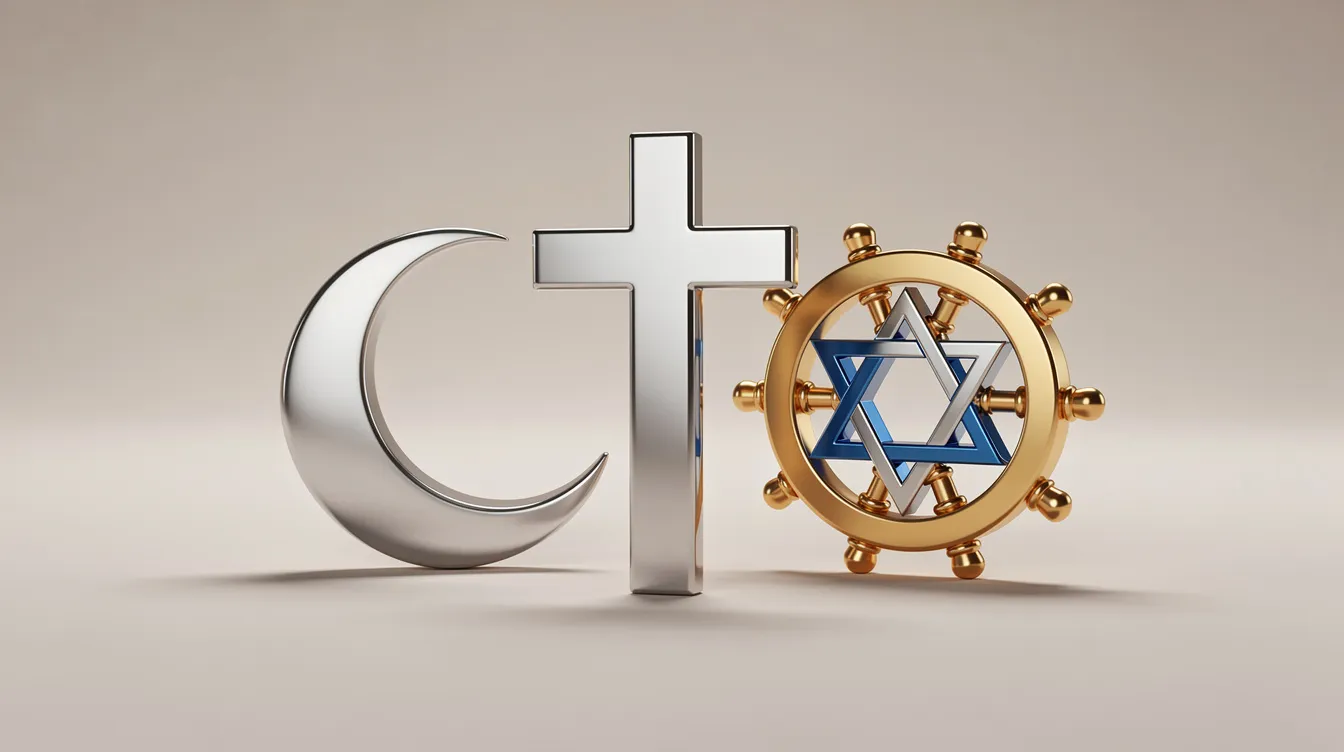
The Shahada is the central declaration of faith in Islam: "There is no god but God; Muhammad is the Messenger of God." This brief, foundational profession must be sincerely recited at least once to become a Muslim, and it functions much like a creed in daily life and religious ceremonies. Beyond the Shahada, Islamic aqīdah literature, such as the al-Fiqh al-Akbar attributed to Abū Ḥanīfa, summarizes core beliefs about god, prophets, and the afterlife in formal statements similar to Christian creedal documents.
The Shema expresses a central affirmation of Jewish faith: "Hear, o israel: the LORD our God, the LORD is one" (Deuteronomy 6:4). Recited twice daily by observant Jews, it functions as a declaration of monotheism. Maimonides' Thirteen Principles of Faith, composed in the twelfth century, also serve as a creed-like summary in many traditional Jewish circles. That said, not all religions have a formal creed; Judaism, for instance, historically places more emphasis on practice and Torah observance than on fixed belief statements.
In some Eastern religions, formulas like the Buddhist "Three Refuges" or the Sikh Mul Mantra serve similar identity-marking and teaching functions, even when not called creeds. Religion, across traditions, tends to produce concise summaries wherever communities need shared language for their core tenets.
Do We Still Need Religious Creeds Today?
In a pluralistic age marked by declining religious affiliation - Pew Research reports that only about 62% of U.S. adults now identify as Christian, down from 78% in 2007 - what role can fixed statements like creeds still play?
Critics raise legitimate concerns. Creeds can feel rigid or formulaic, potentially excluding honest questioners or reducing living faith to mere recitation. In interfaith and secular contexts, their exclusivist claims sometimes become social or political flashpoints. Translation and cultural shifts can also complicate the meaning of ancient formulas for modern audiences.
Yet some believe that creeds continue to offer real value. They provide clarity in a confusing religious landscape, connect believers to the wisdom of earlier generations, and create a shared vocabulary that transcends denominational and cultural boundaries. Creeds serve to unify communities by articulating core doctrines, and they help ensure doctrinal consistency within religious communities that span continents and centuries. However they are rarely taught and mostly implied.
Rather than viewing classic christian creeds as replacements for scripture or personal faith, it helps to see them as starting points for deeper exploration of the Bible and theology. Understanding what a religious creed is helps anyone, Christian or not, make better sense of Christian worship, history, and the ongoing debates about doctrine, teachings, and identity. But more importantly the individual has to decide if the creed is simply a tradition that the community follows or a true rule to be followed.
Whether you encounter creeds in a Sunday service, a university classroom, or a history book, they remain one of the clearest windows into what a faith community considers non-negotiable about god, christ, and salvation.
Frequently Asked Questions About Religious Creeds
Below are answers to common questions about creeds that go beyond what the main article covers.
Are creeds the same as the Bible?
In the christian faith, creeds are not considered equal to scripture. They are summaries that point to a communities beliefs and/or rules. Many traditional churches treat the ecumenical creeds as faithful interpretations of key biblical teachings about God, Christ, and Salvation (but this is highly argued), but not as a replacement for scripture itself. Some Protestant groups reject binding creeds precisely to preserve the Bible's unique authority as the final standard of christian beliefs.
Do all Christian churches recite the same creed every Sunday?
Practices vary widely. Roman Catholic, Eastern Orthodox, Anglican, and many Lutheran churches typically use the nicene creed at Sunday Eucharist and the apostles creed in other contexts such as baptism or daily prayer. Many evangelical and free churches rarely recite any formal creed in worship, even if they agree with the content. Special services like baptisms, confirmations, Easter, and Trinity Sunday often feature particular creeds more prominently.
Can a creed change over time?
Classic ecumenical creeds are usually treated as fixed texts, though minor translation differences exist between languages and traditions. The most famous example of a change is the Western addition of "and the Son" (Filioque) to the nicene creed's article on the Holy Spirit, a change the eastern orthodox church has never accepted. Modern churches sometimes draft new confessions or statements of faith, but these typically stand alongside rather than replace historic christian creeds.
How can someone start learning the Christian creeds?
The simplest entry point is the apostles creed, thanks to its brevity and clear outline of core christian beliefs about God the father, Jesus Christ, and the Holy Spirit. Try reading it slowly alongside key Bible passages, such as Luke 1–2 for the account of Jesus being born of the virgin, or 1 Corinthians 15 for the resurrection, to see how the creed summarizes scriptural teaching. Many churches and published catechisms, including resources from publishers in grand rapids and elsewhere, offer line-by-line explanations of the apostles creed or nicene creed as an accessible introduction to the christian faith.

The Problem With Certainty