What Is Shalom? The True Meaning of the Hebrew Word for Peace and Wholeness
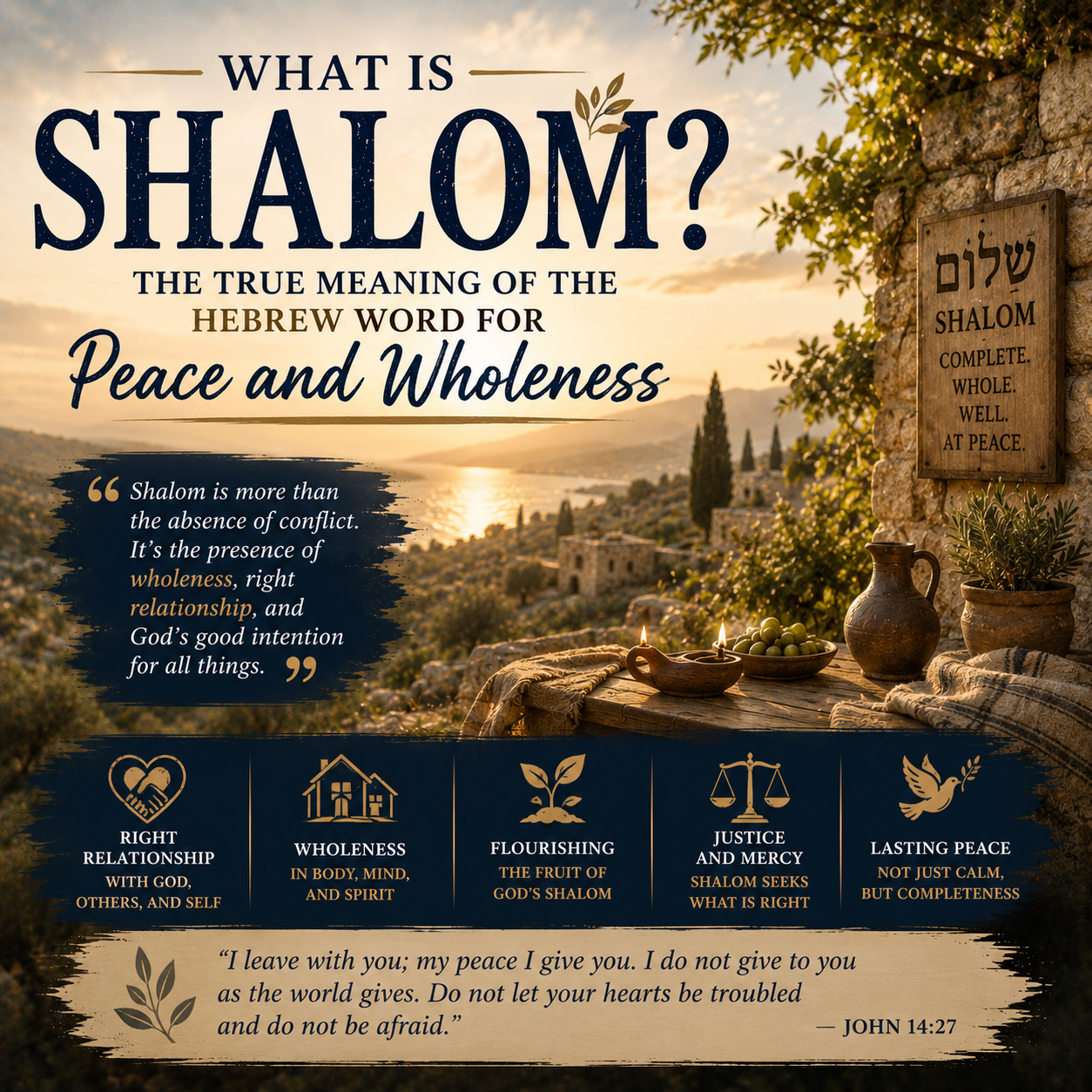
What Is Shalom? The True Meaning of the Hebrew Word for Peace and Wholeness
The hebrew word shalom is one of the most recognized words on earth, yet most people only scratch the surface of what it actually means. Far more than a simple greeting or a wish for calm, shalom carries an entire worldview inside a single word.
Overview
The word shalom (שָׁלוֹם) translates as peace, wholeness, and well being-but it goes far deeper than the English word "peace" typically suggests. In everyday hebrew, shalom means both hello and goodbye, functioning as a blessing each time it's spoken.
-
Shalom means wholeness, completeness, and soundness in every area of life-physical, relational, spiritual, and material.
-
It is rooted in the hebrew word shalem, meaning whole or complete, pointing to a state where nothing essential is missing.
-
Shalom describes completeness in relationships: with God, with others, and within oneself.
-
The concept represents a multidimensional peace encompassing social and spiritual aspects.
This article covers shalom in the bible, jewish tradition, modern speech, prayer, and practical ways to pursue wholeness today.
What Does "Shalom" Mean? (Quick Answer)
So what is shalom? The hebrew word shalom means peace, wholeness, and well being in every dimension of life. It is used as a greeting meaning "may you be full of well-being," not merely "hi" or "bye."
Unlike the English word "peace," which often implies nothing more than the absence of war or conflict, the shalom meaning includes completeness, safety, prosperity, soundness, and harmony. Think of a family gathered around a meal with no unresolved tension, a community where everybody has enough, and a person whose inner life is calm and whole. That picture-all at once-begins to approach what shalom describes.
In modern Israel, shalom serves as a common greeting and a farewell (goodbye), but its roots in scripture and jewish thought run much deeper. Let's explore those roots.

The Hebrew Word Shalom: Roots and True Meaning
Shalom (שָׁלוֹם) is built from the Hebrew root shin-lamed-mem (ש-ל-ם). The same root gives us shalem ("whole, complete") and the verb shalam, meaning to make whole or to restore. According to Strong's Exhaustive Concordance (H7965), shalom covers semantic fields including welfare, health, prosperity, and safety.
In the torah, specifically Exodus 21–22, the verb shalam is used 14 times in the context of paying full restitution-restoring what was damaged until it is complete again. This reveals the true meaning of shalom: a state where nothing essential is missing and nothing broken is left unrestored, materially, relationally, emotionally, and spiritually.
This stands in sharp contrast to the narrower Western sense of peace as merely a cease-fire or a pause in conflict. Biblical shalom is positive fullness, not just the absence of trouble. When a Hebrew speaker asks "Ma shlomcha?"-"How is your peace?"-they are asking about your overall well being, your good health, your circumstances, your wholeness as a person.
Shalom in Jewish Tradition and Daily Life
In jewish tradition, shalom is far more than a word-it is a core religious and ethical principle. Rabbinic literature describes the torah's ways as pleasant ways, declaring that "all her paths are shalom" (Proverbs 3:17). The Sages teach that shalom is the blessing that enables all other blessings in life. Without peace, health, livelihood, and family cannot be enjoyed in harmony.
In Jewish culture, shalom embodies harmony and divine grace. Children learned the importance of shalom as promoting relationships and well being from an early age, absorbing it through prayer, greeting, and community life. Shalom is often associated with God's blessings and peace across jewish communities worldwide.
In daily hebrew speech, shalom functions as a greeting and farewell. The traditional exchange shalom aleichem ("peace be upon you") draws the reply aleichem shalom ("upon you, peace"). Names of synagogues, community centers, and peace organizations frequently include "Shalom" to signal goals of unity, coexistence, and communal well being.
Shalom in the Bible: Peace, Wholeness, and Well-Being
The word shalom appears over 200 times in the Hebrew Bible, with shades of meaning spanning national peace, personal welfare, and spiritual rest. Biblical references to shalom appear across every genre-narrative, law, prophecy, poetry, and wisdom literature.
Shalom as peace between two entities-whether people, tribes, or nations-appears throughout scripture. Treaties and covenants ending war are described with shalom, and the vision in psalm 122 calls readers to pray for the peace of jerusalem, linking the city's shalom to the well being of israel and the world.
Shalom also describes personal welfare. In Genesis 43:27, Joseph asks about his family's shalom-their health, safety, and circumstances. The prophet Isaiah calls the coming messiah the "Prince of Peace" (Isaiah 9:6), and Jesus is identified as this Son who fulfills that promise.
God is referred to as Yahweh-Shalom in Judges 6:24, revealing that the LORD Himself is the source of wholeness. The verse in Isaiah 26:3 declares: "You will keep in perfect peace those whose minds are steadfast, because they trust in you." The passage continues: "Trust in the LORD forever, for the LORD GOD is the Rock Eternal" (Isaiah 26:4). True shalom comes only from God, providing inner peace. To trust God is to find rest even when life is turbulent.
Shalom in Prayer, Blessing, and Jewish Worship
The word shalom appears at climactic moments in Jewish prayer and blessing, serving as the capstone of worship. Shalom is the final word in many Jewish prayers, reflecting its role as the highest spiritual aspiration.
The Aaronic Blessing-the Priestly Blessing given through Moses in Numbers 6:24–26-concludes with a petition for peace: "The LORD bless you and keep you; the LORD make His face shine upon you and be gracious to you; the LORD turn His face toward you and give you shalom." Here, blessing, grace, and God's presence all flow toward the summit of peace.
The central daily prayer, the Amidah, ends with a blessing for peace, asking God to spread a sheltering wholeness over His people. Liturgical texts like Sim Shalom and Shalom Rav close services with requests for peace in the home, in the community, and for israel.
Every Friday evening, the greeting Shabbat Shalom is used to wish others rest and renewal. The traditional shabbat hymn "Shalom Aleichem" welcomes angels of peace into the home, connecting the day of rest with heaven's presence. Classic rabbinic teachings emphasize pursuing shalom actively-resolving conflict, guarding dignity, and building unity-as an imitation of God, who is described as the maker of peace.
Different Dimensions of Shalom: God, Others, and Self
True shalom operates across three intertwined dimensions: relationship with God, relationship with others, and inner well being.
Shalom with God: In scripture, sin is seen as breaking shalom with the Creator, inviting God's wrath and separation. Covenant, sacrifice, and God's forgiveness restore this peace and fellowship. The glory of God's presence fills creation when this relationship is whole. In Christianity, shalom is associated with Christ's reconciling work-the resurrection of Jesus confirmed His identity as the Messiah who restores peace between God and human beings. In the new testament, Jesus greeted His disciples with "Peace be with you" after the resurrection, offering the gift of shalom to everybody who would receive it by faith.
Shalom with others: The concept of shalom includes peace between individuals and classes. It demands justice, fairness, and compassion-not just the absence of open conflict. Social peace requires the end of oppression and violence in relationships. The concept is used for community justice and equity, and it emphasizes ethical ideals, reconciliation, and the prevention of conflict. Shalom implies social harmony and mutual agreement among people across nations and the earth.
Shalom within oneself: Shalom implies an inward sense of completeness and tranquility. Inner peace is the ability to remain tranquil during life's storms-a calm that comes not from favorable circumstances but from praying and trusting God. A person experiences this dimension when their conscience is clear and their hope is anchored.
The full shalom meaning is experienced when these three spheres reinforce one another: spiritual, social, and personal well being working together in harmony.
Shalom in Modern Hebrew and Global Culture
The word shalom remains one of the most recognizable words in the world, symbolizing peace and hope for human beings everywhere. In modern israel, it functions as a standard greeting and farewell-at home, at work, and in formal correspondence. Using shalom fosters an environment of safety and mutual respect in daily interactions.
Shalom appears in the names of educational programs, peace initiatives, and cultural projects seeking reconciliation. It has cognates in other languages, including the arabic salam, which shares a similar root idea of peace-helping shalom resonate in interfaith conversations about prosperity, coexistence, and human flourishing.
Living Shalom: How to Pursue Peace and Wholeness Today
Understanding the shalom meaning invites concrete steps to cultivate peace in personal life and community. The word shalom signifies safety, trust, and healing in relationships-principles that anybody can practice.
-
Seek inner well being: Begin each day with a moment of quiet prayer, choosing to trust God with what you cannot control. Emotional resilience grows through gratitude and regular reflection on scripture.
-
Repair relationships: Make amends where possible, listen carefully, and resolve conflict rather than letting it fester. Children and adults alike benefit when homes are marked by honesty and kindness.
-
Pursue justice: Support efforts that promote fairness, care for the vulnerable, and cross-cultural cooperation. Lasting shalom requires dignity for everybody, not just comfort for a few.
Become a person of shalom-embodying wholeness, grace, and steady peace in daily choices-so that your home, workplace, and community reflect the deeper Hebrew vision of life as God intended it.

FAQ About Shalom
Below are concise answers to common questions that expand on the main sections above.
Is shalom only a religious word, or can anyone use it?
While shalom has deep roots in jewish tradition and the bible, it is also a thoroughly modern word. Secular and religious speakers in israel alike use it daily. Anyone can say shalom as a greeting or blessing. Many people around the world-regardless of faith background-use it to express a desire for peace and well being. The word carries spiritual weight, but it is not restricted to religious contexts; it belongs to everyday hebrew life just as much as to the testament of ancient worship.
What is the difference between shalom and the English word "peace"?
English "peace" often focuses narrowly on the end of conflict or a calm feeling. Shalom includes a far wider sense of wholeness, completeness, and flourishing in all areas of life. A country might have no war but still lack true shalom if there is injustice, poverty, or deep social division. Shalom implies both security and active well being-prosperity, good health, sound relationships, and spiritual wholeness all working together.
How is shalom used in Hebrew greetings like "Shabbat Shalom" or "Shalom Aleichem"?
The phrase shalom aleichem is a traditional greeting meaning "peace be upon you," and the reply is aleichem shalom-"upon you be peace." "Shabbat Shalom" is used on the sabbath (particularly every Friday evening) to wish others a day of rest, harmony, and spiritual and physical renewal. Both expressions reflect the full shalom meaning: not a casual "have a nice day," but a genuine blessing of completeness and well being upon the other person.
Does shalom always refer to inner calm, or can it be material and practical too?
Shalom covers both inner and outer dimensions. It includes emotional rest and spiritual tranquility, but also secure borders, fair relationships, reliable livelihood, and physical health. In biblical and jewish usage, a person, home, or community can be described as having shalom when they enjoy safety, justice, and enough resources to live with dignity. Reducing shalom to a private feeling misses much of its meaning.
How can I start bringing more shalom into my daily routine?
Start with one simple practice: begin each morning with a short moment of quiet or prayer for peace, asking God to grant you wholeness. Choose one relationship to invest in with patience and kindness this week. Before speaking in anger, pause. Each small act of kindness, fairness, and honesty-at home, work, or online-is a concrete way of extending shalom and building a more whole, peaceful environment for everybody around you.

The Problem With Certainty