What Is the Significance of Shepherds in the Bible?
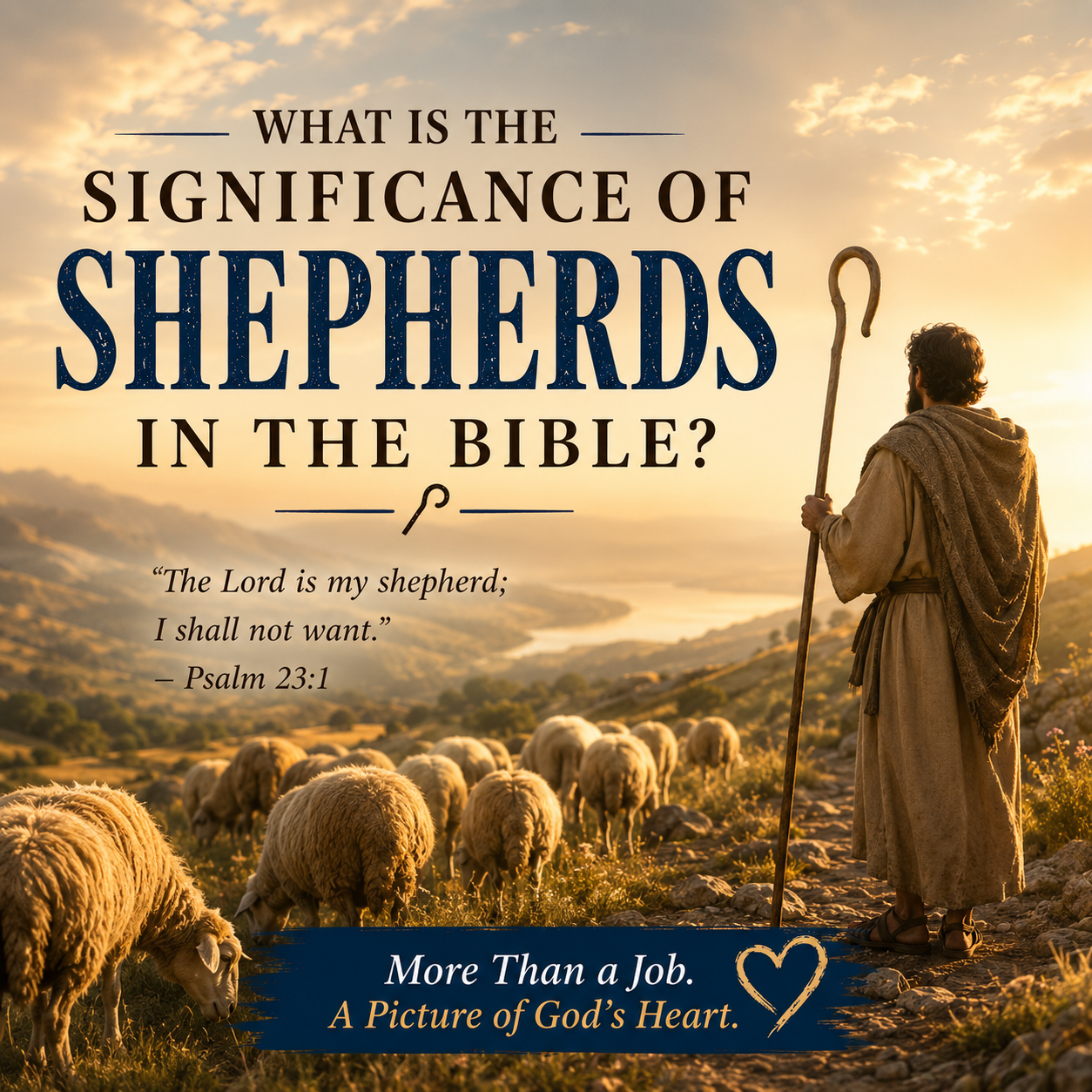
What Is the Significance of Shepherds in the Bible?
Few images in Scripture carry as much weight as the shepherd. From the earliest pages of Genesis to the closing visions of Revelation, the shepherd metaphor illustrates themes of care, guidance, protection, and sacrifice in the Bible. Understanding what shepherds meant in the ancient world-and what they still mean theologically-unlocks one of the most important motifs in all of Scripture.
Overview
-
Shepherds appear over 200 times in the Bible representing leadership and divine care, making the shepherd motif one of the most consistent images from Genesis to Revelation.
-
In the ancient Near East, a shepherd leads, protects, and provides for vulnerable sheep-a concrete role that becomes the Bible's central metaphor for how God relates to His people.
-
Psalm 23 captures the heart of this image: David described God as his shepherd, declaring "the Lord is my shepherd, I shall not want," a confession of total trust in God's provision.
-
Jesus identifies Himself as the Good Shepherd in John 10, fulfilling centuries of Old Testament prophecy about a coming shepherd-king from the line of David.
-
Biblical shepherd language applies to God the Father, to Jesus Christ (Good, Great, and Chief Shepherd), and to human leaders empowered by the Holy Spirit to care for the flock.
-
The low social status of shepherds at Jesus' birth in Luke 2 is a deliberate sign of God's grace toward the humble and marginalized.
Shepherds in the World of the Bible: Historical and Cultural Background
Picture open hills outside Bethlehem, rocky terrain stretching toward the Judean wilderness, and a lone figure moving slowly with a flock of forty or fifty sheep. This was the daily reality for ancient shepherds across the Middle East, from at least the time of Abraham around 2000 BC through the first century AD. Shepherding was a demanding role requiring vigilance and dedication-days under harsh sun, nights exposed to cold, and constant alertness against predators.
A shepherd's job involved far more than simply watching animals graze. The skilled shepherd led sheep to green pastures and still water, used a rod to ward off wild animals like wolves and lions, and relied on a staff to guide straying animals back to the path. When David defended his father's flock from a lion and a bear (1 Samuel 17:34–36), he demonstrated exactly what this occupation required.
Economically, sheep were central to Israelite life. They provided meat, milk, wool for clothing, and-critically-the lambs required for sacrificial worship. Families and clans measured wealth partly by the size of their flocks.
Socially, shepherds occupied an ambiguous position. Patriarchs like Abraham and Jacob were honored flock owners, and King David rose from shepherd boy to Israel's throne. Yet by the first century, many viewed shepherds as rough, ritually unclean, and socially suspect. In surrounding cultures like Egypt and Mesopotamia, kings were often called shepherds of their people, their crooks and scepters echoing a shepherd's rod and staff. The term shepherd carried connotations of both rule and tender care long before the Bible gave it its fullest meaning.

The Shepherd Motif Across Scripture: From Genesis to Revelation
The shepherd motif appears throughout the entire Bible, forming a thread that connects its earliest narratives to its final visions. It is not a passing illustration but a unifying theme that shapes how Scripture talks about God, leadership, and the human condition.
The pattern begins early. Abel is a keeper of sheep in Genesis 4:2. The patriarchs-Abraham, Isaac, and Jacob-own and manage flocks (Genesis 13:5; 30:31–43). Many biblical leaders like Moses and David were shepherds before leading Israel: Moses tended Jethro's flock in Midian before God called him at the burning bush (Exodus 3:1), and David was summoned from his father's sheep to be anointed king (1 Samuel 16:11).
God Himself is explicitly called the Shepherd of Israel. In Genesis 48:15, the aging Jacob blesses Joseph's sons and speaks of "the God who has been my shepherd all my life to this day." Psalm 80:1 addresses God as "Shepherd of Israel," and Isaiah 40:11 describes God as a nurturing shepherd who will "gently lead those that have with young."
In the New Testament, the motif intensifies. Jesus told the parable of the lost sheep in Luke 15:3–7, illustrating God's relentless pursuit of even one wanderer. He then declared "I am the good shepherd" in John 10:11. And in Revelation 7:17, the risen Lamb stands as Shepherd in the final age, guiding the redeemed to springs of living water.
Throughout this arc, a consistent contrast emerges: the faithful shepherd who leads and protects versus the false prophets and corrupt leaders who neglect or exploit. This tension sets the moral and spiritual standard for every generation.
"The Lord Is My Shepherd": Psalm 23 and the Heart of the Image
No passage captures the shepherd image more powerfully than Psalm 23. Composed by David around the 10th century BC-a man who knew firsthand what it meant to tend sheep on Bethlehem's hills-this psalm has been recited in worship services, hospital rooms, funerals, and moments of private desperation for three thousand years.
The psalm follows a careful structure. Verses 1–3 center on provision and rest: the shepherd makes the sheep lie down in green pastures, leads beside still waters, and restores the soul. Verse 4 moves into darkness-"the valley of the shadow of death"-yet pairs danger with the shepherd's unwavering presence, symbolized by the rod and staff that comfort. Verses 5–6 shift to abundant hospitality: a table prepared, a head anointed with oil, a cup that overflows, and the promise of dwelling in God's house forever.
"I shall not want" is not a claim that life will be painless. It is a declaration of deep trust that the perfect shepherd provides everything truly needed-material, emotional, and spiritual. The shepherd's staff symbolizes protection and authority, while the rod defends against predators and disciplines wandering sheep. Together, they represent the full scope of divine care.
Christian tradition has long read Psalm 23 christologically. Early church writers saw Jesus as the Shepherd who walks through the valley of death and emerges victorious. Believers in every generation, guided by the Holy Spirit, have found in these six verses a personal word of comfort that transforms fear into rest.

Shepherd Imagery in the Old Testament: God as Israel's Shepherd
Long before Jesus' earthly ministry, the Old Testament repeatedly portrays the Lord God as the Shepherd who leads His people out of bondage, through wilderness, and into blessing. This is not occasional poetry-it is a sustained theological claim about God's character.
Key texts anchor this theme. Genesis 49:24 calls God "the shepherd, the Rock of Israel," combining tender care with unshakable strength. Psalm 78:52–53 recalls how God led the people Israel "like sheep out of Egypt," guiding them safely through the Red Sea. Psalm 95:7 declares, "we are the people of his pasture, the sheep of his hand," a statement of belonging and dependence.
The exodus and wilderness wanderings function as Israel's national memory of being God's flock: the pillar of cloud and fire guiding by day and night, manna falling like food for the journey, water gushing from rock. These provisions mirror exactly what a shepherd does-leading to pasture, finding water, protecting on the road. God promises to gather His scattered flock in Jeremiah 31:10, reinforcing this covenant faithfulness even when the sheep stray.
Israel's kings, priests, and old testament prophets were expected to mirror this divine shepherding. Their role was to feed the people with truth, protect them from enemies, unify them under God's word, and ensure justice. When human leaders failed-and they often did-the prophets pointed back to God as the true shepherd who never abandons His own people.
Shepherds as Human Leaders: Kings, Priests, and Prophets
In the Old Testament, "shepherd" becomes more than a metaphor-it functions as a job description for human leaders, measuring them by how they treat the vulnerable under their care.
King David stands as the defining example. God took him from shepherding his father's flock in Bethlehem and placed him over Israel. Second Samuel 5:2 records God's words: "You will shepherd my people Israel." Psalm 78:70–72 celebrates how David led with "integrity of heart" and "skillful hands"-the same qualities that made him effective with literal sheep. His shepherd's leadership over Israel became the benchmark for every king who followed.
The prophets frequently addressed rulers as shepherds, praising or condemning them based on how they fed, protected, and unified God's people. Jeremiah 23:1–4 pronounces woe on shepherds who scatter the sheep and drive them away. Zechariah 11:4–17 dramatizes the consequences of leadership that serves its own gain rather than the flock's welfare. Biblical prophets criticized leaders acting as selfish shepherds neglecting the people, and they did so with sharp, unsparing language.
The contrast between good and corrupt shepherd-leaders runs deep. Good shepherds lead by serving, defending the poor, and teaching God's law. Corrupt ones scatter Israel, pursue dishonest gain, and exploit the people for their own gain. This Old Testament pattern of shepherd leadership directly prepares the way for the New Testament idea of pastors and elders as under shepherds, accountable to Christ for how they care for the church.
False Shepherds and Divine Judgment: Ezekiel 34 and Related Texts
Some of the Bible's strongest criticism of leadership appears in passages where unfaithful rulers are denounced as bad shepherds. Ezekiel 34, written during the Babylonian exile in the 6th century BC, delivers this indictment with devastating clarity.
The charge is specific: Israel's shepherds "feed themselves instead of feeding the flock." They neglect the weak, fail to seek the lost, and rule with harshness and force (Ezekiel 34:2–4). The result is catastrophic-scattered sheep wandering across the earth with no one to search for them. Bad shepherds in the Bible are criticized for self-interest, and Ezekiel 34 is the sharpest example.
God's response is equally direct. He declares that He will remove these false shepherds, personally search for His sheep, gather the scattered sheep from every place, and feed them on the mountains of Israel. Ezekiel 34 predicts a shepherd who will restore Israel-a promise that reaches beyond the immediate post-exile context toward a messianic future.
Parallel condemnations appear in Jeremiah 23, where prophets who lead the people astray are called shepherds who "destroy and scatter," and in Zechariah 11, where a foolish shepherd abandons the flock entirely. The message across these other passages is consistent: abuse of authority over God's flock invites severe judgment.
This theme carries directly into Christian reflection. Spiritual leaders remain accountable to the great shepherd. Selfish, exploitative ministry-whether for dishonest gain or personal power-contradicts everything the biblical shepherd image represents.
The Promised Shepherd-Messiah: Old Testament Prophecies
Several Old Testament prophecies look forward to a coming shepherd who will gather, heal, and rule God's people as the ideal king. These texts form the prophetic backbone of the shepherd motif, and they point unmistakably toward Jesus.
In Ezekiel 34:23–24 and 37:24, God promises to set one shepherd over His people-"my servant David"-who will feed them and be their shepherd. The reference to servant David is not about the historical king returning from the grave; it anticipates a future Son of David, the Messiah, who will fulfill what no earthly ruler could.
Micah 5:2–4 ties this expectation to a specific place: from Bethlehem Ephrathah, "small among the clans of Judah," will come a ruler who will "shepherd his flock in the strength of the LORD." Micah 5:2-5a prophesies a ruler from Bethlehem as a shepherd, connecting geographical humility to divine eternity. Old Testament prophecies refer to a future shepherd to come, and these texts were well known in first-century Judaism.
Jeremiah 23:5–6 speaks of a righteous Branch from David's line who will reign as king and execute justice-a shepherd who brings righteousness and peace. Zechariah 9–13 adds a more complex layer: the shepherd-king is also pierced and rejected, creating a pattern of suffering and vindication that finds concrete fulfillment in Christ's death and resurrection.
These prophecies carry a dual horizon. They speak to Israel's history and its immediate hope after exile, but they also point to ultimate restoration under the Messiah. This finds its climax in scenes like Matthew 25:31–46, where the returning Shepherd separates the sheep from the goats in final judgment, and at the second coming, when every promise converges.
Jesus as the Good Shepherd in the New Testament
In John 10, Jesus spoke words that drew together centuries of shepherd imagery into a single, personal claim: "I am the good shepherd." Jesus identifies Himself as the Good Shepherd in John 10, and the force of that statement resonated with every listener who knew Psalm 23, Ezekiel 34, and Micah 5.
The key claims in John 10 are striking. Jesus knows His own sheep by name, a detail that emphasizes intimate, personal relationship rather than distant authority. The Good Shepherd lays down His life for the sheep (John 10:11)-a voluntary sacrifice, not an accident. He protects them from thieves and wolves. And He gathers "other sheep" not yet in the fold, so that all become one flock under one shepherd, uniting Jew and Gentile believers.
Jesus claims a sharp contrast between Himself and hired hands. A hired worker has no stake in the flock and abandons the sheep when danger comes. The Greek term kalos in "good shepherd" carries the sense of noble, excellent, and fitting-not merely morally decent but perfectly suited for the role. A good shepherd lays down his life for the sheep; a hired hand runs.
The New Testament reinforces this identity with additional titles. The Lord Jesus is called the "great shepherd of the sheep" in Hebrews 13:20, emphasizing His resurrection power and the eternal covenant sealed by His blood. He is named the chief shepherd in 1 Peter 5:4, stressing His authority over every other shepherd-leader in the church. These titles confirm that Christ's shepherding spans His earthly life, His present reign, and His future return.
Jesus fulfills every Old Testament shepherd expectation: born in Bethlehem as Micah prophesied, compassionate toward the lost sheep, willing to suffer and give His life for the sheep, and destined to return as Judge and King of the flock.
"The Lord Is My Shepherd": Spiritual Experience and the Holy Spirit's Work
The shepherd image is not only doctrinal but deeply experiential. It describes how believers personally encounter God through the ongoing work of the Holy Spirit in their daily lives.
The Spirit applies the realities of Psalm 23 to the interior life of every Christian. In dark valleys-grief, illness, uncertainty-the Holy Spirit brings inner assurance of God's presence. When believers wander from the path, the Spirit convicts and redirects, functioning much like a shepherd's staff that gently pulls a straying animal back to safety. When spiritual exhaustion sets in, the Spirit restores strength through Scripture, prayer, and the fellowship of the church.
This is how the shepherd leads in practice today. The Spirit uses the word of God to illuminate safe paths. He works through the sacraments and through the community of faith to feed, comfort, and guide believers along the narrow way. Spirit-led living is the opposite of self-directed wandering-it is the daily experience of hearing the Shepherd's voice and choosing to follow.
Peter captures this beautifully in 1 Peter 2:25: "You were like sheep going astray, but now you have returned to the Shepherd and Overseer of your souls." Conversion itself is framed as coming under the Shepherd's care-leaving the wilderness of self-reliance and entering the pasture of grace. The life of faith, from beginning to end, is the experience of being shepherded by the God who knows you by name.
Shepherds at the Birth of Jesus: The Lowly First Witnesses
On a hillside outside Bethlehem, shepherds were keeping watch over their flocks by night when an angel appeared and the glory of the Lord shone around them. The message was extraordinary: "Today in the city of David a Savior has been born to you; he is Christ the Lord" (Luke 2:8–11). Not priests. Not scholars. Not political leaders. Shepherds heard the news first.
The announcement of Jesus' birth to shepherds symbolizes God's concern for ordinary people. These were likely poor men, often considered ritually unclean by strict religious standards, and sometimes distrusted by settled communities. Their inclusion as the first witnesses to the Messiah's arrival was not accidental-it was a theological statement.
God reveals the Good Shepherd's birth to literal shepherds. The symmetry is deliberate: the child in the manger is the one who will call Himself the true shepherd of Israel, and the first to hear of His coming are men who know what shepherding actually costs. There is continuity with David's vocation-born in this same town, called from tending sheep to lead a nation-and there is also a radical signal of grace toward the humble.

The shepherds' immediate response models what encounter with Christ produces. They went to Bethlehem, saw the child, and made the good news known. In the Gospel of Luke, this scene embodies the reversal themes that run through the entire book: the lowly are exalted, the proud are humbled, and the kingdom is announced at the margins of the world rather than from its centers of power.
Shepherd Imagery for Church Leaders: Pastors, Elders, and Undershepherds
In the New Testament, church leaders are repeatedly described in shepherd terms, establishing a pattern for what leadership in Christ's body should look like. The metaphor of shepherding symbolizes spiritual leadership in the Bible, and the early church took this seriously.
In Acts 20:28–31, Paul urges the Ephesian elders to "shepherd the church of God, which he bought with his own blood," and warns them to watch for wolves-false teachers who will try to scatter and devour. This echoes the ancient watchman role of Eastern shepherds and places church leadership squarely within the biblical shepherd tradition.
Peter reinforces this in 1 Peter 5:1–4: elders are to shepherd the flock willingly, not under compulsion; not for shameful gain, but eagerly; not domineering over those in their charge, but being examples. The reward? When the chief shepherd appears, they will receive an unfading crown of glory.
The word "pastor" itself comes from the Latin word for "shepherd." Healthy pastoral ministry centers on feeding the flock with sound teaching, guiding God's people through complex decisions, protecting against error and false prophets, and caring for the weak and wounded. Under shepherds do not own the flock-they serve on behalf of the one true shepherd, Christ.
In modern church life, this means evaluating leaders not by charisma, platform size, or cultural influence, but by shepherd criteria: Does this leader feed people with truth? Do they protect the vulnerable? Do they serve at personal cost? Do they model the Christlike pattern of presence, patience, and sacrifice? These questions matter because the shepherd image is not decorative-it is the standard by which all spiritual leadership will be measured.
The Character of a Good Shepherd: Provision, Guidance, and Sacrifice
The Bible defines "good shepherd" not by title but by character and concrete actions. Three qualities stand out across both Testaments, and together they form the heart of what shepherding means.
Provision. A good shepherd provides nourishment and refreshment for his sheep. He leads to green pastures and still waters (Psalm 23:2), ensuring the flock has food and rest. Spiritually, this means teaching the whole counsel of God-not only comfortable truths but the full range of Scripture that feeds and strengthens people at every stage of faith.
Guidance. A shepherd leads from the front, knows the paths, and calls each sheep by name. A good shepherd guides his flock in paths of righteousness, modeling holiness rather than merely prescribing it. A good shepherd is personally involved with each sheep-knowing their condition, their struggles, their growth. This is relational leadership, not management from a distance.
Sacrifice. This is the defining mark. A good shepherd lays down his life for the sheep. Jesus set the ultimate example in John 10:11, and Paul spent himself for the churches he planted (2 Corinthians 12:15). A good shepherd restores people's souls through compassion, and that restoration often comes at significant personal cost. A good shepherd leads his flock beside still waters not because it is easy, but because love compels it.

The opposite of this is the hired-hand model: transactional, self-protective, absent when sacrifice is required. Biblical shepherd leadership is present, self-giving, and shaped by the cross. It is the furthest thing from domineering authority or leadership for its own gain.
Sheep as a Metaphor for God's People: Vulnerability and Dependence
The shepherd image implies something important about the flock. God's people are repeatedly compared to sheep-not as an insult, but as a realistic assessment of spiritual need. Sheep symbolize humanity's dependence and need for guidance and protection.
Sheep are easily scattered, prone to follow others blindly, largely unable to defend themselves against wild animals, and dependent on a shepherd to find food, water, and safe rest. Without a shepherd, they wander into danger, fall short of finding what they need, and become prey.
Scripture makes this connection explicit. Isaiah 53:6 declares, "All we like sheep have gone astray; each of us has turned to his own way." Matthew 9:36 records that Jesus saw the crowds as "harassed and helpless, like sheep without a shepherd," and His compassion moved Him to teach and heal.
Recognizing ourselves as sheep counters the pride and self-sufficiency that lead us to ignore the Shepherd's voice. It is an invitation to hear and follow the one who actually knows the path rather than trusting the cultural voices that lead toward spiritual cliffs. At the same time, the metaphor affirms the worth of the flock-sheep are beloved, named, and pursued. God does not compare His people to sheep to diminish them but to clarify the relationship: without the Shepherd, we are lost; with Him, we lack nothing.
From Old Covenant to New: Continuity and Fulfillment of the Shepherd Motif
The shepherd motif develops from the Old Testament to the New Testament without being discarded or replaced. It deepens.
Continuity is clear: the same God who shepherded Israel through the wilderness now shepherds His people in Christ. The same ethical demands placed on Israel's leaders persist, now expanded to the global church. The same call to hear the Shepherd's voice and follow echoes from Psalm 95 into John 10.
Fulfillment is equally clear. Prophecies of a Davidic shepherd-king find concrete realization in Jesus' birth in Bethlehem, His life of compassion for the lost, His death as the Lamb of God, His resurrection as the great shepherd of the sheep, and His promised return. National hopes for Israel's restoration become the foundation for a worldwide kingdom where multiple flocks become one flock under one shepherd.
The sacrificial system enriches this further. Lambs offered on Israel's altars for centuries point ultimately to Christ as both Shepherd and Lamb (John 1:29; Revelation 5:6). He is the one who leads and the one who is sacrificed-a convergence of imagery that no other figure in Israel's history could fulfill.
The Holy Spirit continues this shepherding work internally, writing God's law on hearts, uniting believers across cultures into one flock, and preparing them for the final gathering when the earth itself will be renewed under the Shepherd's reign.
Living Under the Good Shepherd Today: Practical Implications for Believers
What does it mean to live under the Good Shepherd in the 21st century? The answer is both theological and deeply practical.
Start by cultivating awareness of Christ as Shepherd through regular meditation on Scripture. Psalm 23, John 10, 1 Peter 5, and Hebrews 13 are not merely historical texts-they are invitations from the Holy Spirit to experience God's shepherding care in real time. Read them slowly. Pray them back to God. Let them reshape how you think about provision, danger, and rest.
To hear His voice today, commit to consistent Scripture reading, honest prayer, and active participation in a local church where shepherd-leaders teach and care for the flock. Discerning the Shepherd's leading in ethical decisions, career choices, and relationships requires listening-not to the loudest cultural voices, but to the word that speaks with quiet authority.
In seasons of suffering-the valleys of Psalm 23-trusting the Shepherd's presence becomes most critical and most difficult. The promise is not that the valley disappears, but that the Shepherd walks through it with you. Resist fear by clinging to His promises. Receive support from the flock around you. The church exists partly for this: to be the Shepherd's hands and voice when the valley is dark.
Finally, evaluate leaders by shepherd criteria. Look for character, sacrifice, sound teaching, and genuine care rather than charisma, celebrity, or status. Align yourself with communities where the Good Shepherd's pattern-not the hired hand's-is honored. This is how you live as part of God's flock in a world that constantly tries to scatter it.
Conclusion: Why the Shepherd Image Still Matters
The shepherd image reveals who God is-protector, provider, guide. It reveals who Jesus is-the Good Shepherd who laid down His life, the great shepherd raised from the dead, the chief shepherd who will return. And it reveals who we are-beloved yet dependent sheep who fall short on our own and need a Shepherd at every step.
This motif links the Old Testament and New Testament, personal devotion and church leadership, past history and future hope. It connects David on a Bethlehem hillside to the Lord Jesus on the cross to the Lamb on the throne.
Make "the Lord is my shepherd" a personal confession, not just a poetic line recited at funerals. Entrust your life, your fears, and your future to His leading. Test your leaders by His standard. Rest in His care when the world feels like a valley of shadow.
The same Shepherd who walked with David through danger, who announced His birth to lowly shepherds in the fields, and who calls His own sheep by name today will one day wipe away every tear. In the new creation, the Lamb will shepherd His people to springs of living water (Revelation 7:17), and every promise spoken across the centuries will finally reach its rest.
FAQ: Common Questions About Shepherds in the Bible
The following questions address related topics not fully explored in the sections above.
Why does the Bible use shepherds instead of another profession as the main leadership image?
Shepherding combined leadership, protection, provision, and constant physical presence in a way few other occupations did in the ancient world. It was universally familiar to Israel's first audiences and naturally pictured God's relational, hands-on care rather than distant or impersonal rule. Other professions like farming or metalwork lacked the same blend of intimacy, sacrifice, and authority that made the shepherd image so versatile across Scripture.
Are shepherds always positive figures in Scripture?
No. While the basic shepherd role is positive, many passages use "shepherds" negatively for corrupt leaders. Ezekiel 34, Jeremiah 23, and Zechariah 11 all condemn those who bear the title without the character-leaders who exploit rather than protect. These warnings make clear that being called shepherds carries serious accountability, and failure invites God's judgment.
How is the Holy Spirit connected to shepherd imagery?
The Holy Spirit is the one who makes Christ's shepherd care real in believers' hearts. He guides, corrects, comforts, and empowers believers to follow the Good Shepherd's voice day by day. Without the Spirit's internal work, the shepherd metaphor would remain an external idea rather than a lived experience of God's personal leading.
What is the difference between "Good Shepherd," "Great Shepherd," and "Chief Shepherd"?
"Good Shepherd" (John 10) highlights Christ's sacrificial love-He lays down His life willingly. "Great Shepherd" (Hebrews 13:20) emphasizes His resurrection power and the eternal covenant established through His blood. "Chief Shepherd" (1 Peter 5:4) stresses His supreme authority over all other shepherd-leaders in the church, the one to whom every pastor and elder must give an account.
What does it practically mean to say "the Lord is my shepherd" today?
It means trusting God for daily provision rather than anxiety-driven striving. It means looking to Christ for guidance and forgiveness, submitting to His word and Spirit-led leaders, and drawing comfort from His promised presence in every season of life-including suffering and death. It transforms a familiar psalm into a daily posture of dependence and gratitude.

What Is Empire in the Bible and Why Does It Matter?