Why Were Tax Collectors So Hated in Jesus’ Day?
Points to discuss
-
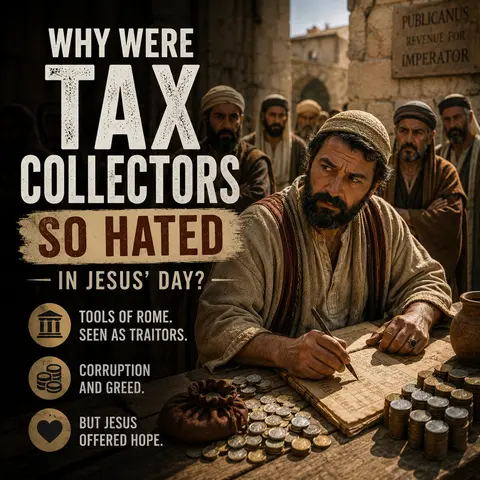
Tax collectors in the New Testament were fellow Jews who collected taxes for Rome, enriching themselves by overcharging their own people; they were viewed as traitors by their community.
-
Jesus repeatedly chose tax collectors like Matthew and Zacchaeus to demonstrate God's mercy and transformation, illustrating an upside-down kingdom where outcasts find acceptance.
-
Matthew left his tax booth to become one of the twelve disciples, and Zacchaeus promised to repay fourfold what he had stolen, showing concrete outcomes of repentance.
-
Many tax collectors responded to John the Baptist and Jesus, revealing surprising openness among these despised figures to faith and ethical change.
-
The biblical tax collector moved from a hated social role to a rich symbol of grace, inclusion, and humble repentance in the New Testament.
Introduction: Who Were the Biblical Tax Collectors?
In the world of first-century Judea, a tax collector was a Jewish man employed by the Roman Empire to collect taxes from his fellow Jews. The Greek word used in the Gospels is telōnēs, and it functions as both a job title and a moral label. The phrase "tax collectors and sinners" appears repeatedly in passages like Matthew 9:10 and Luke 15:1, grouping these officials with the lowest members of society.
Many tax collectors became wealthy through corruption and intimidation, which fueled deep resentment among ordinary people. Tax collectors were viewed as traitors to their people, profiting from the suffering of their own neighbors. Yet Jesus called some of these very outcasts to follow Him, ate in their homes, and made them central figures in His teaching about the kingdom of God.
This article explores why tax collectors were so hated, the real people behind the stigma, and how their stories still carry meaning for the church today.

Historical Background: Roman Taxation in the Time of Jesus
Judea became a Roman province in AD 6 after the Roman government deposed Archelaus, son of Herod the Great. From that point forward, Rome imposed direct taxes on the population. Governors like Pontius Pilate (AD 26-36) oversaw a system designed to extract revenue from a foreign country that many Jews considered God's promised land.
Rome levied several categories of taxes:
-
Land tax (tributum soli): roughly 10-12.5% of agricultural produce
-
Poll tax (tributum capitis): about one denarius per person per year
-
Customs and tolls: 2-5% on goods moving through trade routes and ports
-
Temple tax: approximately 2 denarii per adult Jewish male, separate from Roman taxes
The Roman tax-farming system allowed collectors to charge more than the official tax rate. Wealthy contractors purchased the right to collect taxes in a district, paid Rome a fixed quota, and then hired local collectors to recoup their investment. Tax farming allowed collectors to keep excess taxes collected beyond that quota. Whatever more money they squeezed out of the population became personal profit.
When combining Roman, religious, and local levies, the total tax burden on Judea could reach 40-60% of local production. This economic pressure contributed to simmering unrest that eventually exploded in the Great Revolt beginning in AD 66. For Jews living under this weight in Jesus' day, the tax collector was the face of oppression.
Why Tax Collectors Were So Hated by Their Fellow Jews
Tax collectors were despised not only for their job but for what it represented: betrayal, greed, and impurity. They were Jews who chose to serve the Roman occupiers, extracting wealth from their own people to fund pagan armies and imperial construction.
Tax collectors often overcharged citizens for personal profit. Imagine Rome requiring 5 denarii from a merchant; the collector demands 7 and pockets the difference. Tax collectors often collected more than required and kept the excess, with no accountability to the people they taxed. Luke 3:13 records John the Baptist telling tax collectors to "collect no more than what is appointed you," confirming that overcharging was standard practice.
Many tax collectors used soldiers or enforcers to intimidate people. The ancient writer Philo described collectors torturing those unable to pay, seizing property, and even threatening the families of debtors. For the lower classes, dealing with a tax collector meant fear as much as financial loss.
To devout Jews, collaboration with Gentile rulers made tax collectors ritually and morally suspect. They handled unclean Roman coins stamped with images of pagan emperors. They worked alongside idol-worshiping authorities. They broke principles of justice embedded in the law. The Pharisees viewed tax collectors as outsiders and sinners, unfit for participation in the life of the covenant community.
Tax Collectors in the New Testament: Overview and Symbolism
The New Testament pairs "tax collectors and sinners" as a stock phrase across the Gospels. In Matthew 11:19 and Luke 7:34, critics accuse Jesus of being "a friend of tax collectors and sinners." Tax collectors were grouped with sinners in the Gospels, indicating deep societal rejection. In Luke 15:1, many tax collectors and sinners gather to hear Jesus teach, prompting the Pharisees to wonder why He would accept such company.
In Jesus' parables, the tax collector appears as a surprising example of humility. The parable of the Pharisee and the tax collector in Luke 18:9-14 presents the tax collector as the one who goes home justified before God, not the outwardly righteous Pharisee. This reversal is deliberate. The person everyone assumed was beyond God's mercy turns out to be closer to the kingdom than the person who felt no need for forgiveness.
Tax collectors in the New Testament symbolize redemption and the reach of divine grace. The gospel accounts use these figures to show that sin and betrayal do not place anyone outside the reach of Christ.
Social and Religious Stigma: Tax Collectors and Their Fellow Jews
The gap between tax collectors and other Jews ran deeper than money. They shared ethnicity, scripture, and heritage, yet stood on opposite sides of power and loyalty. Ordinary Jews saw tax collectors as traitors who helped extract money from God's people to fund Roman armies, pagan temples, and imperial luxuries. The Roman oppressors relied on these local collaborators to keep revenue flowing without deploying additional soldiers.
Tax collectors were barred from normal religious life due to their contact with Gentiles. Synagogues excluded them. Courts disqualified them as legal witnesses. Rabbinical literature compared them to robbers and grouped them alongside prostitutes and usurers. In some Talmudic passages, lying to a tax collector was considered permissible because the collector was already irredeemably corrupt.
This ostracism reinforced a cycle. The more society shunned tax collectors, the more they retreated into their own circles of wealth and corruption. They had little interest in returning to a community that despised them, and the community had little interest in welcoming them back.
John the Baptist and the Call to Honest Tax Collecting
Luke describes a scene at the Jordan River where tax collectors come to John the Baptist asking, "Teacher, what shall we do?" (Luke 3:12). John's answer is direct: "Collect no more than you are authorized to do" (Luke 3:13).
John does not tell them to abandon tax collection outright. He calls them to stop exploiting people. His instruction exposes the core moral problem: not taxation itself, but systemic greed, abuse of power, and disregard for justice. The difference between a corrupt collector and an honest one was whether he put God ahead of personal gain.
The presence of many tax collectors in this scene shows that even some of the most hated figures in society were stirred by the call to repentance. They came voluntarily, seeking an answer to their moral dilemma. John opened the door to ethical reform. Jesus would go further, personally welcoming tax collectors into fellowship and discipleship, offering not just moral instruction but relationship and hope.
Matthew the Tax Collector: From Booth to Disciple
In Matthew 9:9, Jesus sees a man named Matthew (also called Levi in Mark 2:14 and Luke 5:27) sitting at the tax booth and says two words: "Follow me." Matthew was a tax collector for the Roman Empire, stationed in Capernaum, a busy town on the Sea of Galilee along trade routes connecting the region to Damascus and beyond.
Matthew immediately rises and follows. The text records no negotiation, no hesitation. Jesus called Matthew to be one of his twelve disciples, a choice that would have upset the rest of the community. A respected rabbi inviting a known collaborator into his inner circle was unheard of. Consider the reaction: other Jews would wonder why a holy teacher would associate with someone they considered a traitor.
Grace precedes repentance as shown in the stories of Matthew and Zacchaeus. Jesus does not wait for Matthew to prove himself righteous first. He calls, and Matthew responds.
Matthew later hosts a large meal in his house where "many tax collectors and sinners" recline with Jesus (Matthew 9:10). The Pharisees are upset, asking the disciples, "Why does your teacher eat with tax collectors and sinners?" Traditional scholarship holds that Matthew the tax collector authored the first book of the New Testament that bears his name, turning his former skills with records and money into a written testament of Jesus' life.

Zacchaeus: A Chief Tax Collector Transformed
Luke describes Zacchaeus in Luke 19:1-10 as a chief tax collector in Jericho and a wealthy man. As the head of tax collection in a prosperous trade center, Zacchaeus likely oversaw a network of other collectors and took a share of their profits. Zacchaeus was described as corrupt and wealthy, a person who represented everything ordinary Jews hated about the Roman system.
Zacchaeus climbed a sycamore tree to see Jesus as He passed through Jericho, because Zacchaeus was short and the crowd was thick. Jesus looked up, called him by name, and invited Himself to stay at Zacchaeus's house. The crowd murmured: "He has gone in to be the guest of a man who is a sinner" (Luke 19:7).
Zacchaeus's response was dramatic. He stood and declared to the Lord: "Half of my goods I give to the poor. And if I have defrauded anyone of anything, I repay it fourfold." Zacchaeus promised to repay fourfold what he had stolen, a standard that exceeded the Old Testament restitution requirement in Exodus 22:1 for stolen property. This was not abstract faith; it was concrete action with real money.
Jesus declared, "Today salvation has come to this house... For the Son of Man came to seek and to save the lost." A person everyone assumed was beyond redemption became a living example of what the kingdom looks like when it breaks into someone's life.
Jesus, Tax Collectors, and Sinners: A New Kind of Table Fellowship
Jesus' habit of eating with tax collectors and sinners became one of the most controversial aspects of His ministry. Jesus associated with tax collectors, challenging societal norms that demanded strict separation between the righteous and the unclean. Jesus associated with tax collectors, illustrating an upside-down kingdom where the last are first and the despised are welcomed.
At the banquet in Matthew's house (Matthew 9:10-13; Mark 2:15-17), many tax collectors and sinners sat with Jesus and His disciples. When the Pharisees asked why, Jesus answered: "Those who are well have no need of a physician, but those who are sick. I came not to call the righteous, but sinners."
Table fellowship in Jewish society implied acceptance and relationship. Sharing bread with someone meant you considered them worthy of your company. By eating with tax collectors, Jesus signaled a radical redefinition of who could belong to God's people. He did not ignore sin. He met people where they were and called them into repentance and new life. Peter and the other disciples witnessed this pattern repeatedly, watching their teacher accept those whom everyone else rejected.
The Tax Collector as a Symbol of Humble Repentance
The parable of the Pharisee and the tax collector in Luke 18:9-14 captures this theme with precision. Two men go to the Temple to pray. The Pharisee stands and prays about himself: "God, I thank you that I am not like other men; extortioners, unjust, adulterers, or even like this tax collector. I fast twice a week; I give tithes of all that I get."
The tax collector stands far off, beats his breast, and prays: "God, be merciful to me, a sinner."
Jesus' conclusion reversed every expectation in the room: the tax collector, not the Pharisee, went home justified before God. The Parable of the Pharisee and the Tax Collector highlights humility in repentance, showing that honest confession matters more than proud religious performance.
This parable cements the symbolic role of the biblical tax collector. The hated outsider who comes to God with nothing but honesty finds acceptance. The self-assured person who believes his righteousness earns God's favor does not. No one in Jesus' audience would have expected this answer. That shock was the point.
The broader New Testament message is clear: no person is beyond forgiveness, and humility opens the way to reconciliation with God.
From Historical Villain to Spiritual Lesson: Why Tax Collectors Still Matter
Tax collectors were real officials who fueled Rome's authority and exploited their fellow Jews. They were also, in the hands of the Gospel writers, powerful examples of both corruption and redemption. The narratives emphasize that faith and repentance can lead to significant personal change, as Matthew and Zacchaeus both demonstrate.
Matthew left behind abusive practices to become a disciple and, according to church tradition, the author of a Gospel. Zacchaeus turned his wealth from a tool of exploitation into a means of restitution and generosity. Tax collectors' transformations reveal lessons on systemic justice and inclusion that still challenge readers today.
Consider how we view people in despised professions or social groups. Do we imagine them beyond hope? Do we seek to extend the same combination of moral clarity and compassionate invitation that Jesus modeled? The story of Judas Iscariot reminds us that proximity to Christ does not guarantee transformation; the difference lies in genuine repentance and faith. But the stories of Matthew and Zacchaeus remind us that even those who owe the deepest debts to society can find a new identity in Christ.
The biblical tax collector is not a figure to romanticize. The profit they extracted, the fear they caused, the betrayal they embodied; these were real harms to real people. But the New Testament refuses to let that be the final word. God's mercy reaches into the most compromised corners of human life and offers something no amount of money can buy: forgiveness, restoration, and a place at the table.

FAQ
Were all tax collectors in the New Testament equally corrupt?
The system of tax farming encouraged dishonesty, but the New Testament does not claim every individual tax collector was equally greedy. John the Baptist's instruction in Luke 3:13 assumes some could choose to "collect no more than authorized," implying room for honest practice within a flawed system. The cultural stereotype was overwhelmingly negative, which is why Jesus' positive interactions with certain tax collectors stand out so clearly against the backdrop of first-century Jewish society.
Did any tax collectors keep their jobs after following Jesus?
The Gospels do not detail the long-term career choices of every converted tax collector. Matthew left his tax booth to follow Jesus full-time, joining the twelve disciples. Zacchaeus's story suggests a radically changed approach to wealth and power, with generous giving and restitution as markers of his new life. Following Jesus often meant re-evaluating one's occupation, especially when that occupation involved systemic injustice and exploitation of the poor.
How did tax collectors compare to other unpopular groups in Jesus' day?
Tax collectors were often grouped with sinners such as prostitutes, loan sharks charging forbidden interest, and others known for breaking the law. Unlike some sinners who were simply morally wayward, tax collectors carried the added weight of political betrayal and economic oppression. This combination of moral, religious, and national offense made them uniquely hated among their fellow Jews, often ranked lower in social standing than even Gentiles in some rabbinic texts.
Why did Jesus choose Matthew the tax collector as a disciple instead of a more "respectable" person?
Jesus often chose unlikely followers to demonstrate that God's kingdom is based on grace, not social respectability or religious status. Matthew's background gave him a unique perspective on exclusion, mercy, and the value of transformation. His later role as a Gospel writer shows how Christ could redeem even a compromised past and place a former tax collector at the heart of telling His story to the world.
What can modern readers learn from the New Testament portrayal of tax collectors?
Modern readers can learn to recognize both the damage caused by unjust systems and the possibility of personal change within them. The central lesson is not to excuse exploitation, but to accept that even notorious wrongdoers can repent, make amends, and become powerful witnesses to grace. These stories challenge every reader to ask whether they mirror Jesus' willingness to confront injustice while still extending hope to those trapped inside it.

The Problem With Certainty