What Does the Number 10 Mean in the Bible?
Overview
-
In scripture, the number 10 often represents completeness, divine order, law, and human responsibility, offering readers practical spiritual guidance for everyday faith.
-
Key biblical stories-the Ten Commandments, the ten plagues of Egypt, tithing 10%, and Jesus' parables involving ten-work together to reveal the biblical meaning of the number 10 as a full measure of God's dealings with humanity.
-
The Bible mentions at least ten lost books by name, connecting to the theme of completeness and God's preservation of essential revelation.
-
The number 10 frequently marks turning points in salvation history, from the Exodus to the timing around Pentecost to prophetic visions and the foundations of the New Jerusalem.
-
This article moves from explanation to application, showing how understanding the significance of 10 can shape your daily life in areas like gratitude, stewardship, and readiness.
Introduction: Why the Number 10 Matters in the Bible
The number 10 appears 242 times across the Old Testament and New Testament, carrying a consistent symbolic weight that few other numbers match. The biblical meaning of this double digit number centers on completeness, law, covenant order, and human responsibility before God. You encounter it in the commandments Moses received on Sinai (Exodus 20), the ten plagues that broke Egypt's hold on Israel (Exodus 7–12), the 10% tithe commanded in Leviticus 27, and the parables Jesus told involving ten coins, ten servants, and ten virgins.
Understanding this pattern provides spiritual guidance for topics like obedience, generosity, judgment, and readiness for God's kingdom. This article stays within the biblical text while also touching on the intriguing topic of at least ten lost books referenced in scripture.

Biblical Meaning of the Number 10: Completeness, Law, and Responsibility
Ten in the bible symbolizes a full measure of obligation, order, and testimony, often linked to God's law and human accountability. Ten represents completeness, order, and divine perfection throughout scripture.
-
Many interpreters see 10 as combining the world (often symbolized by 4, representing physical creation) and man (6), forming a complete testimony of God dealing with humanity.
-
The phrase "And God said" appears ten times in the creation account in Genesis, signaling complete, authoritative speech at the beginning of everything.
-
The number 10 can denote a complete measure in biblical narratives related to law and judgment from the ten generations before the Flood to the ten plagues before the Exodus to the ten virgins at the climax of Jesus' parable.
The Bible does not state that every occurrence of the number 10 has a symbolic meaning. Some uses are purely literal. But when 10 surfaces in covenant, law, or prophetic contexts, its symbolic meaning deepens. For readers who read today's scripture with fresh eyes, 10 invites examination of whether obedience, worship, and stewardship are complete rather than half-hearted.
Tithing 10%: Wealth, Worship, and Trust
Tithing is giving 10% of one's income, making it one of the most practical uses of the number 10 in the bible. Hebrew scholars have often noted a connection between "eser" (ten) and "osher" (riches), tying 10 to themes of prosperity and blessing.
In the Old Testament, Israelites were commanded to give a tenth of produce, flocks, and income to support the Levites, temple worship, and social welfare. Leviticus 27:32 states the tenth animal is holy to the Lord. Deuteronomy 14:22–23 instructs believers to tithe all grain increase. Malachi 3:10 records God's promise that bringing the full tithe into His storehouse would open the windows of heaven with blessing. God promised Abraham and his descendants a land of abundance, and the tithe became a tangible expression of trust in that promise.
The New Testament does not explicitly require a 10% tithe. Instead, 2 Corinthians 9 encourages generous and cheerful giving, elevating heart attitude over rigid percentage under grace. Many believers today use 10% as a helpful baseline for disciplined generosity without turning it into legalism. The tithe functions as spiritual guidance-a training ground for trust, dependence on the Father, and ordered priorities rather than a tax that earns prosperity (however that is not always the case).
Ten Commandments: Law, Covenant, and Moral Order
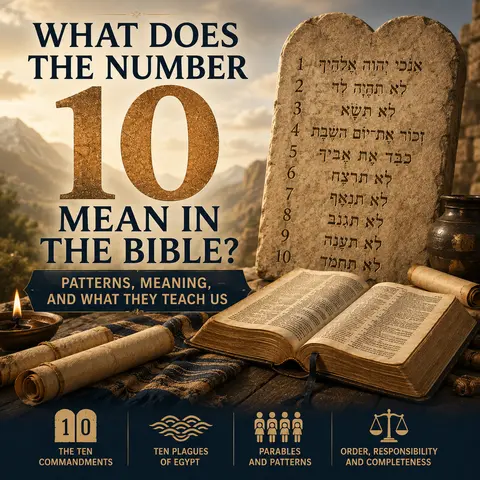
The Ten Commandments are the most famous set of ten in the bible and anchor Israel's covenant with God. Moses received the 10 Commandments on Mount Sinai, and they are found in Exodus 20:1–17 and echoed in Deuteronomy 5:6–21. The 10 Commandments represent God's moral law for humanity.
-
The first four commandments focus on God: no other gods, no idols, reverencing God's name, and keeping the Sabbath.
-
The last six commandments focus on human relations: honor parents, no murder, no adultery, no theft, no false witness, and no coveting.
This 4+6 division subtly reflects heaven and earth, or God and neighbor, bringing ordered completion into everyday ethics. The "ten words" given at Sinai established Israel as a holy nation, with priests serving in the temple and the Jews carrying this law forward through generations. Jesus later summarized the entire law in love of God and neighbor (Matthew 22:37–40), confirming its permanence. In a shifting world, the commandments stand as stable, unchanging divine authority a moral foundation that no person or nation has successfully replaced.
Number 10 and the Exodus: Plagues, Deliverance, and Judgment
God caused ten plagues to fall upon Egypt in Exodus 7–12 to confront Pharaoh and dismantle the power of false gods. The sequence moved from the Nile turned to blood, to frogs, lice, swarms, livestock disease, boils, hail, locusts, three days of darkness, and finally the death of the firstborn. The 10 plagues of Egypt represent God's judgment on paganism-not a random series of miracles but a complete dismantling of Egyptian religion and sin.
The tenth plague connects directly to the institution of the passover lamb. The Passover lamb was selected on the 10th day of the first month, and its blood on the doorposts marked God's people for protection. Christian prophecy sees in this event a foreshadowing of Jesus as the ultimate Lamb of God, whose sacrifice secures final deliverance on the earth. Israel tested God ten times during their wilderness journey, marking complete disobedience-yet God's mercy persisted.
The spiritual lesson is direct: persistent hardness of heart leads to a full measure of judgment, while obedience leads to peace, protection, and a new cycle of freedom.

Ten Generations, Waiting Periods, and Turning Points
The bible often uses blocks of ten to mark transitions in redemptive history. There are ten generations from Adam to Noah, marking a major epoch in human history. Noah, as the tenth patriarch from Adam in Genesis 5, embodies a turning point: the world's wickedness reached its full measure, and God brought the Flood to begin a new cycle of life on earth.
The remarkable ages of the pre-Flood patriarchs-Methuselah living 969 years, for instance-highlight both human dignity at the beginning and the seriousness of increasing sin before completion of that era. Similarly, ten generations stretch from Noah's son Shem to Abraham, marking another pivot toward God's covenant with a chosen people.
The period of about ten days between Jesus' ascension and the coming of the Holy Spirit at Pentecost (Acts 1–2) shows how this waiting marked the completion of preparation for the church's birth. Ten is frequently associated with testing periods or seasons of trial in scripture. These God-ordained waiting seasons invite you to trust divine timing when your own life feels prolonged or incomplete.
Jesus' Parables and the Symbolic Use of Ten
Jesus used the number 10 in parables to illustrate themes of readiness and accountability, embedding kingdom truth in everyday images.
In the parable of the lost coin (Luke 15:8–10), a woman with ten silver coins loses one and searches with joy until she finds it. Every person matters; completion is restored when even one is redeemed. The gospel message rings clear, God pursues each individual with relentless love.
In Luke 19:11–27, a nobleman entrusts equal sums to ten servants and holds each accountable upon his return. Success or failure depends on faithful stewardship of what God gives, not on the size of the gift. John records similar themes of accountability throughout his gospel.
The parable of the ten virgins in Matthew 25:1–13 contrasts five wise and five foolish bridesmaids. Half were prepared; half were not. The separation within a complete group shows that readiness-not mere presence-determines entrance into the kingdom. All three stories reinforce the broader pattern: a complete group under test, where each individual's response reveals their heart toward the Lord.

Ten in Prophecy, Revelation, and the New Jerusalem
Prophetic books like Daniel and Revelation use the number 10 symbolically in visions about kingdoms, the beast, and the final city of God. In apocalyptic literature, ten horns symbolize comprehensive earthly political power-a full set of rulers whose authority is real yet limited under divine sovereignty. In prophetic contexts, a final confederacy of ten kings represents political totality opposing divine rule, as Daniel and Revelation describe nations aligned against heaven.
Revelation 21:19–20 describes twelve foundations of the New Jerusalem, with the tenth foundation stone being chrysoprase, hinting at God's exquisite and ordered design. The Day of Atonement occurs on the tenth day of the seventh month in Jewish tradition, marking a complete cycle of repentance and divine presence.
These prophetic uses of 10 assure believers that history will reach a complete, God-ordered conclusion. No earthly power exceeds the boundaries God has set. Rather than fueling speculative date-setting, the repeated tens in biblical numerology deepen confidence that David's Lord reigns and will bring all things to their appointed end.
Lost Books and the Theme of Ten: What We Know and Don't Know
The Old Testament itself mentions at least ten lost books that are no longer extant. Concrete examples include the Book of Jasher (Joshua 10:13), the Book of the Wars of the Lord (Numbers 21:14), the Book of Nathan the Prophet, the Book of Gad the Seer, and writings attributed to the prophet Ahijah, Iddo, and Shemaiah-cited across Kings and Chronicles as historical sources.
These works were likely court annals, prophetic oracles, or songs. They are referenced as background material but are not part of the canonical scriptures that the Jewish and Christian communities preserved. The fact that about ten such books are mentioned connects to the broader pattern of 10 as completion: even what we do not have points to God's complete oversight of revelation.
According to 2 Timothy 3:16–17, believers trust that the scripture we do possess is sufficient for teaching, correction, and spiritual guidance. The importance of these lost books lies not in what they might add, but in confirming that God believed it necessary to preserve exactly what we need.
Other Significant Sets of Ten in Scripture
Beyond the well-known examples, scripture contains many other sets of ten that round out the pattern.
-
In Ruth 4:2, ten elders witness Boaz's redemption of Ruth, illustrating how 10 signifies a full and formal legal process in the house of Israel.
-
Certain kings and dynasties in the northern kingdom are grouped into roughly ten bloodlines, underscoring that Israel's political story reached a full cycle of decline before exile.
-
In Luke 17:11–19, Jesus heals ten lepers, but only one returns to give thanks. The story highlights human ingratitude-nine out of ten failed in following through-and the rare completeness of true faith.
-
The world of biblical numerology notes that structured groups of ten appear across genres, from genealogy to prophecy to parable.
Practical Spiritual Guidance from the Number 10
The number 10 is not trivia. It offers concrete opportunities to be shaped for modern believers.
Being shaped allows you to develop a personal framework that has meaning to you personally. Using the story of God, which is many stories as books allows us to see patterns that can help shape our convictions.

FAQ about the Number 10 in the Bible
Is the number 10 always symbolic in Scripture, or sometimes just a count?
In many passages, 10 is simply a literal number-ten lepers, ten coins, ten servants. However, because scripture repeatedly uses 10 in key covenant and judgment settings, even literal uses often carry symbolic resonance. The bible does not claim every occurrence is symbolic. Pay special attention when ten appears in law, covenant, or prophetic contexts; elsewhere, let context guide your reading.
Do Christians today have to give exactly 10% of their income?
The Old Testament law established specific tithes of at least 10%, while the New Testament emphasizes generous, willing giving rather than a fixed percentage. Many believers use 10% as a helpful baseline for disciplined generosity, but the heart attitude matters more than hitting a precise number. Grace frees you to give beyond the baseline with joy.
What should we think about modern books claiming to be the "lost books" of the Bible?
Ancient writings like apocryphal and pseudepigraphal texts exist, but they are not the same as the specific lost books mentioned in Old Testament historical records. Value such texts as historical or devotional background if you choose to read them, but treat the canonical scriptures as the final and sufficient authority for faith and practice.
Can the symbolism of 10 be used to predict dates for end-time events?
While ten appears in prophetic imagery-horns, kingdoms, sequences-the bible warns against speculative date-setting. Let the number 10 in prophecy deepen your confidence that God has a complete plan, rather than using it as a codebook for predicting specific timelines.
How many times does the number 10 appear in the Bible?
The number 10 appears approximately 242 times across various English translations, with "tenth" adding roughly 79 more occurrences. More important than the exact total is how consistently 10 is tied to themes of completeness, law, testing, and responsibility throughout scripture.

The Problem With Certainty