The Significance of the Number 12 in the Bible
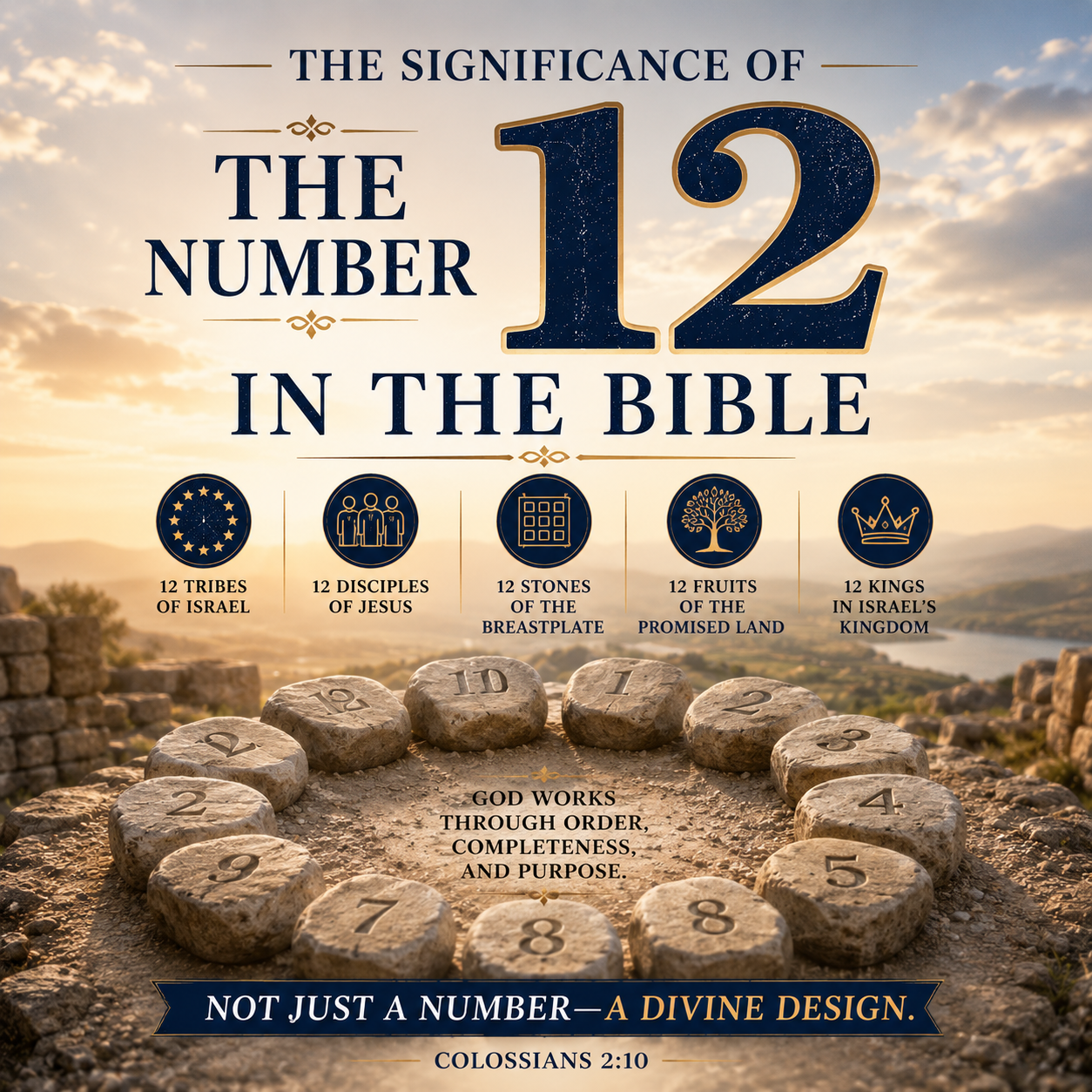
The Significance of the Number 12 in the Bible
Overview
The number 12 in the bible carries deep significance, consistently tied to God's authority, completeness, and covenant people. From the twelve tribes of Israel in the Old Testament to the twelve apostles in the New, this number frames the identity of God's people across scripture.
-
The number 12 appears in both Old and New Testaments, shaping pivotal moments in Israel's history, the life of Jesus, and prophetic visions of eternity.
-
It symbolizes divine order and completeness - seen in the high priest's 12 stones, the twelve gates of the New Jerusalem, and the 144,000 sealed in Revelation.
-
The number 12 represents completeness in the bible, expressing God's power and authority over His creation.
-
Understanding the biblical meaning of 12 can strengthen personal faith today, reminding believers to trust God's order and perfect plan for their lives.
Introduction: What Is the Biblical Meaning of the Number 12?
In scripture, the number 12 generally represents God's perfect government, authority, and the completeness of His people. It is not a random figure - it is a structural marker that organizes worship, leadership, and covenant identity throughout the bible. The number 12 appears 189 times in the bible, spanning from genesis to revelation. When you realize this, you will start to notice how many times it is present in God's story.
You don't need to look far for examples. The twelve tribes of Israel defined the nation under the Old Covenant, and the twelve apostles formed the foundation of the church under the New. These aren't coincidences; they are repeated patterns that underline key themes of covenant, order, and fulfillment.
Here's what the following sections will cover:
-
How the number 12 is rooted in the Old Testament, beginning with Jacob's sons
-
Its role in the life and ministry of Jesus
-
How it shapes biblical prophecy and the vision of the new jerusalem
-
Practical lessons for faith and community today
The Old Testament Roots of the Number 12
The significance of the number 12 begins early in Genesis and quickly becomes foundational to Israel's identity as a nation.
Jacob had 12 sons - Reuben, Simeon, Levi, Judah, Dan, Naphtali, Gad, Asher, Issachar, Zebulun, Joseph, and Benjamin (Genesis 35:22–26). These sons became the twelve tribes of israel, representing the totality of the covenant people. From this point forward, the word "twelve" in the Old Testament almost always points back to this foundational group.
Other early appearances reinforce the theme of provision and order:
-
At Elim, the Israelites found 12 springs of water and 70 palm trees - a picture of complete provision in the wilderness (Exodus 15:27).
-
When israel crossed the jordan river under Joshua, 12 memorial stones were set up as a permanent reminder of God's faithfulness in bringing His people into the promised land (Joshua 4).
-
In Numbers 7, offerings are presented by leaders from each of the twelve tribes, making the number a shorthand for "all Israel" whenever the nation stands together before the lord.

The Twelve Tribes of Israel: God's Covenant People
When readers ask "what is the significance of the number 12 in the bible," the twelve tribes are one of the clearest answers.
The tribes came from Jacob's sons, but over time the structure shifted for practical reasons. Joseph's two sons, Ephraim and Manasseh, each received a separate tribal inheritance, while Levi was set apart for priestly service without territory. Despite these adjustments, the total count of tribes in Israel's organizational life always returned to twelve.
The tribes appear at crucial covenant moments:
-
Camping in ordered formation around the tabernacle, three tribes per side, four sides total (Numbers 2)
-
Standing at Mount Sinai to receive the law
-
Represented by leaders, offerings, and censuses throughout the wilderness period
This arrangement made twelve a shorthand for the fullness of God's people under His rule. Even after the nation divided into northern and southern kingdoms, prophets continued writing and speaking as though the original pattern of twelve remained God's design for His children.
The High Priest's Breastplate and Other Old Testament Twelves
One of the most vivid number 12 images in the bible is the high priest's breastplate described in Exodus 28:15–30.
The high priest's breastplate contained 12 stones, each engraved with a tribe's name, arranged in four rows of three. The priest wore this breastplate over his heart as he went before the lord, visually expressing the idea that the entire covenant people - all twelve tribes - were carried into God's presence. On the ephod's shoulders, two onyx stones each bore six tribal names, so the priest carried israel in both heart and burden.
Other significant "twelves" in organized worship and governance include:
-
Bread of the Presence: 12 loaves of showbread were placed in the tabernacle every Sabbath as a sign of God's provision for His people (Leviticus 24:5–8).
-
Solomon's officers: King Solomon appointed 12 officers to provide food for the royal household, each responsible for one month of the year (1 Kings 4:7).
-
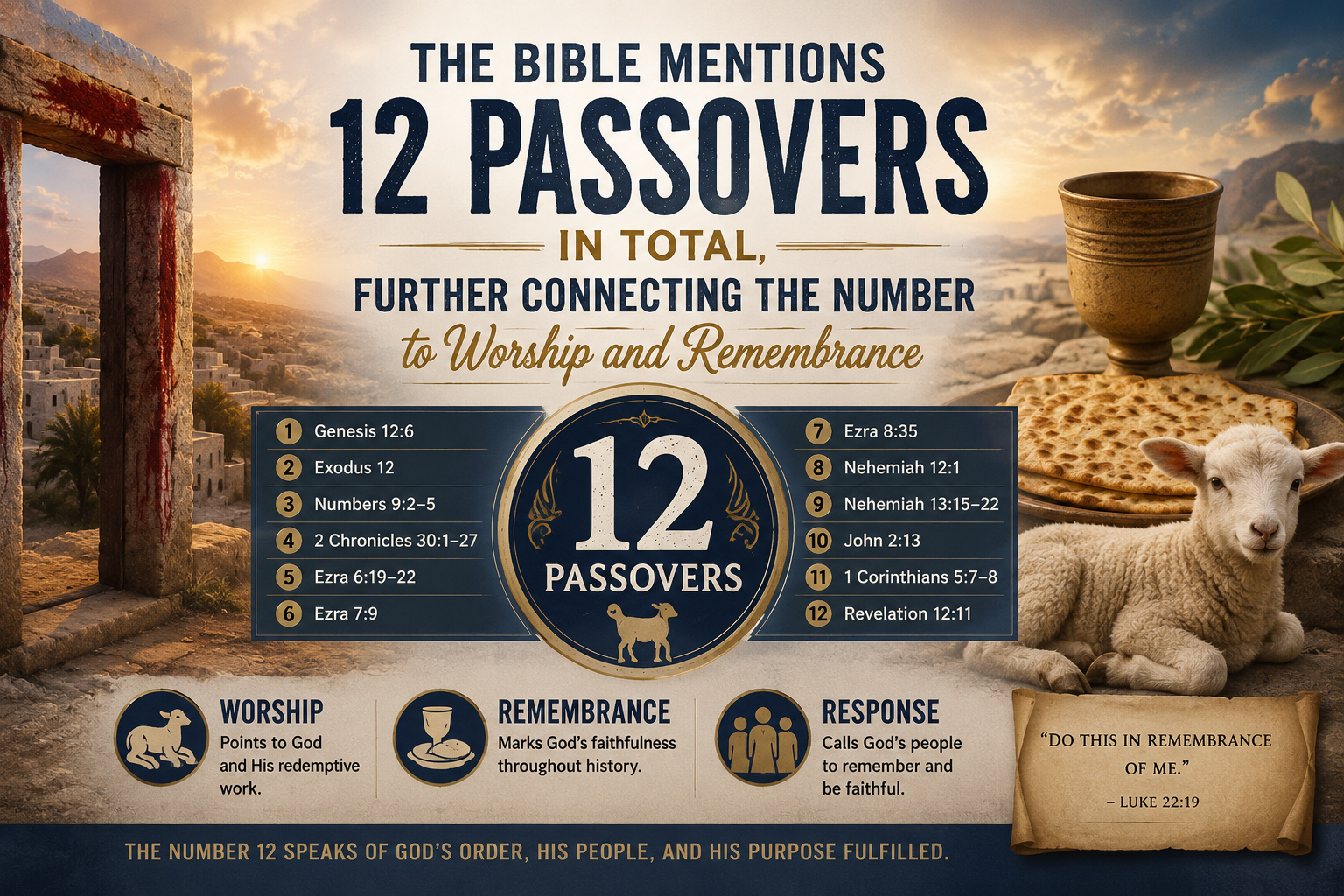
Passovers: The bible mentions 12 Passovers in total, further connecting the number to worship and remembrance.
Each example reinforces the same theme: twelve signals ordered worship, organized leadership, and divine provision.
Jesus and the Twelve Apostles
The twelve apostles are the central New Testament expression of the number 12, deliberately echoing the twelve tribes. When Jesus called this specific group, He was not assembling a random collection of disciples, He was re-forming God's people around Himself.
The names recorded in Matthew 10:2–4 are Peter, James, John, Andrew, Philip, Bartholomew, Matthew, Thomas, James son of Alphaeus, Thaddaeus, Simon the Zealot, and Judas Iscariot. This group of twelve became the spiritual foundation of the church, a point Paul echoes in Ephesians 2:20 when he describes the apostles as foundation stones.
After Judas' betrayal and death, the early church moved quickly to restore the number. In Acts 1:15–26, Matthias was chosen to replace Judas, a decision that shows the early believers treated twelve as a fixed, meaningful number that absolutely needed to be preserved. They were not simply waiting for a volunteer; they recognized the theological weight the number carried.
Jesus Himself made the connection explicit. In Matthew 19:28, He promises the twelve that they will sit on twelve thrones judging the twelve tribes of israel, tying Old and New Covenant people together in one story of redemption. The 12 apostles represent the spiritual foundation of the church, just as the tribes represented the nation of israel under the old covenant.
Twelve in the Life and Ministry of Jesus
Beyond the twelve apostles, the number 12 appears in key scenes of healing, miracle, and provision throughout christ's ministry.
Age twelve in the temple. Jesus was 12 years old when He taught in the temple, showing His divine purpose (Luke 2:41–52). At this age, a mark of transition toward maturity in Jewish culture, He stayed behind in jerusalem, amazing the teachers with His knowledge. When His parents found Him, He answered with words that revealed His awareness of His Father's business.
Feeding the massive crowd. When Jesus fed 5,000 men plus women and children with five loaves of bread and two fish, the disciples gathered exactly twelve baskets of leftovers (Matthew 14:20; Mark 6:43). Many interpreters recognize this as a sign of abundant provision for all israel - enough for every tribe, with nothing wasted.
Healings marked by twelve. In Mark 5:25–42, two accounts are woven together: Jesus healed a woman who suffered bleeding for 12 years, and He raised a girl who was 12 years old from the dead. In both cases, the number underlines restoration and wholeness. The woman was finally healed, the girl was raised to life, and the past years of brokenness gave way to renewal.
In these stories, 12 in the bible is tied not just to structures but to personal life, to the kind of wholeness only christ can create.

The Number 12 in Biblical Prophecy and the New Jerusalem
Prophetic and apocalyptic books, especially revelation, gather all the earlier "twelves" into a final vision of God's kingdom on earth.
The Twelve Minor Prophets. The Old Testament includes 12 minor prophets - a unified collection of shorter prophetic books. In Hebrew tradition, these are considered one book with twelve parts, and the grouping itself signals completeness in God's prophetic word to His people.
The 144,000. In Revelation 7 and 14, 144,000 sealed servants are described - 12,000 from each of the 12 tribes. This multiplied twelve pictures the fullness of God's redeemed crowd, not a limited number but a symbol of total inclusion.
The New Jerusalem. Revelation 21 describes the holy city in detail. The new jerusalem has 12 gates named after Israel's tribes, with angels stationed at each, and twelve foundations bearing the names of the twelve apostles. The city's wall measures 144 cubits (12 × 12), and its dimensions span 12,000 stadia. Even the tree of life bears twelve kinds of fruit.
Revelation 12 also describes a woman clothed with the sun, with the moon under her feet and a crown of twelve stars, another image connecting twelve to God's covenant people.
Whether you read these images as literal or symbolic, the repeated twelves point to a future of complete, secure life under God's eternal rule. The gates and foundations unite Old Testament tribes and New Testament apostles in one finished city, written as the climax of heaven coming to earth.
Practical Lessons from the Biblical Meaning of 12
Understanding the significance of the number 12 in the bible can shape how believers think about church, calling, and everyday trust in God.
Community matters. The twelve tribes and twelve apostles remind us that God has always called an identifiable, gathered people, not isolated individuals. If you realize you've been drifting from community, the pattern of twelve invites you back to local church life and prayer together.
Here are a few practical takeaways:
-
God brings order to a chaotic world. When circumstances feel scattered, the repeated twelves in scripture invite you to trust His timing and structure rather than your own.
-
Every believer has a place in God's ordered mission. Just as the apostles were sent out and Solomon's officers served the king, you have a role in God's perfect plan for His people.
-
You don't need complex tools to study this yourself. Read Genesis 35, Exodus 28, Luke 6, Mark 5, and Revelation 21 together, and let the pattern speak for itself. There are also 12 chapters in the books of Ecclesiastes and Daniel , more threads to explore.
Consider sharing these posts or insights on facebook or with a small group. Bible study gains depth when it happens in community, not in isolation.
Conclusion: Why the Number 12 Still Matters
The number 12 in the bible consistently signals God's perfect government, complete people, and trustworthy order, from Genesis to Revelation. The two images most readers will remember are the twelve tribes of israel and the twelve apostles, and both find their fulfillment in the new jerusalem's twelve gates and twelve foundations.
Christians should avoid speculative numerology, but paying attention to repeated biblical patterns like twelve can deepen your appreciation for how unified and intentional god's word really is. The next time you encounter the number 12 in scripture, let it remind you of something significant: God is bringing order, completeness, and community into your own life, just as He does throughout every story of the bible.
FAQ: Common Questions About the Number 12 in the Bible
Below are answers to related questions not fully covered above.
Is the number 12 always symbolic in the Bible?
Not always. Sometimes 12 is simply a literal count, twelve oxen, twelve cities, twelve springs. In other places, context suggests a symbolic layer connected to tribes, apostles, or prophetic visions. Many Bible students see both literal and symbolic significance working together, especially in books like revelation. The best approach is to read the passage on its own terms first, then notice whether the number echoes larger biblical themes.
How is the number 12 different from the number 7 in Scripture?
Both numbers express perfection and completeness, but in different spheres. Seven usually points to creation, rest, and spiritual wholeness, think seven days of creation in genesis. Twelve emphasizes god's people and His governing order among them, the twelve tribes, the twelve apostles. Rather than forcing rigid categories, recognize that each number contributes to the bible's overall symbolic language of divine completeness.
Does the Bible teach a formal system of numerology?
No. Scripture does not present a hidden codebook for predicting events or decoding secret messages. Responsible interpretation treats numbers as one literary tool among many, always subordinate to clear teaching about God, christ, and salvation. Using the number 12 or any other number for fortune-telling or speculative date-setting departs from how the bible actually uses its patterns.
Are there other important numbers I should study besides 12?
Yes. Other frequently significant numbers include 3 (the Trinity), 7 (creation and rest), 10 (the law and commandments), 40 (years in the wilderness, days of testing), and 70 (elders of israel). Focus first on understanding each passage itself before exploring numerical patterns, so that symbolic numbers serve the message rather than distract from it. A simple notebook where you track repeated numbers and their contexts as you read through the bible can be a practical study habit.
What Is Empire in the Bible and Why Does It Matter?