What Is the Significance of the Number 40 in the Bible?
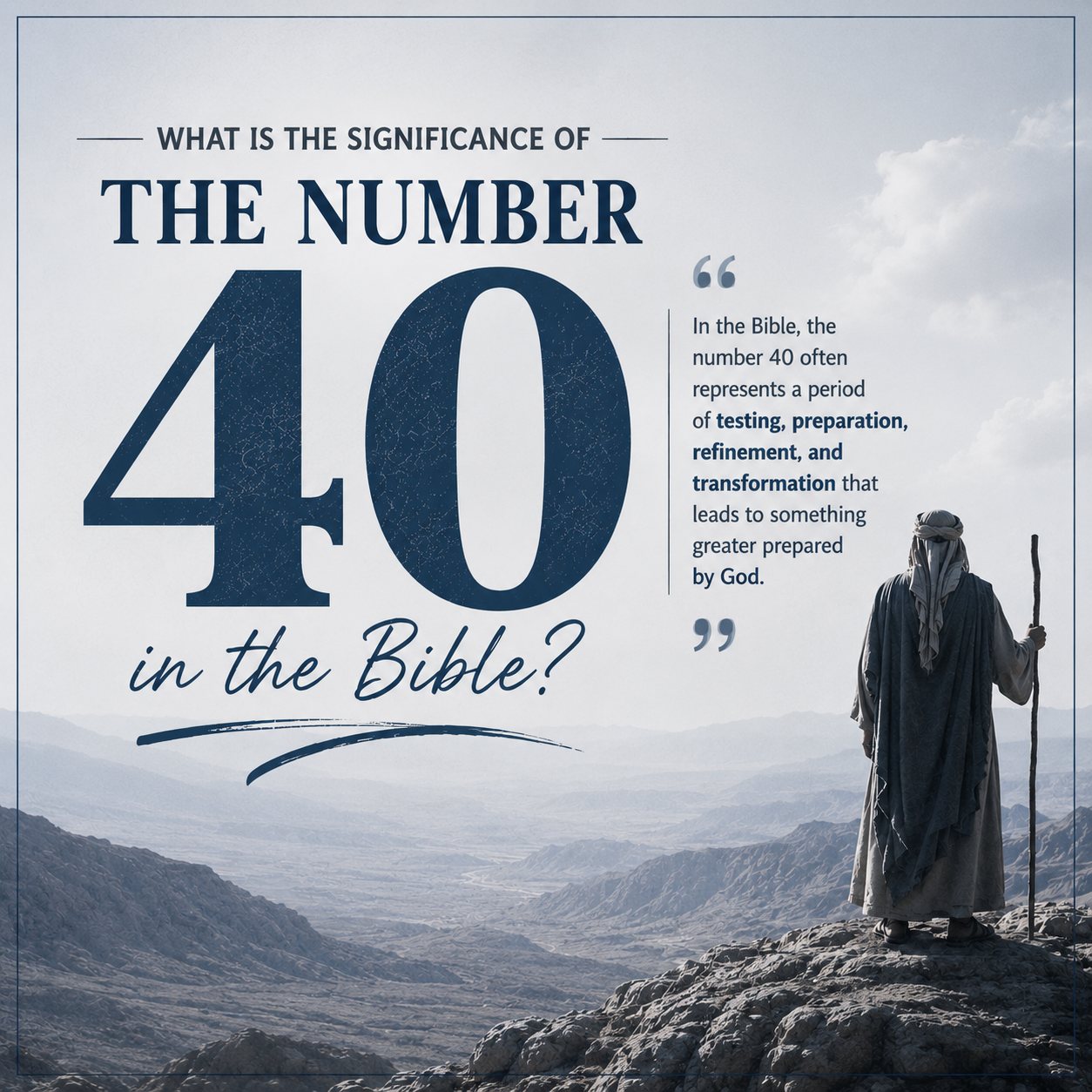
What Is the Significance of the Number 40 in the Bible?
The number 40 appears throughout sacred scripture as one of the most recognizable markers of testing, preparation, and transformation. While the bible never specifically assigns a formal definition to this significant number, its repeated use across dozens of narratives links it with judgment, repentance, and the long road to the promised land.
Overview
-
The number 40 symbolizes a period of testing, trial, purification, and transition in the bible, appearing in both the old testament and the new testament.
-
Famous examples include the great flood's 40 days and nights of rain, the forty years Israel wandered in the wilderness, Moses fasted forty days on mount sinai, and Jesus fasted 40 days in the desert before his public ministry.
-
Jesus appeared to his disciples for 40 days after his resurrection before ascending to heaven.
-
The Church's 40 days of Lent consciously echo these biblical periods of self examination and spiritual warfare.
-
The number 40 often represents a generational shift, marking the full cycle before God acts decisively in history.

Biblical Foundations of the Number 40
Biblical numerology is not about secret meanings or hidden messages in a mystical sense. It simply recognizes that certain numbers recur in scripture with consistent thematic weight. The number 40 is one of the clearest examples. It appears 158 times in the King James Bible, spanning law, narrative, prophecy, and gospel.
In high-level terms, 40 is often connected with periods of testing or trial, preparation before a major mission or covenant, and transition from judgment to renewal. In biblical language, forty years frequently represent a generation - the span during which one population passes away and another rises, as when the children of israel who refused to enter the land died off during their wilderness wandering.
Some Church Fathers reflected deeply on this pattern. Saint Augustine, in Sermon 75, tied the number to "the perfection of righteousness," seeing Moses, the prophet Elijah, and Christ all fasting forty days as a sign of the earthly discipline that leads toward heaven. For Augustine, 40 symbolized the labor of this life oriented toward eternal reward, not a magic formula or code.
Old Testament Examples of the Number 40
The Old Testament is where 40 first becomes prominent, appearing in narratives of judgment, covenant, and Israel's journey toward the promised land.
The Flood. God flooded the earth for 40 days and nights as judgment on a corrupt world (Genesis 7:12). It rained without ceasing, and through this great flood God destroyed the wickedness that filled the earth. Yet the waters also gave way to a fresh start - Noah's family stepped out into new life on cleansed ground.
Moses' Life. Moses' 120-year life breaks into three forty-year phases: forty years in egypt as a prince, forty years in Midian as a shepherd, and forty years leading the israelites through the wilderness. Each period prepared him for one great task ahead. On mount sinai, Moses fasted 40 days and 40 nights without eating bread or drinking water, receiving the law from the Lord (Exodus 24:18). After israel sinned with the golden calf, he ascended the mountain again for another 40 days, renewing the covenant (Exodus 34:28).
The Spies and the Wilderness. Twelve spies explored the land of Canaan for 40 days (Numbers 13:25). When the people refused to trust God, he decreed that Israel wandered forty years in the desert - one year for each day the spies had scouted, before their children could enter the promised land (Numbers 14:34). God allowed that generation to bear the consequences of unbelief while preparing the next generation for what lay ahead.
Kings and Judges. Other old testament examples include Goliath taunting israel for 40 days before David fought him (1 Samuel 17:16), and kings like Saul, david, and solomon each reigning approximately 40 years. Periods of oppression and peace in Judges also follow this pattern, reinforcing 40 as a measure of a complete era.

New Testament: Jesus, 40 Days, and Christian Life
In the New Testament, the number 40 centers above all on Jesus Christ and the inauguration of the New Covenant.
After his baptism, Jesus fasted for 40 days in the wilderness, led by the holy spirit into the desert where the devil tempted him (Matthew 4:1–2; Luke 4:1–2). This period echoes Israel's forty years of wandering but where the israelites failed in faith, Christ succeeded in perfect obedience. His testing was preparation: it launched his public ministry of roughly three years of preaching, healing, and calling disciples.
After Jesus resurrection, he appeared to his disciples over a period of 40 days before ascending to heaven (Acts 1:3). During this time he taught them about the kingdom of God, preparing them to receive the holy spirit at Pentecost and carry his mission to the ends of the earth. These 40 days mark the transition from Christ's earthly ministry to the life of the Church.
Many Christians also note the approximately 40 years between Jesus' crucifixion (around 30–33 A.D.) and the destruction of Jerusalem and the temple in 70 A.D., seeing that span as a period in which God allowed time to repent before judgment fell, a pattern consistent with the word of scripture throughout.
Theological Meaning: Testing, Repentance, and Transformation
Taken together, the biblical uses of the number 40 form a clear pattern: a period of testing that opens into new beginnings. Forty is associated with significant moments leading to transformation throughout scripture.
The theme of testing runs through nearly every instance. Whether it is the 40 days of the flood, Israel's wilderness years, or Jesus' temptation, these trials are not arbitrary. They are ordered toward growth and deeper faith in God. The important thing to recognize is that the testing always serves a purpose.
The theme of repentance and judgment is equally strong. The prophet Jonah warned Nineveh that it had 40 days before destruction (Jonah 3:4) - and the city repented. The prophet Ezekiel was told to lie on his left side for days representing Israel's sin and then on his right side for 40 days to bear the punishment of Judah (Ezekiel 4:6), a sign of coming judgment.
Finally, 40 marks transition and new mission - the move from slavery in egypt to freedom, from old covenant to new, from Christ's earthly life to the age of the Church. Each period of 40 is a bridge between what was and what will be.
Scripture does not use the number 40 to encode secret predictions. It carries a spiritual truth about repentance, faith, and hope, not speculation. Readers should avoid attaching too much significance to numerology divorced from the plain message of the text.
From Scripture to Practice: 40 Days in Christian Tradition
The Church has drawn on the Biblical symbolism of 40 to shape its patterns of prayer, fasting, and preparation. Lent is 40 days long precisely because it is rooted in Jesus' 40 days of fasting in the wilderness, while also recalling Moses' 40 days on mount sinai and Elijah's 40-day journey to mount horeb, where the Lord renewed his calling (1 Kings 19:8). Lent emphasizes self examination, repentance, and preparation for Easter,a great task of spiritual renewal.
Other 40-day customs developed over time. In the early Church, converts preparing for baptism often underwent 40 days of instruction and prayer, entering new life in Christ at Easter. In many traditions, memorial observances 40 days after a person's death reflect the hope of resurrection, echoing the same biblical rhythm of transition from death to life.
These practices connect back to the central themes of scripture: moving from bondage to freedom, from sin to grace, and from old life to new life. The special meaning of 40 is not in the number alone but in the pattern it represents God meeting his people in seasons of struggle to prepare them for something greater.

FAQ: Common Questions About the Number 40 in the Bible
These FAQs address related questions not fully explored above, offering additional clarity on how to read and apply the number 40 in scripture.
Is the number 40 always symbolic, or is it sometimes just a literal count?
The number 40 can be both literal and symbolic at once. Biblical authors often report real spans of 40 days or forty years, and the repetition of that same number across so many narratives gives those spans additional symbolic weight as times of testing or transition. You do not have to choose one or the other.
Does the number 40 guarantee that a situation will last exactly 40 days or years today?
No. The biblical use of 40 is descriptive of God's past actions in history, not a promise that every trial today will fit that exact pattern. Instead, see 40 as an invitation to persevere in faith during any extended season of difficulty, trusting that God uses such seasons for your good.
Are there connections between the number 40 and other biblical numbers like 7 or 12?
Yes. While 7 often signifies divine completion and 12 is linked with God's people (the tribes of israel, the apostles), 40 tends to emphasize the process leading up to fulfillment - a journey or probation before fullness arrives. These numbers complement rather than compete with one another.
How should Christians today apply the symbolism of 40 to their own spiritual lives?
Believers can voluntarily set aside focused 40-day periods of prayer, repentance, or scripture reading during individual times as a way of imitating biblical patterns of preparation. The deeper call is not to fixate on the number itself but to embrace repentance, trust, and readiness for whatever mission the lord is preparing you for.

The Problem With Certainty