Why Did Jesus Ask Questions? A Deep Dive into the Teaching Method of Jesus Christ
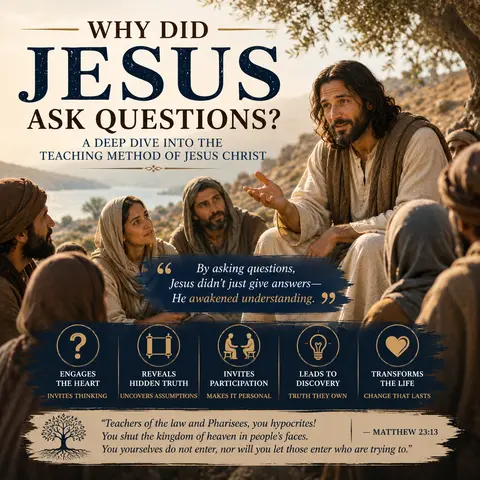
Why Did Jesus Ask Questions? A Deep Dive into the Teaching Method of Jesus Christ
Jesus could have simply announced truth from a mountaintop and walked away. Instead, He sat down with fishermen, tax collectors, and religious scholars and asked them questions that cut straight to the bone. Understanding why Jesus asked questions unlocks one of the most overlooked dimensions of His ministry and reshapes the way we read the Gospels, relate to God, and engage with the people around us.
Overview
-
To reveal hearts. Jesus's questions were rarely for His own information. Since He is presented as the all-knowing Son of God, His questions were designed to surface what people truly believed, feared, and desired.
-
To teach. The Gospels in the Holy Bible record roughly 307 questions Jesus asked, far more than the number of direct answers He gave. This ratio points to a deliberate teaching strategy that prioritized engagement over lecture.
-
To invite faith. Many of Jesus' questions invited personal faith and commitment, pressing listeners toward a decision about who He was and whether they would follow Him.
-
To confront unbelief. Jesus confronted hypocrisy with questions, especially when religious leaders prioritized tradition over obedience to God.
-
To model dialogue. Jesus asked curiosity questions and open ended questions to engage minds and emotions, modeling how Christians today can use questions in evangelism and relationships rather than relying on arguments alone.
Why Did Jesus Ask So Many Questions? (Fast, Clear Answer)
Jesus Christ asked questions to reveal what was in people's hearts, to teach spiritual truth through engagement rather than monologue, to invite personal trust in Him, and to expose hypocrisy among those who should have known better. He did not ask because He lacked knowledge. He asked because questions accomplish what statements alone cannot.
Here is a quick summary of the key purposes behind His questions:
-
Teaching: Jesus used questions as a teaching tool to stimulate critical thinking and help listeners grasp truths about the kingdom of God.
-
Testing: His questions often tested the faith of his followers, surfacing whether they trusted God or only what their eyes could see.
-
Inviting belief: He created opportunities for confession and faith through questions, pressing people to declare what they actually believed.
-
Rebuking: He challenged misplaced priorities through probing questions aimed at religious leaders and self-righteous onlookers.
Scholars tally around 305 questions Jesus asked across Matthew, Mark, Luke, and John. By contrast, when others posed questions to Him, Jesus answers directly in as few as three to eight instances, depending on how "direct" is defined. The rest of the article will unpack the specific types of questions Jesus asked and what they show us about His character and our own discipleship.
How Many Questions Did Jesus Ask in the Gospels?
Depending on translation and how compound questions are counted, Jesus asked roughly 305 distinct questions in the four Gospels. Martin B. Copenhaver, in his book Jesus Is the Question, counted 307. Other researchers note slightly different totals depending on whether parallel passages in the synoptic Gospels are counted separately.
Here is how the numbers break down across various approaches:
-
Some popular lists identify about 135 "major" unique questions, removing duplicates across Matthew, Mark, and Luke.
-
Academic studies, such as Bienvisa Nebres's content analysis of Matthew, catalog around 90 questions in that single Gospel alone, addressed to crowds, individuals, and religious leaders.
-
Other teachers reference "around 300 questions Jesus asked" as a round figure, and the pattern is unmistakable regardless of the precise count.
Here are four of the most well-known questions with references:
-
"Who do you say that I am?" (Matthew 16:15)
-
"What do you want Me to do for you?" (Mark 10:51)
-
"Why are you afraid, O you of little faith?" (Matthew 8:26)
-
"Do you love Me?" (John 21:15–17)
Jesus's questioning style contrasts sharply with modern expectations of religious leaders who often major on lectures and monologues. In His first-century context, and even today, this approach stands out as remarkably interactive.

Questions as a Central Part of Jesus's Teaching Style
Instead of delivering long philosophical speeches, Jesus often engaged people in dialogue. He asked questions in synagogues (Luke 4:16–21), on dusty roads, at meals with tax collectors, and in the temple courts in Jerusalem. The settings varied, but the method stayed consistent: ask, listen, respond.
Questions Jesus asked functioned much like a rabbi's interactive method in first-century Judaism, where asking and answering questions was a normal part of learning Scripture and the Law. The Mishnah and Talmud, compiled later but reflecting earlier traditions, show that legal and theological education relied heavily on disputation and dialogue rather than one-way instruction.
In the Sermon on the Mount (Matthew 5–7), Jesus sprinkled in questions to make listeners examine their assumptions. He asked about sparrows, lilies, and anxiety, turning everyday images into spiritual mirrors. This method allowed Him to reach multiple kinds of listeners at once: the curious crowd heard an invitation, committed disciples heard a challenge, and hostile religious leaders heard an indictment. Each group encountered the same question but experienced it differently, which is precisely what made the approach so effective.
Curiosity Questions: When Jesus Asked "How?" and "Why?"
Many questions Jesus asked were curiosity questions, probing how and why. These questions invited people to explore their motives, fears, and expectations. When Jesus asked curiosity questions, He was not learning new facts. He was helping people notice what they truly believed about God, money, power, and their own identity. Jesus asked questions to provoke introspection among listeners, and the curiosity category is where this shows up most clearly.
Here are four examples with citations:
-
"Why are you anxious about clothing?" (Matthew 6:28) - forcing listeners to confront whether they trusted that God clothes the lilies and would care for them too.
-
"Why do you call Me 'Lord, Lord,' and not do what I tell you?" (Luke 6:46) - exposing the gap between words and obedience.
-
"Why do you think evil in your hearts?" (Matthew 9:4) - a pointed question to those who would entertain evil thoughts rather than celebrate a man being healed.
-
"How many loaves do you have?" (Mark 8:5) - drawing attention to the disciples' resources before multiplying them miraculously.
Jesus also asked why people noticed the speck in their brother's eye but ignored the plank in their own eye (Matthew 7:3). This question about hypocrisy remains uncomfortable for every reader who encounters it.
Great leaders remain curious, and Jesus modeled this perfectly. Rather than offering quick advice, wise leaders and mentors still use curiosity questions to help people discover truth for themselves. Jesus asked questions to promote self-reflection, and that pattern has not gone out of style.
Open Ended Questions Jesus Asked to Invite Honest Reflection
Open ended questions cannot be answered with a simple "yes" or "no." They require people to tell the truth about themselves in their own words. Many of Jesus's questions are open-ended and challenging, designed to draw out stories, desires, and confessions. Direct questions require a verbal response from the listener, but open ended questions go further: they demand honest engagement.
Here are five specific examples:
-
"What are you seeking?" (John 1:38) - Jesus's first question to disciples was, "What are you looking for?" He was genuinely interested in their motives from the very first conversation.
-
"What do you want Me to do for you?" (Mark 10:51; also Matthew 20:32) - asked to the blind man Bartimaeus, this question invited him to name his need and express expectation.
-
"Which of these three, do you think, proved to be a neighbor…?" (Luke 10:36) - pushing a lawyer past theory into practical love that crossed ethnic and social boundaries, even toward extended family members of rival groups.
-
"If you love those who love you, what reward do you have? Do not even tax collectors do the same? And if you greet only your brothers, what more are you doing than others?" (Matthew 5:46–47) - Jesus pressed beyond comfortable affection toward radical generosity that does not expect repayment.
-
"Which one of you, if he has a sheep that falls into a pit on the Sabbath…?" (Matthew 12:11) - using a scenario every listener at the time could relate to.
Jesus asked, "What do you want?" to engage His followers and let them articulate their faith, doubt, or pain in front of Him. Christian readers can imitate this pattern in evangelism and discipleship today. Asking questions fosters relationships and dialogue, and using open ended questions to understand others beats rushing to argue every time.

Rhetorical Questions: Stirring the Conscience Without Expecting an Answer
Rhetorical questions are asked for effect rather than to receive an audible reply. He often used rhetorical questions to teach spiritual truths, and rhetorical questions prompt introspection without expecting verbal answers. They function like a mirror, forcing the listener to confront what they already know to be true.
Here are four iconic examples:
-
"For what does it profit a man to gain the whole world and forfeit his soul?" (Mark 8:36–37) - confronting the idolatry of wealth and success. No one can answer this question without reevaluating their priorities.
-
"Is not life more than food, and the body more than clothing?" (Matthew 6:25) - challenging anxiety and materialism with a question that needs no verbal reply, only surrender.
-
"If then you are not able to do as small a thing as that, why are you anxious about the rest?" (Luke 12:26) - exposing the futility of worry by pointing out that anxiety has never added how much growth to a person's life span.
-
"If I am telling the truth, why do you not believe Me?" (John 8:46) - confronting hardened unbelief with devastating simplicity.
Rhetorical questions in the Holy Bible act as mirrors that work across centuries. Bible verses like these still force readers today to examine their own priorities, anxieties, and resistance to God. In sermons, Bible studies, and personal reflection, rhetorical questions remain one of the most powerful tools available because they let the Holy Spirit do the convincing.
Questions for Teaching: Drawing Listeners into God's Kingdom Truths
Jesus used questions as His primary teaching tool to help people grasp spiritual truths about the kingdom of God rather than merely memorizing doctrines. His most critical responsibility as a teacher was not the one of delivering information but of transforming hearts.
Consider the episode of a lawyer asking, "Teacher, what shall I do to inherit eternal life?" (Luke 10:25–28). Jesus did not lecture. He answered with a question: "What is written in the law? How do you read it?" The man quoted Deuteronomy 6:5 - to love God with all your heart and all your soul - and Leviticus 19:18. Jesus said he had answered correctly. But the lawyer, wanting to justify himself, pressed further: "And who is my neighbor?" Jesus responded with the Parable of the Good Samaritan, illustrating love in action through story rather than abstraction.
In Matthew 16:9–11, Jesus asked His disciples, "Do you not yet perceive? Do you not remember the five loaves for the five thousand, and how many basketfuls you gathered?" He was not quizzing them for sport. He wanted them to connect previous miracles to their current worries. He also asked about how many loaves fed the four thousand, pressing them to see a pattern of divine provision.
Elsewhere, Jesus referenced a faithful and wise servant to teach about the critical responsibility of stewardship (Matthew 24:45). He asked whether the stone the builders rejected had not become the cornerstone (Matthew 21:42). He spoke of a man owns a hundred sheep and loses one, asking whether he would not leave the ninety nine and search carefully for the lost sheep (Luke 15:4). He asked about a strong man's house and who could plunder it (Matthew 12:29). He asked whether you men who are fathers would give a stone when your own sons asked for bread (Matthew 7:9). He even asked whether a man offering a gift sacred at the altar should first reconcile with his brother (Matthew 5:23–24). Each question was a doorway into a deeper kingdom truth.
Jesus used questions to encourage deep thinking, and these teaching questions show that He wanted listeners handling worldly wealth, religious duty, and everyday relationships to see everything through the lens of eternal life.
Questions for Testing: Revealing the State of a Person's Faith
Some questions Jesus asked were explicitly designed to test disciples - not to trap them, but to surface whether they trusted God or only what they could see. Jesus used questions to test the faith of His followers on numerous occasions, and these moments became some of the most transformative scenes in the Gospels.
In John 6:5–6, Jesus asked Philip, "Where are we to buy bread, so that these people may eat?" The Gospel itself tells us He said this to test him, because Jesus knew what He would do. Philip's response focused on cost - two hundred denarii would not the one time buy enough for everyone. Andrew found a boy with five barley loaves and two fish but doubted that would help. The miraculous sign that followed, feeding five thousand from almost nothing, revealed the gap between human calculation and divine provision.
Jesus also tested His disciples in the storm on the Sea of Galilee. When waves crashed over the boat, He asked, "Why are you afraid, O you of little faith?" (Matthew 8:26). The question gently rebuked their fear while simultaneously strengthening their trust. He asked whether there are not twelve hours in the day (John 11:9) to challenge anxiety about timing and danger. He even asked Peter whether the kings of the earth collect duty and taxes from their own sons or from strangers (Matthew 17:25), prompting Peter to think about identity and freedom.
These testing questions reveal that Jesus's questions aimed to elicit personal responses from individuals, not abstract theological debates.
Questions for Believing: Leading People to Personal Faith in Jesus Christ
Questions Jesus asked often brought people to a crossroads where they had to decide what they believed about Him. Many of Jesus' questions invited personal faith and commitment, and nowhere is this more visible than in two Gospel scenes.
At the tomb of Lazarus, Jesus declared to Martha, "I am the resurrection and the life. Whoever believes in Me, though he die, yet shall he live… Do you believe this?" (John 11:25–27). Martha answered, "Yes, Lord; I believe that You are the Christ, the Son of God." This belief-question reframed grief and death in light of Jesus's identity as God's Son and His power over the grave.
After Jesus taught difficult things about His body and blood in John 6, many disciples turned back. Jesus turned to the Twelve and asked, "Do you want to go away as well?" (John 6:67). Simon Peter answered, "Lord, to whom shall we go? You have the words of eternal life." Many disciples turned back after challenging questions from Jesus, but Peter's confession demonstrates that Jesus' questions required reflection and invited transformation. The question did not force anyone to stay. It honored human freedom while making the cost and the reward unmistakably clear.
These exchanges show that Jesus was not the one interested in theoretical religion. He pressed for belief that changes everything - a life filled with trust rather than distant admiration.
Questions for Proclaiming: "Who Do You Say That I Am?"
Some questions Jesus asked were designed to turn private faith into public proclamation. The scene at Caesarea Philippi (Matthew 16:13–17; Mark 8:27–29) is the defining example.
Jesus first asked a safer question: "Who do people say that the Son of Man is?" The disciples reported various opinions - John the Baptist, Elijah, Jeremiah. Then Jesus pressed closer: "But who do you say that I am?"
Simon Peter answered, "You are the Christ, the Son of the living God." Jesus replied that flesh and blood had not revealed this but the Father in heaven. This was not the one moment where Jesus needed to accept praise for His own ego; it was the pivotal moment where a disciple declared the truth that Jesus is fully God and fully man. Peter's proclamation became the bedrock confession of the early church.
This question still stands over every reader of the Holy Bible today. It demands a personal answer rather than a secondhand report of what others believe. No one can hide behind someone else's opinion when Jesus said, "But who do you say that I am?" It is not the one question you can dodge indefinitely.

Questions for Rebuking Hypocrisy and Exposing Hidden Motives
Jesus did not only use gentle curiosity questions. He also asked sharp, challenging questions to confront religious hypocrisy, especially among some Pharisees and chief priests in first-century Judea. Jesus used questions to handle traps and hostility with surgical precision.
In Matthew 21:23–27, the chief priests and elders demanded to know by what authority Jesus taught. He answered with a question: "The baptism of John, from where did it come? From heaven or from man?" They could not answer without exposing their own political fear or spiritual dishonesty, so they said, "We do not know." Jesus replied, "Neither will I tell you men by what authority I do these things."
He asked, "Why do you break the commandment of God for the sake of your tradition?" (Matthew 15:3), exposing how religious leaders elevated human rules above divine command. He asked, "Which is lawful on the Sabbath: to do good or to do harm, to save life or to kill?" (Mark 3:4), forcing His opponents to admit their priorities were backwards. He asked about the stone the builders rejected (Matthew 21:42). He asked whether it was lawful to do good on the Sabbath or to nurse evil intent while claiming holiness. He even referenced whether someone could enter a strong man's house without first binding the strong man (Matthew 12:29). He asked whether one could do more than twelve legions of angels could do in His defense (Matthew 26:53), revealing that His submission to the cross was voluntary.
These questions were a form of merciful confrontation, giving people a chance to repent rather than crushing them with mere accusation. Jesus often reveals a person's heart through his questions, and these moments of rebuke were no exception.
Why Did an All-Knowing Jesus Ask Questions at All?
Orthodox Christian belief holds that Jesus is fully God and fully man (John 1:1,14; Colossians 2:9). If only God knows the thoughts of every heart, then Jesus's questions cannot be reduced to simple ignorance. So why did Jesus ask questions at all?
Two truths work together here:
-
As true man, Jesus entered real human conversations, honoring human freedom and process. He did not override people's agency by simply announcing what they were thinking.
-
As true God, He often asked questions to reveal, not to discover, what was in people's hearts (John 2:24–25). Jesus knew the answer before He asked. The question was for the listener's benefit.
This pattern runs through the entire Bible. In Genesis 3:9, God asked Adam, "Where are you?" - not because the Creator had lost track of His creature, but to draw a sinner out of hiding toward grace. In Genesis 4:9, God asked Cain, "Where is your brother Abel?" - again, not for information, but to open the door for confession.
This reveals something profound about God's character. He does not merely shout commands from heaven. He dialogues with people, using questions to invite relationship. The fact that only God has the power to declare, yet chooses to ask, shows a kindness that runs deeper than authority. God bring people along through conversation, not coercion.
What Jesus's Questions Teach Us About Discipleship Today
Following Jesus means not only learning His answers but also being willing to live inside His questions. Jesus's questions often led to personal introspection and growth, and that process did not end with the first century. Discipleship involves living according to God's revealed reality, and Jesus's questions are one of the primary ways that reality gets pressed into daily life.
Jesus's questions resist an overly consumer approach to faith that demands instant clarity. "Why do you call Me 'Lord, Lord,' and not do what I tell you?" (Luke 6:46) is not the one question you process once and discard. It stays with you. Jesus's questions challenge followers to examine their faith and measure how much growth has actually taken place between Sunday mornings. When a church loses sight of this self-examination, it drifts into comfortable routine.
Here are three companion questions for ongoing spiritual growth:
-
"What are you seeking?" (John 1:38) - revisit this question whenever you face significant challenges or start chasing a dream job, a relationship, or a goal that might not align with God's purposes.
-
"Do you love Me more than these?" (John 21:15) - let this question interrogate your attachments.
-
"Who do you say that I am?" - carry this into prayer as an anchor for your own idea of who Jesus is.
Jesus's questions provoke deep introspection among His followers, and that is exactly the point. He wants a life filled with examined faith, not passive religion. This is not about arriving at an eternal framework of tidy answers but about walking with a Savior who keeps asking the right questions.
Learning to Ask Questions Like Jesus in Evangelism and Relationships
Just as Jesus did, Christians today can use thoughtful questions to open conversations rather than starting with arguments. Without further ado, here are four things questions do well in evangelism and relationships:
-
Reveal underlying assumptions and motives. A good question helps someone discover what they actually believe rather than what they think they should say.
-
Create natural, non-threatening spiritual conversations. People are more open when they feel heard rather than targeted.
-
Make others think instead of passively listening. Jesus asked questions to provoke deeper thinking in disciples, and the same dynamic works in a coffee shop or a living room.
-
Relieve pressure on the Christian to have every answer, leaving room for the Holy Spirit to work.
Here are three example questions a modern believer might ask, grounded in Jesus's own style:
-
"What do you think Jesus meant when He talked about the father's house having many rooms?"
-
"How has your view of God changed over time?"
-
"If you could ask God one question, what would it be?"
Imitating Jesus in this way requires patience, genuine listening, and humility. It is not manipulation. When someone is genuinely interested in another person's story, the conversation goes deeper naturally. Jesus's questions lead followers to wrestle with their faith, and the same wrestling happens when we ask good questions of the people we care about.
Did Jesus Ever Ask "When" Questions?
Among the 307 questions Jesus asked, virtually none are focused on "when" as the main concern. This is a striking observation. He asked about all these great buildings in Mark 13:2 and discussed the destruction of the temple, but He redirected "when" questions toward trust and readiness rather than satisfying curiosity about dates and times (cf. Acts 1:6–7).
Jesus referenced twelve hours of daylight in a day (John 11:9) to illustrate that there is a set time for work, but He never pinned down prophetic calendars. The question's emphasis was always on who you follow and how you live, not when things will happen. This reflects an eternal framework: faithfulness in the present moment matters more than forecasting the future.
Christians today are often preoccupied with timelines - career milestones, when to expect a miraculous sign of God's favor, or end-times predictions. Jesus's approach offers freedom from that anxiety. His questions press deeper into whether you trust God bring about His purposes in His own timing, whether handling worldly wealth or navigating personal uncertainty.
Conclusion: Letting the Questions Jesus Asked Question Us
Throughout the Gospels, Jesus asked curiosity questions, open ended questions, rhetorical questions, and testing questions that still speak directly to readers today. He used questions to reveal hearts, teach truth, invite faith, and confront hypocrisy. Jesus' questions required reflection and invited transformation - and they have not stopped doing so.
Do not just study questions Jesus asked as an interesting Bible fact. Sit quietly with a few of them and answer honestly before God. Pick one question from the Gospels this week - such as "Who do you say that I am?" or "What do you want Me to do for you?" - and carry it into prayer, journaling, or conversation with a trusted friend. Jesus's questions often challenge followers to examine their beliefs, and that challenge is an invitation, not a threat.
In responding to Jesus's questions, you encounter not a distant lecturer but a living Savior who still engages hearts and minds. He is still asking. The question is whether you will answer.

FAQ
The following questions address common curiosities about Jesus's questioning style that are not fully covered in the main sections above. Each answer is concise and tied to Scripture where appropriate.
Did Jesus ever directly answer people instead of asking questions?
Yes. While Jesus often responded to questions with more questions, He sometimes gave straightforward answers. In John 14:6, He declared, "I am the way, and the truth, and the life." In Mark 12:29–31, He summarized the greatest commandments without hesitation. He also told the woman at the well plainly, "I who speak to you am He" (John 4:26). Even when He answered directly, those answers often grew out of a question someone had first asked Him. Jesus said what needed to be said when the moment called for clarity, but His default mode leaned toward asking rather than telling.
How should I study the questions Jesus asked in my own Bible reading?
A simple and effective practice is to read one Gospel - Mark is a great starting point because of its pace - and underline every question Jesus asked. Then choose one question per day to ponder and journal about. Rewrite the question in your own words, answer it honestly, and pray in response. Treat the question as if Jesus is asking you personally, because in a very real sense, He is. Over time, this exercise will reshape how you read Scripture and how you approach God in prayer.
Are all the questions Jesus asked recorded in chronological order?
The four Gospels arrange events with both chronological and thematic concerns. Matthew, for example, often groups teachings by topic rather than strict timeline, while Mark tends to follow a more sequential narrative. Similar questions may appear in different contexts or orders across the synoptic Gospels. This is not a contradiction but a feature: each Gospel writer, under the Spirit's inspiration, highlights particular questions to serve his specific audience and purpose.
Why do some lists say 135 questions Jesus asked and others say about 300?
Different counts arise from different methods. Some lists include only major, unique questions, removing parallel occurrences across Matthew, Mark, and Luke. Others count every interrogative phrase, including questions embedded within parables or spoken by characters in Jesus's stories. The exact number is less important than recognizing that questions are a dominant feature of Jesus's teaching style. Whether the count is 135, 173, or 307, the pattern is unmistakable: Jesus preferred asking over lecturing.

Building a Personal Framework for Faith: A Foundation for Thinking, Growing, and Changing