Hyperbolic Overstatement in the Bible: How Jesus Used Shocking Exaggeration to Expose Religious Blindness
Key Takeaways
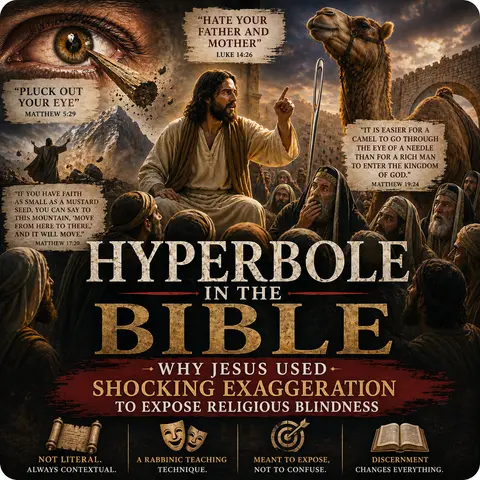
Biblical hyperbole is a deliberate figure of speech where more is said than is literally meant, designed to emphasize spiritual truth rather than convey factual information. Jesus frequently used hyperbolic statements to confront the self righteous Pharisees and pierce their religious complacency.
-
Core examples include: the camel passing through the eye of a needle, gouging out your right eye, hating your father and mother, the plank in your own eye, and letting the dead bury the dead
-
These sayings are not literal commands but vivid word pictures demanding total allegiance to God and deep repentance
-
Misunderstanding hyperbole leads to two errors: legalism and fear on one side, or dismissing Jesus words as cruel and impossible on the other
-
Recognizing this language pattern unlocks the true meaning behind some of Scripture’s most disturbing passages
What Is Hyperbole in the Bible
Hyperbole occurs when a speaker uses deliberate exaggeration for emphasis. This is not a mistake or deception but a recognized rhetorical technique used in the bible across both testaments.
Jewish teachers in the first century, including Jesus, commonly used bold overstatement in sermons and debates to make truths unforgettable. G.K. Chesterton described Jesus’ style as “full of camels leaping through needles and mountains hurled into the sea.”
Consider everyday English examples of hyperbole:
-
“I told you a thousand times”
-
“I am starving” (when merely hungry)
-
“This bag weighs a ton”
You already use and recognize exaggeration without confusion. The same principle applies to figures of speech used in Scripture. When Jesus says it is easier for a camel to go through the needle than for a rich person to enter heaven, he speaks hyperbolically. When he says “love your enemies,” he means it literally.

Why Jesus Used Hyperbolic Overstatement
Jesus’ ministry spanned roughly AD 27 to AD 30 in Galilee and Judea, a world shaped by intense religious tradition and Pharisaic influence. The Pharisees considered themselves masters of the Torah, yet Jesus consistently clashed with them because his message exposed pride and hypocrisy.
Sharp and shocking word pictures functioned as prophetic alarms. Jesus compressed entire sermons into single unforgettable sentences like “whitewashed tombs” and “blind guides.” These statements were designed to pierce religious complacency and self deception.
Jesus reserved his harshest language for leaders who misled others, not for humble seekers or obvious sinners. The emphasis fell on shaking those most convinced of their own righteousness.
The Camel and the Needle
In Matthew 19:23 to 26, Mark 10:23 to 27, and Luke 18:24 to 27, Jesus delivers one of Scripture’s most famous hyperbolic statements. Speaking near Jericho late in his public ministry, he declares it easier for a camel to pass through the eye of a needle than for the rich to enter the kingdom of God.
The camel was Palestine’s largest common animal, standing up to ten feet tall and weighing 1,500 pounds. The needle eye was a sewing needle, the smallest everyday opening. The image is intentionally absurd and impossible.
This hyperbole confronted disciples and religious leaders who viewed wealth as a sign of divine favor. They assumed rich people had the best chance with God. Jesus meant to expose the impossibility of self salvation and the absolute necessity of God’s power.
The point is not a mythical “Needle Gate” in Jerusalem. Scholars have found no archaeological or textual evidence for such a gate. The point is simple: what seems impossible for humans is possible with God.
The Dead Burying the Dead
Matthew 8:21 to 22 and Luke 9:59 to 60 record a would be disciple asking to bury his father before following Jesus. Burial obligations in first century Judaism carried enormous cultural weight, including family honor and mourning customs extending weeks or months.
Jesus’ answer strikes hard: “Let the dead bury their own dead; you go and proclaim the kingdom.”
This statement contrasts spiritual life in Christ with spiritual deadness in the world. Jesus is not forbidding genuine love for parents. He himself honored his mother from the cross in John 19:26 to 27. Rather, he insists that following him outranks even the most serious family duties.
For modern readers, this challenges the tendency to let legitimate obligations endlessly postpone obedience. Careers, family pressures, and timing concerns can become excuses for delayed discipleship.
Blind Guides and Pits
In Matthew 15:12 to 14 and Matthew 23:16 to 24, Jesus calls the Pharisees “blind guides” leading others into a pit. The picture of blind men guiding blind men into a ditch is obvious overstatement meant to expose the danger of confident yet spiritually blind leadership.
The Pharisees saw themselves as Scripture experts. Jesus portrays them as unable to see even basic truth about mercy and justice. He delivers biting hyperbolic phrases: they “strain out a gnat and swallow a camel.”
This language addressed religious leaders who obsessed over tiny rules while ignoring weightier matters such as compassion, repentance, and integrity. The same warning applies today when churches major in minors and neglect the heart of the gospel.

Destroying and Raising the Temple
In John 2:19, during Passover around AD 27, Jesus says, “Destroy this temple and in three days I will raise it up.” His opponents later twisted this into a literal accusation about threatening Herod’s temple, as recorded in Mark 14:57 to 59 and Matthew 27:40.
Jesus used hyperbolic symbolic language, calling his own body the temple where God’s presence truly dwells. The three days reference points forward to the resurrection in about AD 30, giving this exaggerated claim deeper prophetic truth.
Misunderstanding this hyperbole led to false charges at his trial. The religious leaders refused to hear the figurative and spiritual meaning, illustrating the danger of woodenly literal interpretation when the speaker clearly intends something more.
The Wicked Servant’s Fate and Cutting Off the Memory of Sinners
Matthew 18:21 to 35 tells the parable of an unforgiving servant. A king forgives an enormous debt of 10,000 talents, representing millions of denarii and far beyond what a laborer could repay in many lifetimes. Yet the forgiven servant violently demands a small payment from a fellow servant and faces severe judgment.
The scale of debt is itself hyperbolic, highlighting the greatness of God’s mercy compared to the pettiness of human unforgiveness. Old Testament language about cutting off the memory of sinners in Psalm 34:16 and Psalm 9:5 uses similar exaggerated finality.
These overstatements awaken holy fear and deep gratitude. They do not invite speculation about exact amounts of pain but convey the seriousness of persistent rebellion and the reality of divine judgment.
Famous Hyperboles in Jesus’ Teaching about Personal Discipleship
Three of Jesus’ best known overstatements about sin, relationships, and self examination often disturb modern readers. Each uses graphic memorable imagery not to encourage self harm or hatred but to reveal the absolute seriousness of following Christ.
Gouging Out an Eye or Cutting Off a Hand
Matthew 5:27 to 30 and Matthew 18:8 to 9 contain shocking words: if your right eye causes you to stumble, gouge it out; if your right hand leads you to sin, cut it off. Better to lose a body part than for your whole body to be thrown into hell.
Self mutilation is forbidden elsewhere in Scripture (Deuteronomy 14:1), so these commands must function as hyperbole. Jesus stresses decisive ruthless action against sin, not literal amputation. An eye and a hand represent treasured abilities; the picture calls believers to sacrifice even good things if they consistently lead into evil.
Some early believers tragically misread this literally. Modern application includes abandoning a corrupt career or leaving a digital platform that fuels repeated sin. Resisting sin requires radical measures, but the measures are spiritual, not surgical.
Hating Father and Mother in Comparison to Loving God
Luke 14:26 records Jesus saying that a disciple must hate father, mother, spouse, children, and even life to follow him. Yet the same Jesus affirms honoring parents in Matthew 15:4 to 6 and shows tender care for his mother in John 19:26 to 27.
This apparent contradiction resolves through Semitic idiom. Strong love for one thing and lesser love for another can be described as loving and hating in relative terms, as seen in Genesis 29:30 to 31 where Jacob “hated” Leah compared to Rachel.
The hyperbole confronts family centered loyalties that rival obedience to God. In cultures where clan honor is supreme, believers may face pressure to abandon faith or compromise ethics. This saying speaks directly into those tensions.
The Plank in Your Eye and the Speck in Your Brother’s Eye
Matthew 7:1 to 5 and Luke 6:41 to 42 present a comedic image: someone with a massive plank in their own eye trying to remove a tiny speck from their brother’s eye. A plank lodged in an eye is physically impossible, marking this as conscious comedic hyperbole.
The picture exposes religious hypocrisy, especially among groups like the Pharisees who scrutinized minor faults in others while ignoring their own greater sins. Jesus does not ban all moral judgment but demands humble self examination before attempting to correct another person. It also directly relates to an implicit meaning of "the good eye" whereas one person gives the gift of self reflection before removing the plank from the others eye. This has deep meaning in Jewish culture.
Practical disciplines include confession, accountability, and gentle speech that embody the spirit of this exaggerated warning.
How to Recognize Hyperbolic Overstatement in Scripture
Several tests help identify hyperbole without turning every hard teaching into a metaphor:
| Test | Example |
|---|---|
| Literal impossibility | A plank in your eye |
| Conflict with Jesus’ example | Jesus prayed publicly despite Matthew 6:6 |
| Contradiction with broader Scripture | “No oaths” versus God’s oath in Psalm 110:4 |
| Extreme words | “All,” “every,” “never” |
Use a parallel passage when available. Comparing Matthew and Luke often reveals one Gospel restating a strong image in plainer terms. Avoid two opposite errors: wooden literalism that ignores genre and casual dismissal that explains away uncomfortable truth.
What Hyperbolic Overstatement Reveals about Jesus and the Gospel
Jesus’ fierce images show both his compassion for the lost and his refusal to flatter religious pride. Hyperbole uncovers the depth of human sin and the impossibility of saving ourselves, driving listeners to rely on God’s grace alone.
These sayings display Jesus’ authority. He speaks about wealth, family loyalty, judgment, and eternal destiny with absolute freedom and confidence. The Lord of all creation does not hesitate to throw conventional wisdom aside.
The gospel answer to these extreme demands is not human heroism but the cross and resurrection. Jesus bears the ultimate consequence described in his warnings. Let these intense word pictures search your heart today, opening the way for repentance, deeper faith, and courageous obedience.
FAQ about Hyperbolic Overstatement in the Bible
Is it dangerous to call some of Jesus’ sayings hyperbole?
Recognizing intentional exaggeration respects the way Jesus actually chose to speak in his culture. It does not weaken his authority. Hyperbolic sayings still bind the conscience by revealing real commands beneath the vivid imagery, such as radical repentance and supreme loyalty. Use careful context and the whole of Scripture, not personal preference, to decide when language is figurative.
How can I tell the difference between hyperbole and a literal command?
Check whether the literal reading is impossible, contradicts Jesus’ actions, or violates clear teaching elsewhere in the bible. Consult mature teachers and reliable commentaries, especially on passages that have historically puzzled the church. Reading surrounding context aloud often reveals whether the tone is vivid illustration or direct instruction.
Did the Pharisees understand that Jesus was using hyperbole?
Some probably recognized his rhetorical style since rabbis commonly used similar techniques. Yet they still resisted his message because it threatened their status and control. Gospel accounts show them sometimes twisting figurative sayings into literal accusations, as with the temple statement at his trial. Hardness of heart, not lack of intelligence, was the main barrier to understanding.
Should Christians today ever preach or teach using hyperbole?
Thoughtful use of strong images and bold turns of phrase can help modern audiences feel the weight of spiritual realities. Follow Jesus’ example by directing the sharpest language at self righteousness and hypocrisy rather than at the weak and wounded. Explain clearly when using vivid metaphor so hearers do not misunderstand practical application.
Can misunderstanding hyperbole harm someone’s faith?
Over literal readings can lead to unnecessary fear, self harm, or despair when people suppose Jesus requires impossible or cruel actions. Learning how biblical language works often brings relief and deeper trust in God’s character. If you struggle with particular sayings, seek patient pastoral help rather than silently carrying confusion. Understanding hyperbole correctly leads to wonder, not anxiety.
When Outsiders Became Family: The Conflict That Shaped the Early Church