What Did Jesus Mean by “Moving Mountains”?
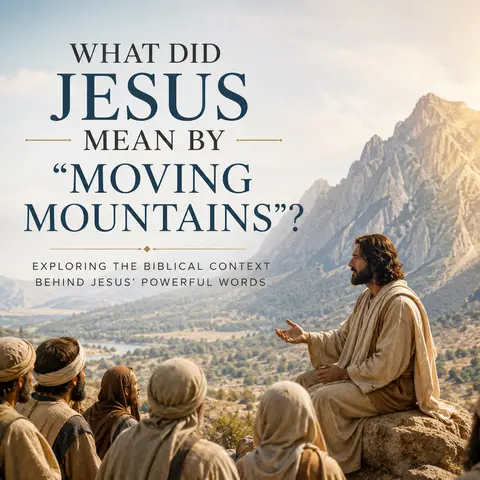
When Jesus told his disciples they could say to this mountain "be taken up and thrown into the sea," he was not offering a geology lesson. He was teaching about faith in God, prayer, and the kind of divine power that breaks through barriers no human effort can budge. The phrase "moving mountains" appears across the Gospels and Paul's letters, and each passage adds a distinct layer to its meaning.
This article walks through every passage where this language appears, the Jewish background Jesus drew from, and how believers can apply this teaching in prayer today.
Main Points
-
In Scripture, moving mountains is a vivid picture of God removing humanly impossible obstacles, not a command to rearrange geography. The phrase symbolizes faith's power to overcome obstacles.
-
Jesus ties mountain-moving to faith in God (Mark 11:22-24; Matthew 17:20; Matthew 21:21), using the mustard seed image to show that even small, genuine trust connects us to God's unlimited power.
-
In Jewish teaching, "mountains" could symbolize huge difficulties or powerful rulers. Jesus builds on this familiar metaphor rather than inventing a new one.
-
The main New Testament references where "move mountains" language appears are Matthew 17:20, Matthew 21:21, Mark 11:23, and 1 Corinthians 13:2; each teaches something distinct about the relationship between faith, prayer, and love.
-
Biblical faith is not "name it and claim it" but confident trust in God's character and will, leading believers to pray boldly while submitting to his purposes.
What Does "Moving Mountains" Mean in the Bible?

In the Bible, moving mountains is a metaphor for God accomplishing what is humanly impossible, especially through the faith-filled prayers of his people. Jesus used mountain metaphors to illustrate faith's power, and the image carried weight because his listeners already knew it from the Hebrew Scriptures. Mountains symbolize obstacles that can be overcome through faith.
The image appears in both Testaments. In Isaiah 40:4, God promises that "every valley shall be lifted up, and every mountain and hill be made low," turning uneven ground into a plain. In Zechariah 4:7, a great mountain becomes level before Zerubbabel. In the New Testament, Jesus tells his disciples that anyone with faith can say to this mountain "move from here to there" and it will move (Matthew 17:20).
No biblical writer expects readers to command literal mountains at will. The phrase points to God's power to remove barriers that look permanent: sin, opposition, persecution, demonic power, unbelief. The mountain is real in the sense that the obstacle is real. The promise is real in the sense that God acts. But the language is the vivid, prophetic speech of a teacher who wants his disciples to grasp one truth: nothing will be impossible when God's people trust him.
Where Does the Bible Talk About Moving Mountains?
Four New Testament texts carry the "mountain-moving" phrase, and several Old Testament passages lay its groundwork. Here are the core references:
Matthew 17:20 states faith can move mountains. Jesus answered his disciples after they failed to cast out a demon: "If you have faith like a grain of mustard seed, you will say to this mountain, 'Move from here to there,' and it will move, and nothing will be impossible for you." The verse establishes that even minimal genuine faith grants access to what seems humanly impossible.
Matthew 21:21 follows the withered fig tree. Jesus spoke to his disciples: "If you have faith and do not doubt, you will not only do what was done to the fig tree, but even if you say to this mountain, 'Be taken up and thrown into the sea,' it will happen." This ties the mountain metaphor to prayer and belief, and it connects to the symbolic action of judging the fruitless fig tree.
Mark 11:23-24 expands the teaching: "Whoever says to this mountain, 'Be taken up and thrown into the sea,' and does not doubt in his heart but believes that what he says will come to pass, it will be done for him. Therefore I tell you, whatever you ask in prayer, believe that you have received it, and it will be yours." Mark 11:23 emphasizes believing without doubt to move mountains. The passage frames mountain-speaking as part of faith-filled prayer, not a magical formula.
1 Corinthians 13:2 records the Apostle Paul writing: "If I have prophetic powers, and understand all mysteries and all knowledge, and if I have all faith, so as to remove mountains, but have not love, I am nothing." Paul assumes the mountain-moving motif is familiar in the churches and uses it as an extreme example of spectacular spiritual power that still falls short without love.
Old Testament passages that prepare the way include Isaiah 40:4 (every mountain made low, paths straight through the valley), Isaiah 41:15 (threshing mountains), Zechariah 4:7 (the great mountain becoming a plain), Psalm 97:5 (mountains melting like wax before the Lord), Nahum 1:5 (mountains quaking), and Job 9:5 (God who removes mountains and they know it not).
Jewish Background: Mountains as Symbols of the Impossible
Jesus did not coin the mountain-moving metaphor. He drew from a symbolic world his hearers already inhabited.
In the Hebrew Scriptures, mountains function in at least three ways:
-
Immense obstacles. Isaiah 40:4 pictures God leveling every mountain so his people can return from exile. Zechariah 4:7 addresses a great mountain standing in the way of rebuilding the temple and declares it will become a plain. Isaiah 41:15 envisions Israel threshing mountains and reducing hills to chaff. In each case, the mountain represents a barrier only God can flatten.
-
Political or spiritual powers. "The mountain of the Lord" (Isaiah 2:2; Micah 4:1) represents God's sovereign rule. Mount Zion and Sinai anchor Israel's worship and identity. David knew these holy places as sites where God's glory was revealed. When Jesus says "this mountain," he may well have been standing within view of the Mount of Olives or the temple mount, making the image vivid and immediate.
-
The stability of God's creation. Psalm 90:2 declares that before the mountains were brought forth, God existed. Psalm 104:5-9 describes the earth's foundations as fixed. Mountains represent permanence, which is precisely why moving one requires divine power.
Rabbis in the Second Temple period sometimes called a brilliant teacher a "mountain remover" (Hebrew: ʿōqēr hārîm) because he could solve enormous legal difficulties. Jesus picks up this familiar idiom and radicalizes it: with faith in God, not just intellectual skill, the mountain moves.
Jesus' Teaching: "Say to This Mountain" in Context
The fullest version of this teaching appears in Mark 11:22-24 and Matthew 21:21-22, set during the last week of Jesus Christ's life in Jerusalem.
The scene opens with Jesus and his disciples walking past a fig tree he had cursed the day before. The tree had leaves but no fruit, a pointed image of religious life without substance. By morning it had withered to the roots. Peter, astonished, pointed it out. Jesus answered with a sequence that matters: first, "Have faith in God" (Mark 11:22). Then the mountain saying. Then the instruction on prayer.
That sequence is not accidental. The foundation is faith in God, not self-confidence, not willpower, not technique. From that foundation, Jesus stresses four elements:
-
Speaking to the mountain. The believer addresses the obstacle directly, not passively hoping it disappears. The words "say to this mountain" imply active, God-directed confidence.
-
Refusal to doubt in the heart. Doubt can hinder the effectiveness of prayer. The Greek word (diakrinetai) carries the sense of a divided, wavering mind.
-
Faith that what is spoken will happen. Jesus says the one who believes that what he says will come to pass will see it done.
-
Prayer joined to faith. "Whatever you ask in prayer, believe that you have received it, and it will be yours." This is not a blank check; it is prayer rooted in trust that God hears and acts.
Jesus used mountain metaphors to illustrate God's power, and here that power is accessed through a specific channel: trusting prayer. The disciples' amazement at the fig tree became the doorway to a deeper lesson about what faith in God can do in a world full of obstacles.
Faith Like a Mustard Seed: Why Such a Tiny Image?
In first-century Galilee, the mustard seed was a proverbial symbol for something extremely small. Jewish listeners used it the way English speakers use "a grain of sand." Jesus pairs this grain of mustard seed with enormous outcomes: moving a mountain in Matthew 17:20, uprooting a mulberry tree in Luke 17:6.
The mustard seed is a Biblical analogy representing the smallest genuine faith necessary to trust God. Faith as small as a mustard seed can achieve great things. This puzzles many readers. If Jesus says even so little faith can move mountains, why do believers still face immovable obstacles?
The answer lies in the direction of the faith, not its volume. The effectiveness of faith is not about its volume but its object, which is God. A child who trusts her father to catch her does not need a Ph.D. in physics; she needs to believe he will catch her. Even small faith can overcome seemingly impossible obstacles through God's power, because God, not the believer, supplies the power.

Jesus' command is not to work up enormous emotions. It is to place real trust, however weak, in God's character and promises. A person with little faith who prays honestly, "Lord, I believe; help my unbelief" (Mark 9:24), has enough faith to access the same God who levels mountains. The seed you will say is small; the God who responds is not.
Literal or Figurative? How to Read "Move This Mountain"
Neither the New Testament nor early church history records Christians re-engineering landscapes by command. The book of Acts documents healings, exorcisms, prison doors opening, and miracles of provision; it does not record relocated mountain ranges.
Jesus used hyperbolic language such as "moving mountains" to teach about overcoming difficulties. This is consistent with his broader teaching style. He told listeners to pluck out an eye if it causes sin (Matthew 5:29) and described a camel passing through a needle's eye (Matthew 19:24). No one reads those instructions as surgical advice or zoological prophecy. They are emphatic speech, common in Semitic rhetoric, designed to make a point impossible to forget.
In its original context, "moving mountains" is best read as vivid, prophetic hyperbole about God overcoming impossible obstacles: entrenched unbelief, demonic oppression, persecution, or seemingly unchangeable circumstances. Faith is not just positive thinking but confidence in God's character and power. Jesus is promising real, concrete divine intervention. The "mountains" are the obstacles, not necessarily literal geology.
This does not weaken the promise. God bless the reader who takes Jesus at his word: the earth shakes, fire falls, and barriers crumble when God acts. The point is that the power belongs to him, and faith is the posture that receives it.
Nothing Will Be Impossible: How Faith Relates to God's Power
"Nothing will be impossible for you" (Matthew 17:20) echoes the angel's words to Mary in Luke 1:37: "Nothing will be impossible with God." The parallel is deliberate. The power behind mountain-moving faith is God's power, not human willpower.
Mark 9:23 reinforces this: "All things are possible for one who believes." Ephesians 3:20 says God is "able to do far more abundantly than all that we ask or think." God's purpose works in response to our prayers, but his responses reflect his wisdom, not just our requests.
Two guardrails keep this promise from becoming a prosperity formula:
-
Scripture assumes requests are made "according to his will" (1 John 5:14-15). John 14:13-14 frames answered prayer in the context of glorifying the Father. Faith is trustful dependence, not a guarantee that every specific desire will be granted in our way or timing.
-
Paul's "thorn in the flesh" (2 Corinthians 12:7-10) shows that sometimes God's answer to faithful prayer is sustaining grace, not removal of the mountain in the way we expect. Paul asked three times. God answered with "My grace is sufficient for you." Even small faith can overcome seemingly impossible obstacles through God's power; sometimes that overcoming looks like endurance rather than elimination.
Elijah's prayer caused a drought for three years and six months (James 5:17), and then his prayer brought rain. The prayer of a righteous person has great power. But Elijah did not control the timing. God did.
Paul's Addition: Faith That Can Remove Mountains but Lacks Love
The Apostle Paul writes in 1 Corinthians 13:2 that faith can remove mountains, but without love it is nothing. He assumes the mountain-moving image is already well known in the churches from Jesus' teaching. He uses it as a ceiling, not a floor: "If I have all faith, so as to remove mountains, but have not love, I am nothing."
His point reframes the entire discussion. Even the most astonishing mountain-moving faith is spiritually worthless if it is not joined to Christ-like love. This means mountain-moving faith is servant-hearted, not self-exalting. Its goal is God's glory and others' good, not personal standing in the church or the world. Prophecy, knowledge, and power all point somewhere beyond themselves: toward love. The hope of the gospel is not a life of spectacular miracles but a life shaped by the character of Jesus Christ.
Real-Life "Mountains": What Kind of Obstacles Does God Move?
If mountains are metaphors for unmovable barriers and trials in life, what kinds of barriers does Scripture describe God removing?
-
Spiritual bondage and sin patterns. Romans 6 describes believers as freed from slavery to sin. 2 Corinthians 10:4-5 talks about strongholds being demolished. These are mountains of habitual sin that years of self-effort cannot shift.
-
Deeply rooted unbelief or hardness of heart. Mark 9:24 records a father crying out, "I believe; help my unbelief." Ezekiel 36:26 promises God will remove the heart of stone and give a heart of flesh. The mountain here is internal.
-
Opposition to God's purposes. Acts 4:24-31 records the early church praying against threats from authorities; God answered with boldness and power. Zechariah 4:7 addresses the great mountain blocking the temple's reconstruction.
-
Personal limitations, fear, and weakness. 2 Corinthians 12:9-10 redefines strength as something found in weakness. Psalm 23:4 walks through the valley of the shadow of death with confidence, not because the valley disappears, but because the Lord is present.
Biblical faith offers strength to either remove obstacles or climb them with God's support. Challenges can serve as opportunities to deepen reliance on God rather than serving only as obstacles. Faithful prayer, sometimes joined with fasting (cf. Matthew 17:14-21 in some textual traditions), is the God-appointed means by which these mountains are confronted and, in his time, removed or transformed.
How to Pray Mountain-Moving Prayers Today
Faith in God is necessary to face trials rather than being controlled by fear or circumstances. Here is how Scripture teaches believers to pray when standing before a mountain:
-
Begin by focusing on God's character. "Have faith in God" (Mark 11:22). Trust in the Lord with all your heart and lean not on your own understanding; in all your ways acknowledge him, and he will make your paths straight (Proverbs 3:5-6). Psalm 121:1-2 asks, "Where does my help come from? My help comes from the Lord." The one who seeks finds (Matthew 7:8).
-
Bring specific mountains to God in honest prayer. Name the obstacle. Pray with specifics, not vagueness. Mark 11:24 says to believe you have received what you ask. Matthew 7:7-8 promises that whoever asks receives, and whoever seeks finds.
-
Align requests with God's revealed will in Scripture. 1 John 5:14 says that if we ask anything according to his will, he hears us. Romans 8:28 grounds assurance in God's sovereign purpose working for good.
-
Ask in faith, without double-mindedness. James 1:5-8 warns against wavering. Doubt divides the heart and weakens prayer. Confidence in God is not arrogance; it is taking him at his word.
-
Persevere in prayer and obedience. Luke 18:1 says believers should always pray and not lose hope. Hebrews 4:15-16 invites us to approach God's throne of grace with confidence, knowing Jesus Christ our Lord intercedes. Do not forget that God's mercy and timing are wiser than ours.

The power is always God's. Humans cannot move mountains by willpower or formula. Only the Lord does this, and he often acts in ways we do not expect (Job 9:5; Nahum 1:5). The blessed life is not one free of mountains but one lived in the confidence that the Father who cast the earth into being can move whatever stands in the way of his purposes.
FAQ: Questions About Moving Mountains in the Bible
Did Jesus literally expect his followers to move physical mountains?
Jesus used familiar hyperbolic language to emphasize God's power working through faith. The New Testament gives no example of disciples relocating actual mountains. It does record God removing impossible spiritual and practical obstacles: Peter freed from prison by an angel (Acts 12:1-17), Paul and Silas freed by an earthquake (Acts 16:25-34), and many instances of healing and deliverance. The image is about real divine intervention, not landscape architecture.
Where exactly does the Bible say "faith can move mountains"?
The core references are Matthew 17:20, where Jesus says faith like a grain of mustard seed will move a mountain and nothing will be impossible; Matthew 21:21-22, where Jesus links mountain-moving to prayer after the fig tree withers; Mark 11:23-24, where Jesus says whoever speaks to this mountain without doubt in his heart will see it cast into the sea; and 1 Corinthians 13:2, where the Apostle Paul says faith to remove mountains without love is nothing.
What is the difference between a "mustard seed" and a "grain of mustard seed" in these verses?
Both phrases refer to the same thing: a tiny seed known across first-century Palestine as the smallest cultivated seed. English translations vary between "mustard seed" and "grain of mustard seed," but the point is identical. God honors even the smallest genuine faith.
Does "nothing will be impossible for you" mean I will always get what I ask?
Jesus' promise is framed by other teachings. Prayers must align with God's will (1 John 5:14-15; John 14:13-14). Faith is trustful dependence rooted in worship of the Father, not a guarantee that every specific desire will be granted in our way or timing. Assuredly, God hears every prayer; but his answers reflect his truth, his mercy, and his glory, not always our preferences.
How can I know whether a mountain in my life is meant to be moved or endured?
Scripture recommends discernment: examine God's word, seek wise counsel from the church, pray persistently, and watch for how God answers. Paul asked three times for his thorn to be removed (2 Corinthians 12:7-10). God answered with sustaining grace rather than removal. Sometimes God glorifies himself more by walking with you through the mountain than by flattening it. Biblical faith covers both outcomes: mountains removed and mountains climbed, both by the grace and power of the living God.

The Problem With Certainty